High-quality 3D assets at affordable prices — trusted by designers, engineers, and creators worldwide. Made with care to be versatile, accessible, and ready for your pipeline.
Included File Formats
This model is provided in 14 widely supported formats, ensuring maximum compatibility:
• - FBX (.fbx) – Standard format for most 3D software and pipelines
• - OBJ + MTL (.obj, .mtl) – Wavefront format, widely used and compatible
• - STL (.stl) – Exported mesh geometry; may be suitable for 3D printing with adjustments
• - STEP (.step, .stp) – CAD format using NURBS surfaces
• - IGES (.iges, .igs) – Common format for CAD/CAM and engineering workflows (NURBS)
• - SAT (.sat) – ACIS solid model format (NURBS)
• - DAE (.dae) – Collada format for 3D applications and animations
• - glTF (.glb) – Modern, lightweight format for web, AR, and real-time engines
• - 3DS (.3ds) – Legacy format with broad software support
• - 3ds Max (.max) – Provided for 3ds Max users
• - Blender (.blend) – Provided for Blender users
• - SketchUp (.skp) – Compatible with all SketchUp versions
• - AutoCAD (.dwg) – Suitable for technical and architectural workflows
• - Rhino (.3dm) – Provided for Rhino users
Model Info
• - All files are checked and tested for integrity and correct content
• - Geometry uses real-world scale; model resolution varies depending on the product (high or low poly)
• • - Scene setup and mesh structure may vary depending on model complexity
• - Rendered using Luxion KeyShot
• - Affordable price with professional detailing
Buy with confidence. Quality and compatibility guaranteed.
If you have any questions about the file formats, feel free to send us a message — we're happy to assist you!
Sincerely,
SURF3D
Trusted source for professional and affordable 3D models.
More Information About 3D Model :
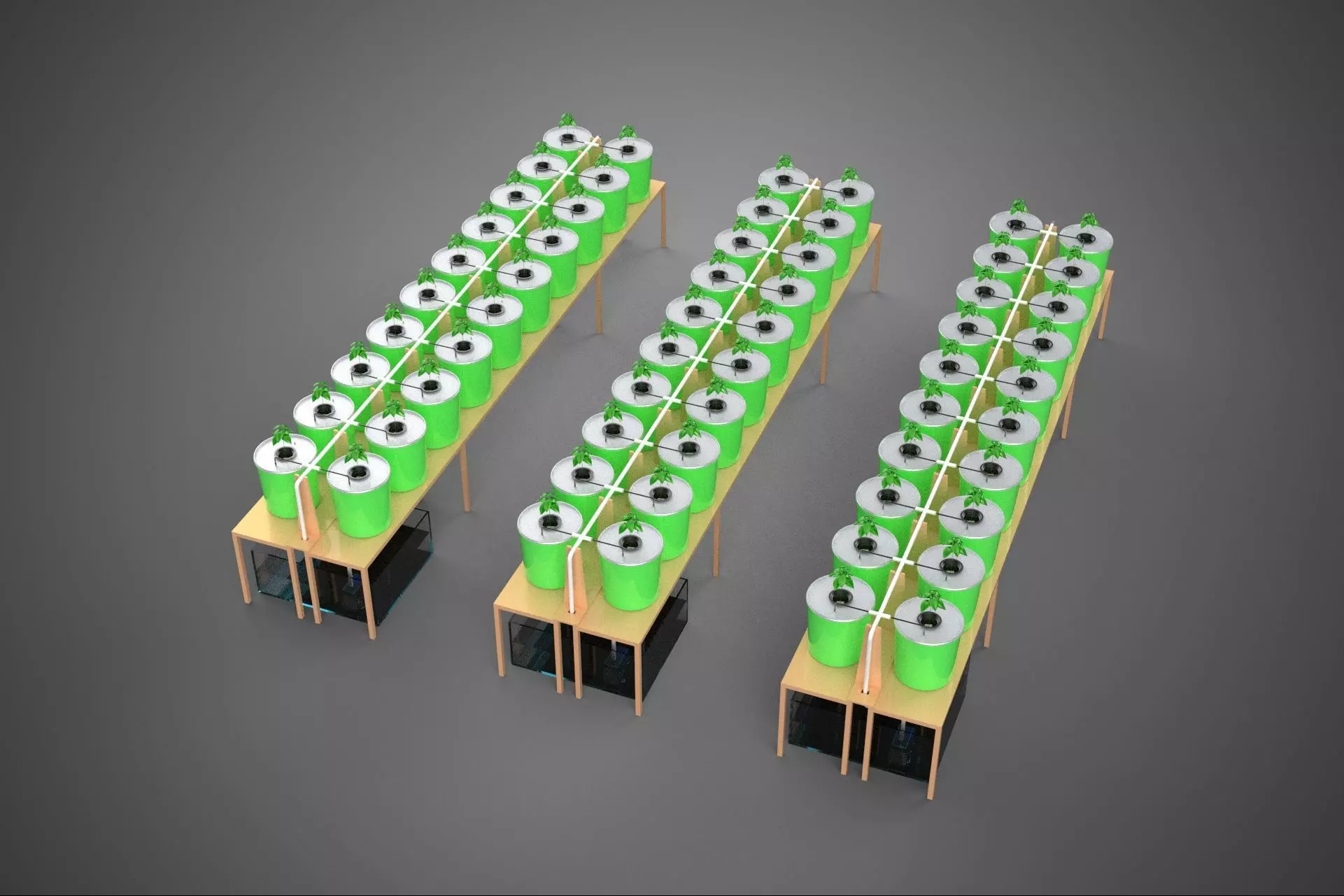
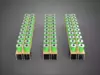
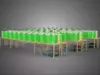
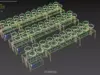
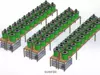
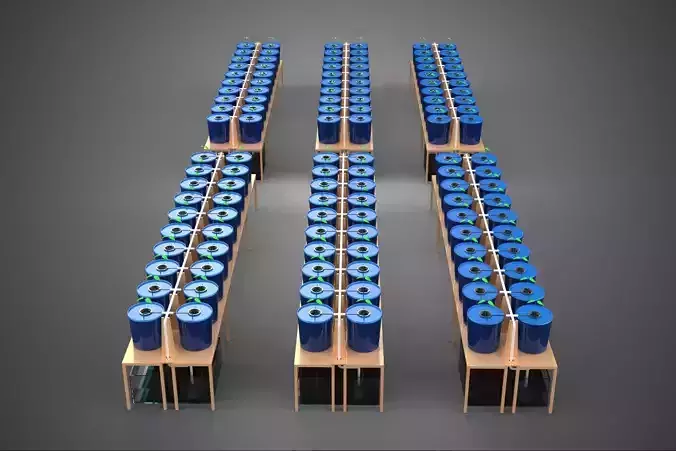
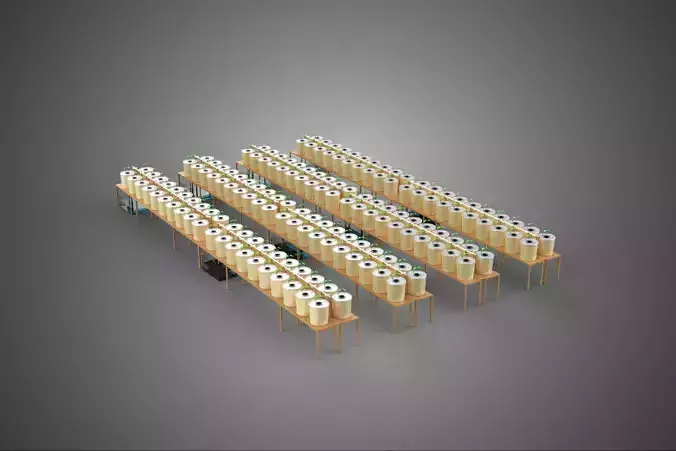
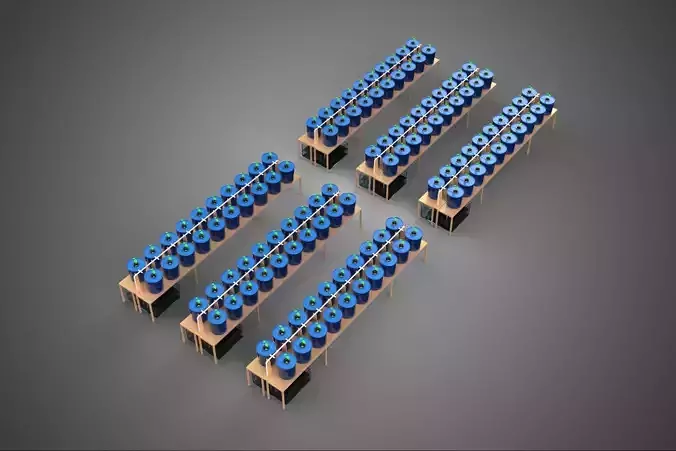
The LAYOUT PARALLEL ARRAY ROW INDOOR DUTCH BUCKET HYDROPONIC SYSTEM is a highly structured, controlled environment agriculture (CEA) methodology utilizing recirculating hydroponics, optimized for the intensive production of indeterminate or large fruiting crops, such as tomatoes, cucumbers, peppers, and eggplants.
Definition and Configuration
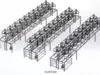
The system is fundamentally based on the Dutch Bucket (or Bato Bucket) module, a specialized container designed for soilless culture that employs a controlled drainage mechanism. The Parallel Array Row Layout refers to the precise geometrical configuration where identical rows of cultivation modules are arranged linearly and positioned parallel to one another. This spatial arrangement is engineered to maximize the Cultivation Area Ratio (CAR) within a predefined indoor facility footprint while ensuring adequate access pathways (aisles) for cultivation tasks, harvesting, and pest management.
Each row typically consists of numerous Dutch Buckets connected in sequence along a central drainage manifold and a primary nutrient supply line. The parallel configuration facilitates scalable integration with overhead environmental control systems, including supplemental lighting arrays (LED or HPS), HVAC ducting, and automated monitoring sensors.
System Components and Functionality
1. Dutch Bucket Module
The Dutch Bucket is an inert, light-blocking container (typically polypropylene) filled with an inert growth medium, most commonly perlite, coco coir, or rockwool cubes. The bucket's distinguishing feature is a siphon elbow or drainage fitting placed approximately 2.5 to 5 centimeters from the base. This fitting ensures a shallow nutrient reservoir is retained within the bucket, providing root moisture while allowing excess, spent nutrient solution (NS) to drain into the return manifold. This controlled overflow mechanism ensures the root zone is consistently saturated yet remains sufficiently aerated, preventing anaerobiosis.
2. Nutrient Delivery System
Nutrient solution delivery is achieved via low-flow, pressure-compensated drip emitters, positioned to deliver the NS directly to the base of the plant stem within the inert media. This irrigation schedule is automated via a programmable logic controller (PLC) and is tailored based on crop stage, light intensity, and evapotranspiration demands. The NS is drawn from a centralized reservoir, filtered, and pressurized before distribution.
3. Drainage and Recirculation Manifold
The parallel rows are interconnected by a sloped PVC or polyethylene drain line (the return manifold). Gravity drives the drained NS from the elbow fittings of individual buckets back to the main reservoir. This fully recirculating design (closed-loop system) significantly conserves water and fertilizers compared to non-recirculating (run-to-waste) systems, requiring stringent daily monitoring and adjustment of electrical conductivity (EC) and pH levels.
Operational Principles in an Indoor Environment
Operating within an indoor setting necessitates rigorous environmental control. The parallel array layout is designed specifically to interface efficiently with Controlled Environment Agriculture (CEA) infrastructure:
- Light Optimization: Rows are often oriented north-south to promote uniform light penetration in setups that utilize natural light supplements, or positioned symmetrically relative to fixed overhead lighting rigs to ensure uniform Photosynthetically Active Radiation (PAR) flux density across the canopy.
- Climate Management: Airflow is managed along the parallel aisles to ensure uniform temperature, humidity, and CO₂ distribution, minimizing microclimatic variations between rows. Humidity extraction via dehumidification systems is critical, given the high rate of plant transpiration inherent in densely planted indoor systems.
- Efficiency: The modularity and parallel alignment facilitate easy expansion or contraction of the system, allowing operators to scale production volumes while maintaining high operational efficiency and standardization.
### Advantages
The Parallel Array Row Indoor Dutch Bucket System offers several critical advantages: modularity, superior drainage control, high Water Use Efficiency (WUE) due to recirculation, and versatility in accommodating diverse inert substrates. The system’s architecture is particularly suited for maximizing yield per square meter (Y/m²) in vertically constrained environments.
KEYWORDS: Bato Bucket, Controlled Environment Agriculture, Recirculating Hydroponics, Drip Irrigation, Parallel Array, Row Layout, Inert Media, Soilless Culture, Nutrient Film Technique, Water Use Efficiency, PLC Automation, Drainage Manifold, Siphon Elbow, Perlite, Coco Coir, Solanaceae, Cucurbits, High Density Planting, Modular System, Root Zone Aeration, Electrical Conductivity, pH Monitoring, CEA Infrastructure, Supplemental Lighting, HVAC, Greenhouse Management, Vertical Farming, Passive Drainage, Irrigation Schedule, Yield Optimization.