For other uses, see Anchor (disambiguation).Anchoring redirects here. For the cognitive bias, see Anchoring effect.Boat anchor redirects here. For the metaphor, see Boat anchor (metaphor).
Stockless ship's anchor and chain on display
Anchor of Amoco Cadiz in Portsall, north-west Brittany, France
Memorial anchor in Kirjurinluoto, Pori, Finland
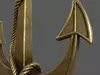
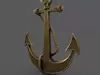
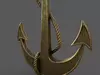
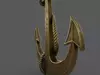
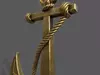
Massive anchor chain for large ships. The weight of the chain is vital for proper holding of the anchor.[1]An anchor is a device, normally made of metal, used to secure a vessel to the bed of a body of water to prevent the craft from drifting due to wind or current. The word derives from Latin ancora, which itself comes from the Greek ἄγκυρα (ankȳra).[2][3]
Anchors can either be temporary or permanent. Permanent anchors are used in the creation of a mooring, and are rarely moved; a specialist service is normally needed to move or maintain them. Vessels carry one or more temporary anchors, which may be of different designs and weights.
A sea anchor is a drag device, not in contact with the seabed, used to minimize drift of a vessel relative to the water. A drogue is a drag device used to slow or help steer a vessel running before a storm in a following or overtaking sea, or when crossing a bar in a breaking sea.
AnchoringiconThis article needs additional citations for verification. Please help improve this article by adding citations to reliable sources. Unsourced material may be challenged and removed.Find sources: Anchor – news · newspapers · books · scholar · JSTOR (August 2020) (Learn how and when to remove this message)
Anchor winch, or windlass, on RV Polarstern
Colored plastic inserts on a modern anchor chain show the operator how much chain has been paid out. This knowledge is crucial in all anchoring methods.
A stockless anchor being broken out
Holding ground in Akaroa HarbourAnchors achieve holding power either by hooking into the seabed, or weight, or a combination of the two. The weight of the anchor chain can be more than that of the anchor and is critical to proper holding. Permanent moorings use large masses (commonly a block or slab of concrete) resting on the seabed. Semi-permanent mooring anchors (such as mushroom anchors) and large ship's anchors derive a significant portion of their holding power from their weight, while also hooking or embedding in the bottom. Modern anchors for smaller vessels have metal flukes that hook on to rocks on the bottom or bury themselves in soft seabed.
The vessel is attached to the anchor by the rode (also called a cable or a warp). It can be made of rope, chain or a combination of rope and chain. The ratio of the length of rode to the water depth is known as the scope.
Holding ground is the area of sea floor that holds an anchor, and thus the attached ship or boat.[4] Different types of anchor are designed to hold in different types of holding ground.[5] Some bottom materials hold better than others; for instance, hard sand holds well, shell holds poorly.[6] Holding ground may be fouled with obstacles.[6] An anchorage location may be chosen for its holding ground.[7] In poor holding ground, only the weight of an anchor and chain matters; in good holding ground, it is able to dig in, and the holding power can be significantly higher. The basic anchoring consists of determining the location, dropping the anchor, laying out the scope, setting the hook, and assessing where the vessel ends up. The ship seeks a location that is sufficiently protected; has suitable holding ground, enough depth at low tide and enough room for the boat to swing.
The location to drop the anchor should be approached from down wind or down current, whichever is stronger. As the chosen spot is approached, the vessel should be stopped or even beginning to drift back. The anchor should initially be lowered quickly but under control until it is on the bottom (see anchor windlass). The vessel should continue to drift back, and the cable should be veered out under control (slowly) so it is relatively straight.
Once the desired scope is laid out, the vessel should be gently forced astern, usually using the auxiliary motor but possibly by backing a sail. A hand on the anchor line may telegraph a series of jerks and jolts, indicating the anchor is dragging, or a smooth tension indicative of digging in. As the anchor begins to dig in and resist backward force, the engine may be throttled up to get a thorough set. If the anchor continues to drag, or sets after having dragged too far, it should be retrieved and moved back to the desired position (or another location chosen.)
Using an anchor weight, kellet or sentinelLowering a concentrated, heavy weight down the anchor line – rope or chain – directly in front of the bow to the seabed behaves like a heavy chain rode and lowers the angle of pull on the anchor.[8] If the weight is suspended off the seabed it acts as a spring or shock absorber to dampen the sudden actions that are normally transmitted to the anchor and can cause it to dislodge and drag. In light conditions, a kellet reduces the swing of the vessel considerably. In heavier conditions these effects disappear as the rode becomes straightened and the weight ineffective. Known as an anchor chum weight or angel in the UK.
Forked moorUsing two anchors set approximately 45° apart, or wider angles up to 90°, from the bow is a strong mooring for facing into strong winds. To set anchors in this way, first one anchor is set in the normal fashion. Then, taking in on the first cable as the boat is motored into the wind and letting slack while drifting back, a second anchor is set approximately a half-scope away from the first on a line perpendicular to the wind. After this second anchor is set, the scope on the first is taken up until the vessel is lying between the two anchors and the load is taken equally on each cable. This moor also to some degree limits the range of a vessel's swing to a narrower oval. Care should be taken that other vessels do not swing down on the boat due to the limited swing range.
Bow and stern(Not to be mistaken with the Bahamian moor, below.) In the bow and stern technique, an anchor is set off each the bow and the stern, which can severely limit a vessel's swing range and also align it to steady wind, current or wave conditions. One method of accomplishing this moor is to set a bow anchor normally, then drop back to the limit of the bow cable (or to double the desired scope, e.g. 8:1 if the eventual scope should be 4:1, 10:1 if the eventual scope should be 5:1, etc.) to lower a stern anchor.[9] By taking up on the bow cable the stern anchor can be set. After both anchors are set, tension is taken up on both cables to limit the swing or to align the vessel.
Bahamian moorSimilar to the above, a Bahamian moor is used to sharply limit the swing range of a vessel, but allows it to swing to a current. One of the primary characteristics of this technique is the use of a swivel as follows: the first anchor is set normally, and the vessel drops back to the limit of anchor cable. A second anchor is attached to the end of the anchor cable, and is dropped and set. A swivel is attached to the middle of the anchor cable, and the vessel connected to that.
The vessel now swings in the middle of two anchors, which is acceptable in strong reversing currents, but a wind perpendicular to the current may break out the anchors, as they are not aligned for this load.
Backing an anchorAlso known as tandem anchoring, in this technique two anchors are deployed in line with each other, on the same rode. With the foremost anchor reducing the load on the aft-most, this technique can develop great holding power and may be appropriate in ultimate storm circumstances. It does not limit swinging range, and might not be suitable in some circumstances. There are complications, and the technique requires careful preparation and a level of skill and experience above that required for a single anchor.