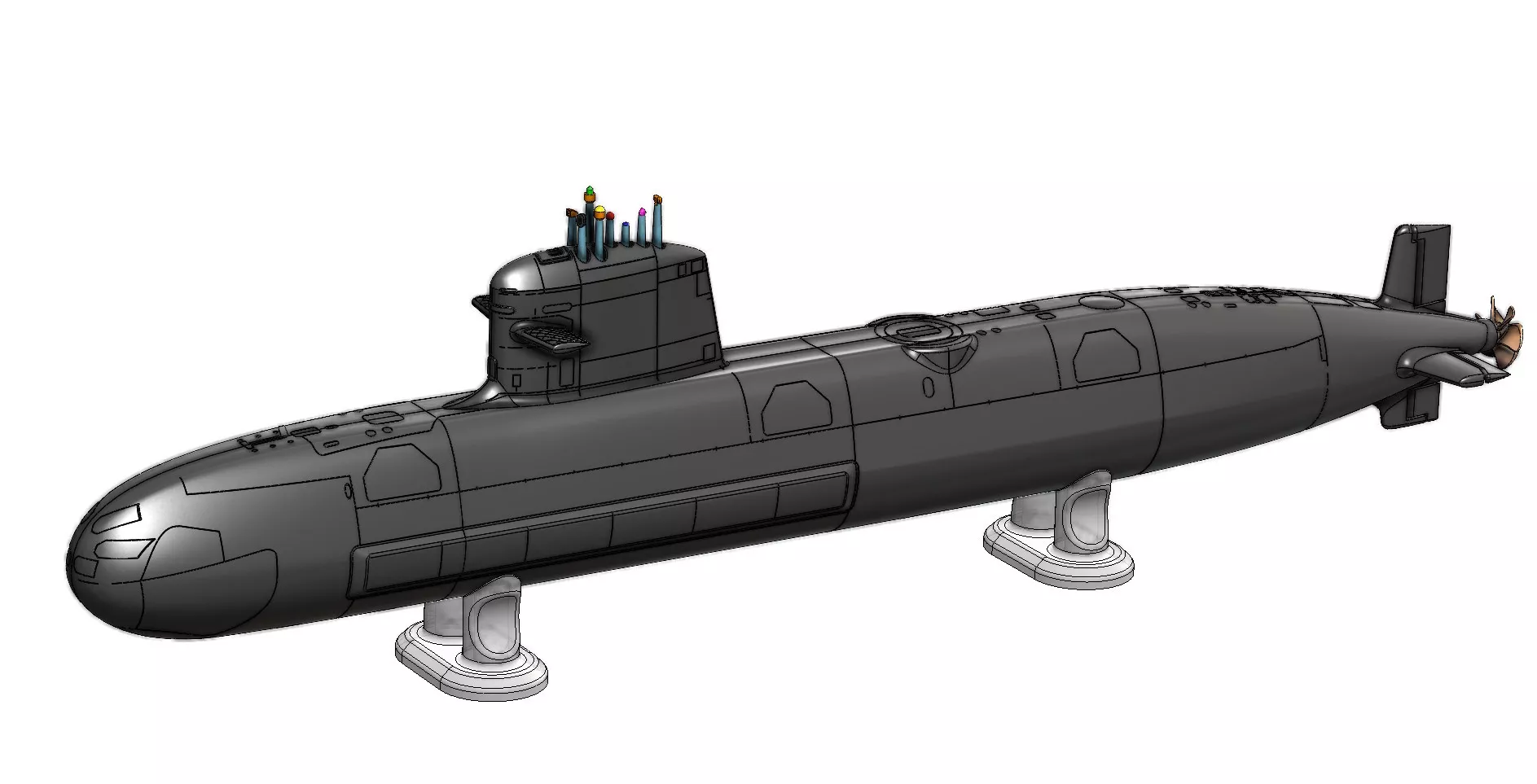
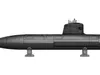
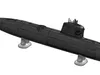
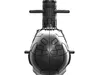
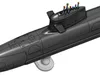
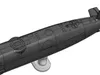
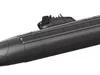
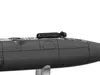
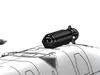
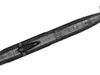
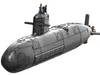
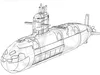
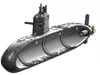
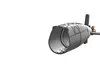
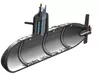
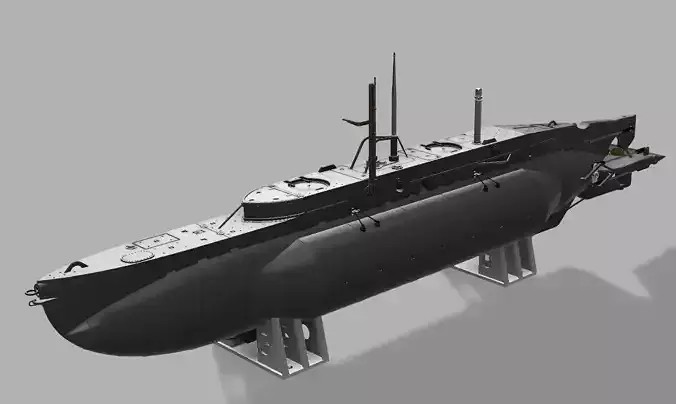
The Scorpène-class is one of the most widely recognized modern conventional submarine designs, developed through French-Spanish cooperation and subsequently adapted for different national requirements. Its international career began with Chile, which acquired two submarines, O'Higgins and Carrera, followed by Malaysia, with Tunku Abdul Rahman and Tun Abdul Razak. India subsequently selected the design for its Project 75 program, producing six submarines at Mazagon Dock Shipbuilders: Kalvari, Khanderi, Karanj, Vela, Vagir and Vaghsheer. Brazil also adopted the design for its PROSUB program, building four locally produced boats: Riachuelo, Humaitá, Tonelero and Angostura. The different national versions are particularly interesting to scale-model builders because the basic Scorpène design has been modified to meet different operational requirements. The Brazilian boats, for example, were made slightly longer to provide additional capacity for crew, provisions and fuel. Our model is based primarily on the characteristic form of the Scorpène family, giving builders an opportunity to create a detailed representation of this internationally operated submarine class. At 763 mm long and 1:87 scale, it is large enough to display the distinctive hull, sail, control surfaces and external details while remaining suitable for desktop 3D printing.
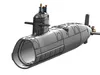
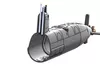
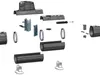
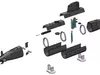
The model is supplied as a modular collection of 35 STL files, allowing the submarine to be printed in manageable sections and assembled into a substantial display model. The modular approach also gives builders room for customization and experimentation. Because the Scorpène design exists in several national configurations, the model can serve as a useful starting point for creating different boats of the family by modifying or reproducing details such as the sail arrangement, external fittings, masts, antennas, markings and other visible features. Builders interested specifically in the Chilean, Malaysian, Indian or Brazilian boats can therefore use the model as a basis for their preferred interpretation rather than being restricted to a single configuration. This is particularly useful for modelers who want to build a submarine representing a particular navy or even create a small collection showing how the same underlying design evolved between operators. The model is intended primarily as a detailed scale-model project, with the modular files making printing, finishing and customization considerably easier than attempting to reproduce the entire 763 mm submarine as a single piece.
Kalvari, Khanderi, Karanj, Vela, Vagir, Vaghsheer, Riachuelo, Humaitá, Tonelero, Angostura, O'Higgins, Carrera, Tunku Abdul Rahman, Tun Abdul Razak.