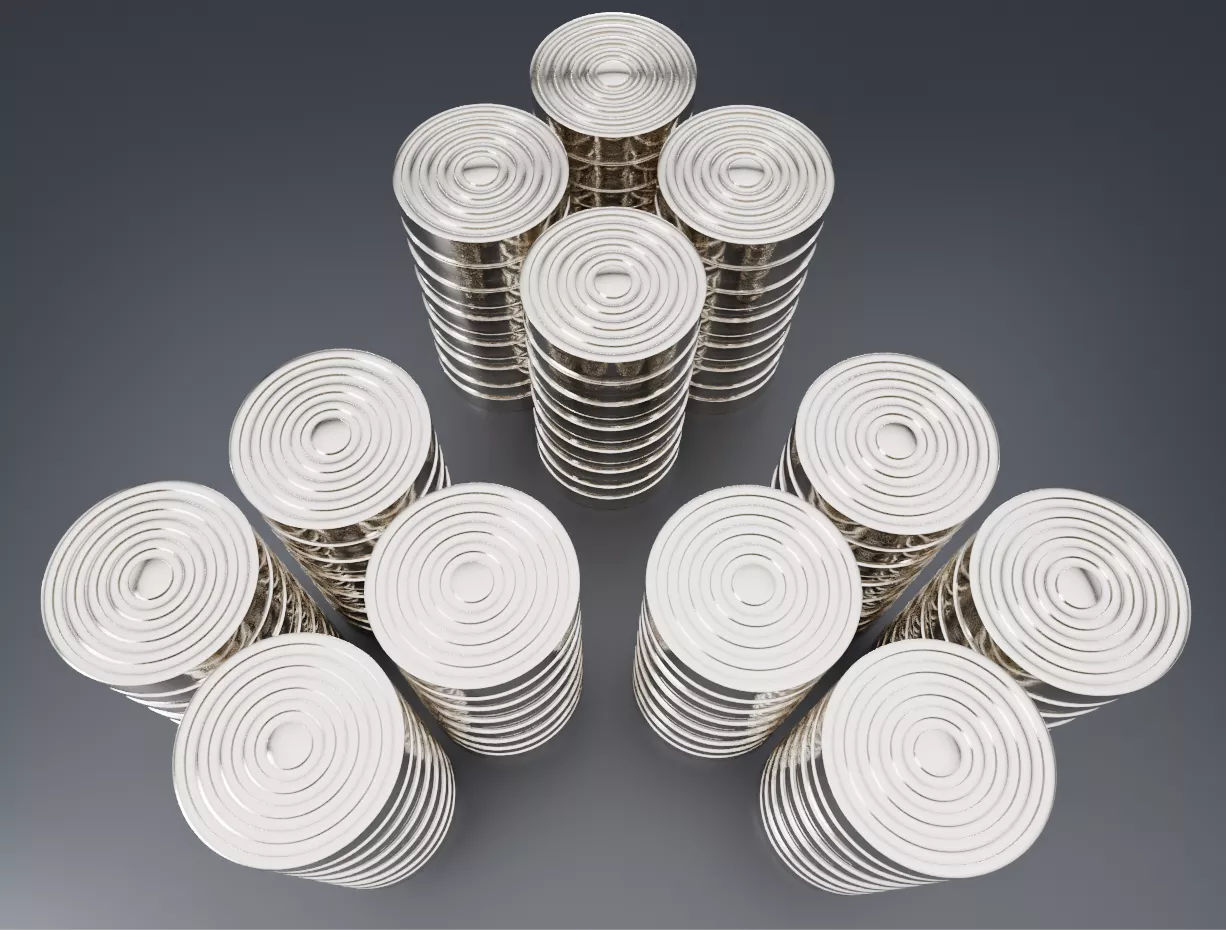
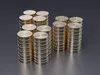
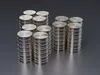
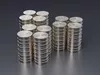
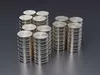
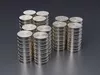
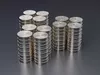
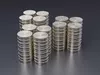
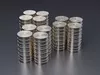
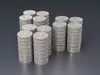
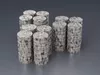
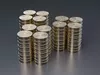
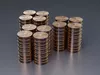
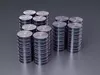
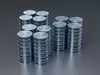
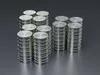
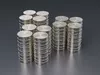
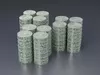
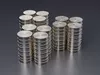
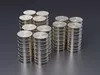
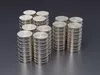
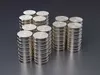
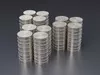
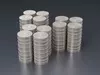
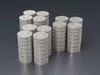
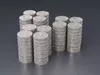
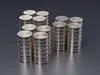
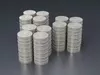
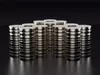
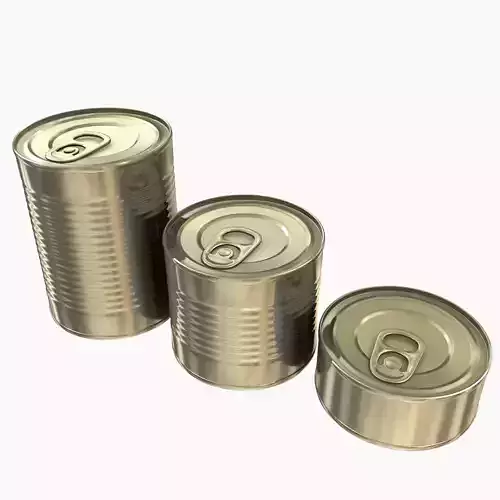
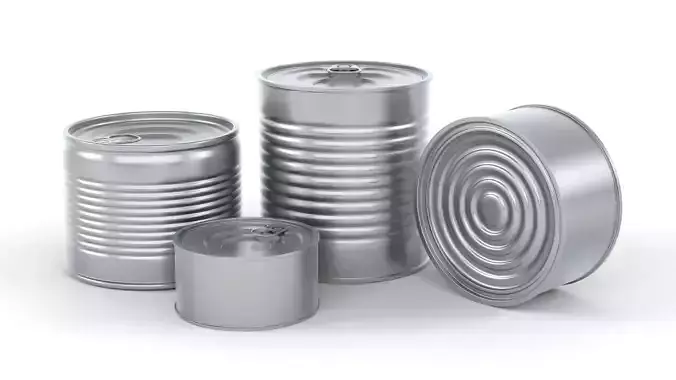
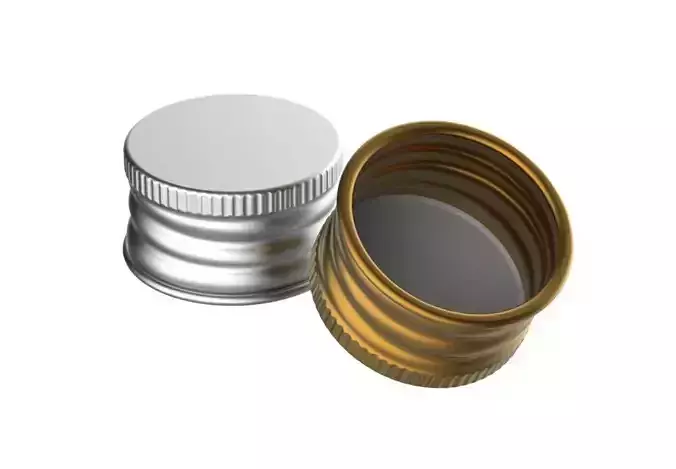
Twelve stacks of concentric-ringed nickel discs, 59 cm across, with a radial anisotropic highlight and 64 surface dials on a single Age knob. Procedural in Blender, with baked 4K PBR maps for every format.
About This Element
Nickel is named after a goblin: German miners called its ore Kupfernickel — Old Nick's copper — because it looked like copper ore and yielded none. It is one of only four elements still magnetic at room temperature, and it is the metal that makes stainless steel stainless. Its real colour is warmer than the chrome most renders reach for, and this model proves it rather than guessing — base colour is nickel's Fresnel F0 computed from its optical constants, linear (0.6488, 0.5972, 0.5218) or #D3CBBF, which agrees with the published metal-reflectance value to one part in 255.
Product Information
Element: Nickel (Ni) · Atomic Number 28Form: twelve stacks of concentric-ringed discs · one object, one materialDimensions: 0.591 × 0.549 × 0.222 m — 59.1 × 54.9 × 22.2 cm, true real-world scale, metric unitsSurface area: 0.815 m²Geometry: 368,424 polygons · 369,600 vertices · 739,152 triangles · 738,000 edgesTopology: quad-dominant and smooth shaded — 368,400 quads + 24 n-gonsMesh: watertight and manifold — 0 non-manifold edges, 0 boundary edges, 0 loose verticesMaterials: 1 — nickel, fully procedural in the .blend with 64 adjustable properties, image-mapped PBR in every other formatTextures: 4096 and 2048 PNG, 8-bit · metal / roughness workflowMaps: Base Color and Normal as RGB · Roughness, Metalness and AO as single-channel grayscaleUVs: single UVMap (st in USD), 3,044 islands, zero overlap, inside 0–1, 15.8% coverage, texel density spread 1.73×Texel density: 0.555 mm per texel at 4096Origin: interchange files have transforms applied, scale 1,1,1, origin at the base centre — it rests on Z = 0, centred in X and YNative File: Blender 5.0 · CyclesPart of a 118-element procedural periodic table collection
Performance & Quality
Procedural in Blender — resolution independent, no bitmap ceiling, no stretched pixels at any camera distanceBaked 4K and 2K PBR maps ship with every interchange format, so the look survives outside Blender64 dials in ten panels — polish, wear, oxide bloom, heat tint, corrosion, circulation grime, handling marks — all driven by a single MASTER Age knob, so one slider takes the whole stack from factory-fresh to decades oldMeasured base colour, not eyeballed: nickel's F0 from its optical constants, matching published reflectance to one part in 255The normal map carries real relief here — mean tilt 1.28°, 5.88° at p99, 29.77° at its worst — and the AO map does real work too, 0.04–0.99 with a 0.506 mean, because a stack of rings genuinely self-occludesWatertight manifold mesh — print-ready as supplied, no repair pass neededModelled at true metric scale, so it drops straight into an existing scene without rescalingThe .blend also carries the complete studio set and the four cameras that produced the listing images, with per-camera exposure trims
What's Included
.blend — Blender 5.0, procedural material, the complete studio lighting set and the four cameras.fbx — FBX 7.4 binary, triangulated, with tangents, Y-up.obj + .mtl — Wavefront, quads preserved, Y-up.usdc — USD binary crate, UsdPreviewSurface.stl — Geometry only, all 739,152 triangles, no UVs and no material.ply — Binary, geometry + UVs, no material definition.abc — Alembic (Ogawa), geometry + UVs, no material definitionglTF 2.0 — separate: .gltf + .bin + its own textures, metal-rough packedtextures/ and textures/2K/ — 4096 and 2048 PNG maps on their ownPlus TECHNICAL_PROPERTIES.txt with every number in one place
Each model archive bundles the maps it needs, so it works the moment you unzip it. STL carries no UVs or material, so take the textures archive if you need the maps for it.
Before You Buy, Not After
Anisotropy is 0.40, radial about the object's Z axis, and no map can carry it. Set it by hand or the metal reads flatter than the listing images. Ambient occlusion also has no input on a standard Principled BSDF — wire the AO map into your engine's AO slot, or multiply it into base colour if your renderer expects that. It ships unbaked into the other maps so the choice is yours.UV coverage is 15.8%, and that is not laziness. The surface is roughly 3,000 thin concentric ring bands, so every island is a long thin strip. Smart UV Project, cube, cylinder and sphere projections were all tested against concave, convex and AABB packing at margins from zero upward — the ceiling is 16%. What you do get is an even layout: texel density varies only 1.73× across the whole model and no islands overlap. In practice the 4K set behaves like a fully packed ~1.6K map.The procedural material is finer than any texture. The radial strike grain has features around 0.15 mm; a 4K map on this model is 0.555 mm per texel, so that grain averages out in the bake. Its overall character survives in the roughness map and the anisotropy value, but if you want it exactly, render from the .blend.The .blend keeps its object scale, on purpose. It is left at (0.055693, 0.055693, 0.110953) while every interchange file has transforms applied. The edge-wear network reads mesh curvature through Cycles' Pointiness attribute, which is computed in object space, so baking a non-uniform scale into the mesh shifts where the edge polish lands — measured at a third of the frame. The material is tuned to the model as shipped and as photographed. If your pipeline needs unit scale, Ctrl+A ▸ Scale takes one keystroke; expect the edge wear to move slightly.It is a dense mesh. 368,424 faces and 739,152 triangles. That is display and render quality, not a real-time budget, and it is not built for subdivision — it is already dense. There is no LOD chain in this pack.The top-down view is the weakest angle. A stack of horizontal mirrors either blows out or goes flat. That is the subject, not the lighting — the hero and macro angles are the ones to use.The lighting set contains no light objects. It is built from camera-invisible emissive panels rather than lamps, which is intentional. The text block LIGHTING SET — README inside the .blend explains how to arm each shot.DirectX (−Y) normal maps: flip the green channel. glTF users: metallic and roughness are already packed into one texture per the glTF specification, nothing to do.
Use Cases
Periodic table sets and element collection rendersScience, education and museum visualisationPlating, alloy and industrial-metal look developmentMaterial and finish studiesStills, turntables and close-up macro shots
Notes
This is a digital product. No physical items will be shipped.Gallery images are rendered in Cycles at 1920 × 1440, 1024 samples, AgX Medium High Contrast, using the included material. Your result depends on your own lighting and render settings.The complete studio set and the four cameras used for the previews are included in the .blend.
License
Covered by the CGTrader Royalty Free License.Use in personal and commercial projects, including client work, games and film.Reselling, sharing or redistributing the model files themselves — as-is or repacked — is not permitted.
Download
Your files are delivered directly through CGTrader. After purchase, go to My Account > Purchases and download from the order page.