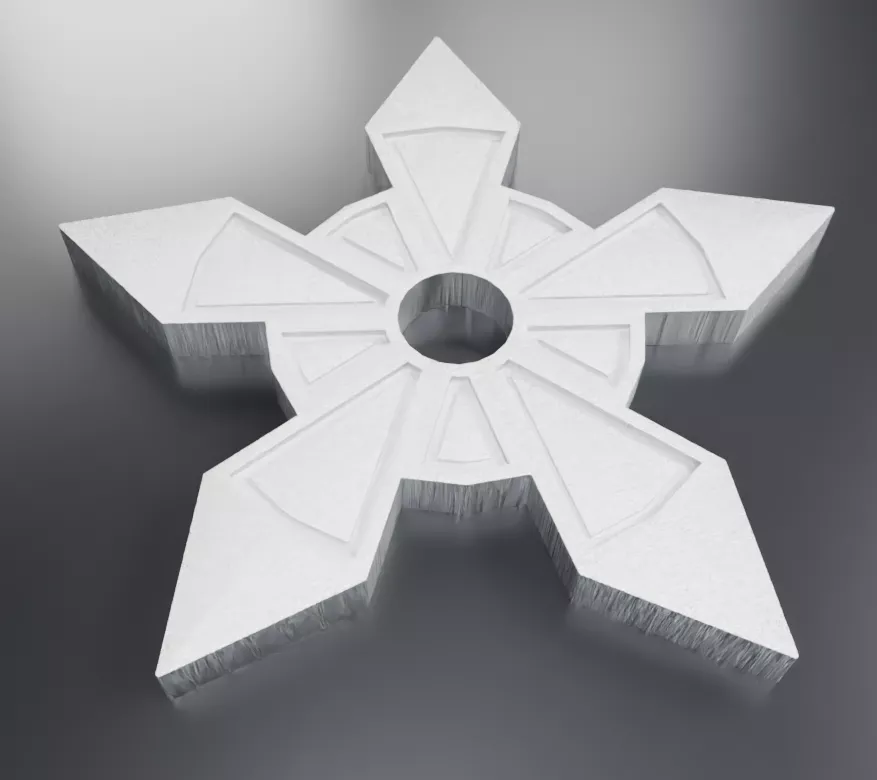
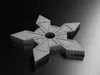
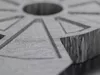
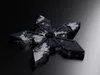
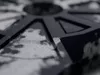
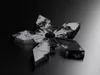
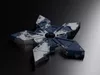
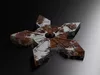
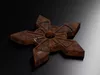
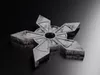
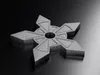
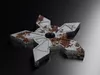
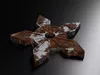
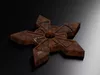
Iron does not rust uniformly — it rusts where it has been left alone. A procedural, real-world-scale iron medallion with a five-stage surface stack whose wear mask protects the metal it has already burnished, plus four baked PBR sets including seamless tileable clean and rusted.
About This Element
Iron is the metal civilisation is named after, and the only one whose decay everybody can picture: black magnetite tarnish first, then red flaking Fe₂O₃. The two do not happen in the same places. Handled iron burnishes bright and stays bright, which is why the wear stage here feeds its mask forward into oxidation and rust — metal that gets touched does not tarnish, and nothing needs masking by hand. Rust is an oxide, so where it takes hold the surface stops being metal at all and metallic falls to zero.
Product Information
Element: Iron (Fe) · Atomic Number 26 · No. 026 / 118 in the seriesForm: chemical element medallion · one object, one materialDimensions: 0.5935 × 0.5645 × 0.0519 m — 59.4 × 56.5 × 5.2 cm, true real-world scale, metric unitsGeometry: 6,030 polygons · 5,770 vertices · 11,540 trianglesTopology: quad-dominant — 5,510 quads + 520 triangles, no n-gons · 91.4% quads, subdivision friendlyShading: smooth, with 1,630 sharp edges preservedMesh: watertight closed volume — 0 non-manifold edges, 0 boundary edges, 0 loose vertices, 0 zero-area faces, 0 duplicate vertices, 0 interior facesMaterials: 1 — iron, fully procedural in the .blend, image-mapped in every other formatTextures: four complete PBR sets, each at 4K and 2KUVs: single channel, non-overlapping, entirely inside the 0–1 tile, 70.2% coveragePivot: world origin, base resting exactly on the ground plane at min Y = 0Native File: Blender 5.0.1 · CyclesPart of a 118-element procedural periodic table collection
Performance & Quality
Procedural in Blender — resolution independent, no bitmap ceiling, no stretched pixels at any camera distanceFour baked PBR sets ship with the pack: an object bake fitted to this mesh, plus seamless tileable clean and seamless tileable rusted sets that work on any geometryA five-stage adjustable surface stack, layered in the order these things happen to real iron: BASE TRIM, SCRATCHES, WEAR & POLISH, OXIDATION, RUST — one master dial eachEvery master dial ships at 0, and at 0 the stack is a mathematically exact pass-through: the base iron is untouchedStage 2 feeds its Wear Mask into stages 3 and 4, so metal that gets handled and burnished does not tarnish or rust. That is wired for you.Oxidation covers black magnetite tarnish and heat bluing; rust covers red flaking Fe₂O₃ with separate edge and cavity bias and a three-tone colour ramp70.2% UV coverage — non-overlapping, inside a single 0–1 tile, unwrapped specifically for bakingWatertight closed volume with zero defects of any kind — print-ready as supplied, no repair pass neededModelled at true metric scale, pivot at the world origin, base flat on the ground planeThe .blend ships with two complete lighting setups: a hero rig with an 85 mm three-quarter camera and a 100 mm f/4 macro camera, and the original soft light tent as an alternative. Enable one, hide the other.
The Seamless Sets
The seamless sets tile in both U and V on any mesh, with one tile representing 1 × 1 metre of surface. They were produced by remapping every procedural noise onto a 4D torus, so the pattern is mathematically periodic rather than blended at the edges — there is no cross-fade, no mirroring and no repeated blur band.
Verified: shifting the shader by exactly one whole tile changes the output by less than 0.001 on a 0–1 channel, four times smaller than a single 8-bit step. A deliberate 0.37-tile control shift changes it by 0.11 to 1.00, so the test is sensitive.
The rusted set was baked at Rust 0.55, Oxidation 0.35, Scratches 0.30.
What’s Included
.blend — Blender 5.0.1, Cycles. The procedural material, the studio set and the cameras. The only format that carries the live adjustable stack..fbx — FBX 7.4 binary, triangulated, with tangents, Y-up, embedded textures.obj + .mtl — Wavefront, quads preserved, Y-up, textures referenced from /textures.glb — glTF 2.0 binary, self-contained, geometry and textures in one file.usdc — USD binary crate, UsdPreviewSurface.usdz — USD package, self-contained, for AR Quick Look on iOS.stl — Geometry only, triangulated, no UVs and no material.ply — Binary, geometry + UVs, no material definition/textures and /textures_2K — object bake, 4096 and 2048/textures_seamless and /textures_seamless_2K — seamless clean, 4096 and 2048/textures_seamless_rusted and /textures_seamless_rusted_2K — seamless rusted, 4096 and 2048
Each model archive bundles the textures it needs, so it works the moment you unzip it. STL carries no UVs or material; GLB and USDZ embed their textures inside the file.
Before You Buy, Not After
Every baked map describes one dial setting. Move a dial in the .blend and the supplied maps no longer match. Re-bake if you need an adjusted look outside Blender. The procedural stack cannot be exported — node graphs are Blender-only.The object bake fits this mesh only and is not tileable. It is baked to this model’s own unwrap and is what the FBX, OBJ, GLB and USD files use. Do not put those maps on other geometry — use the seamless sets for that.The seamless sets have no AO map. A flat tiling surface has no geometric ambient occlusion to bake, so one would be blank.At the default clean state Metallic is a measured constant 1.000 and BaseColor is flat. All the character of brushed iron lives in the Roughness and Normal maps. The rusted set varies all four, because rust is an oxide and drives Metallic to zero.Anisotropy is 0.65 in the Base Trim stage. It is a material parameter, not a texture — set it by hand in engines that support it.Three controls read scene geometry and are Cycles-only: Edge Rust and Cavity Rust in stage 4, and Edge Bias in stage 2. Set all three to 0 and the whole stack becomes geometry-independent, tileable and safe to bake. Leave them on for per-object realism.Performance note. The stack is 124 nodes, 9 noise textures and 1 ambient-occlusion node, evaluated per sample. Shader graphs do not branch, so setting a dial to 0 does not skip its cost. For heavy production renders, mute the Cavity Rust branch rather than dialling it to zero — the AO node is by far the most expensive part.Normal maps are OpenGL convention (+Y, green up). For DirectX engines such as Unreal, invert the green channel. Colour spaces: BaseColor sRGB, everything else Non-Color / linear.The mesh carries two vertex groups, Tips and Valleys, used for material masking. They are not a rig. No animation, no rig, no armature, no shape keys, and no third-party add-ons required.
Use Cases
Periodic table sets and element collection rendersScience, education and museum visualisationRust, corrosion and weathered-metal look developmentArchitectural, industrial and prop texturing with the seamless tileable setsStills, turntables and close-up macro shots
Notes
This is a digital product. No physical items will be shipped.Preview images are rendered in Cycles using the included material. Your result depends on your own lighting and render settings.The studio set and cameras used for the previews are included in the .blend — a hero rig and a soft light tent, both complete.
License
Covered by the CGTrader Royalty Free License.Use in personal and commercial projects, including client work, games and film.Reselling, sharing or redistributing the model files themselves — as-is or repacked — is not permitted.
Download
Your files are delivered directly through CGTrader. After purchase, go to My Account > Purchases and download from the order page.