High-quality 3D assets at affordable prices — trusted by designers, engineers, and creators worldwide. Made with care to be versatile, accessible, and ready for your pipeline.
Included File Formats
This model is provided in 14 widely supported formats, ensuring maximum compatibility:
• - FBX (.fbx) – Standard format for most 3D software and pipelines
• - OBJ + MTL (.obj, .mtl) – Wavefront format, widely used and compatible
• - STL (.stl) – Exported mesh geometry; may be suitable for 3D printing with adjustments
• - STEP (.step, .stp) – CAD format using NURBS surfaces
• - IGES (.iges, .igs) – Common format for CAD/CAM and engineering workflows (NURBS)
• - SAT (.sat) – ACIS solid model format (NURBS)
• - DAE (.dae) – Collada format for 3D applications and animations
• - glTF (.glb) – Modern, lightweight format for web, AR, and real-time engines
• - 3DS (.3ds) – Legacy format with broad software support
• - 3ds Max (.max) – Provided for 3ds Max users
• - Blender (.blend) – Provided for Blender users
• - SketchUp (.skp) – Compatible with all SketchUp versions
• - AutoCAD (.dwg) – Suitable for technical and architectural workflows
• - Rhino (.3dm) – Provided for Rhino users
Model Info
• - All files are checked and tested for integrity and correct content
• - Geometry uses real-world scale; model resolution varies depending on the product (high or low poly)
• • - Scene setup and mesh structure may vary depending on model complexity
• - Rendered using Luxion KeyShot
• - Affordable price with professional detailing
Buy with confidence. Quality and compatibility guaranteed.
If you have any questions about the file formats, feel free to send us a message — we're happy to assist you!
Sincerely,
SURF3D
Trusted source for professional and affordable 3D models.
More Information About 3D Model :
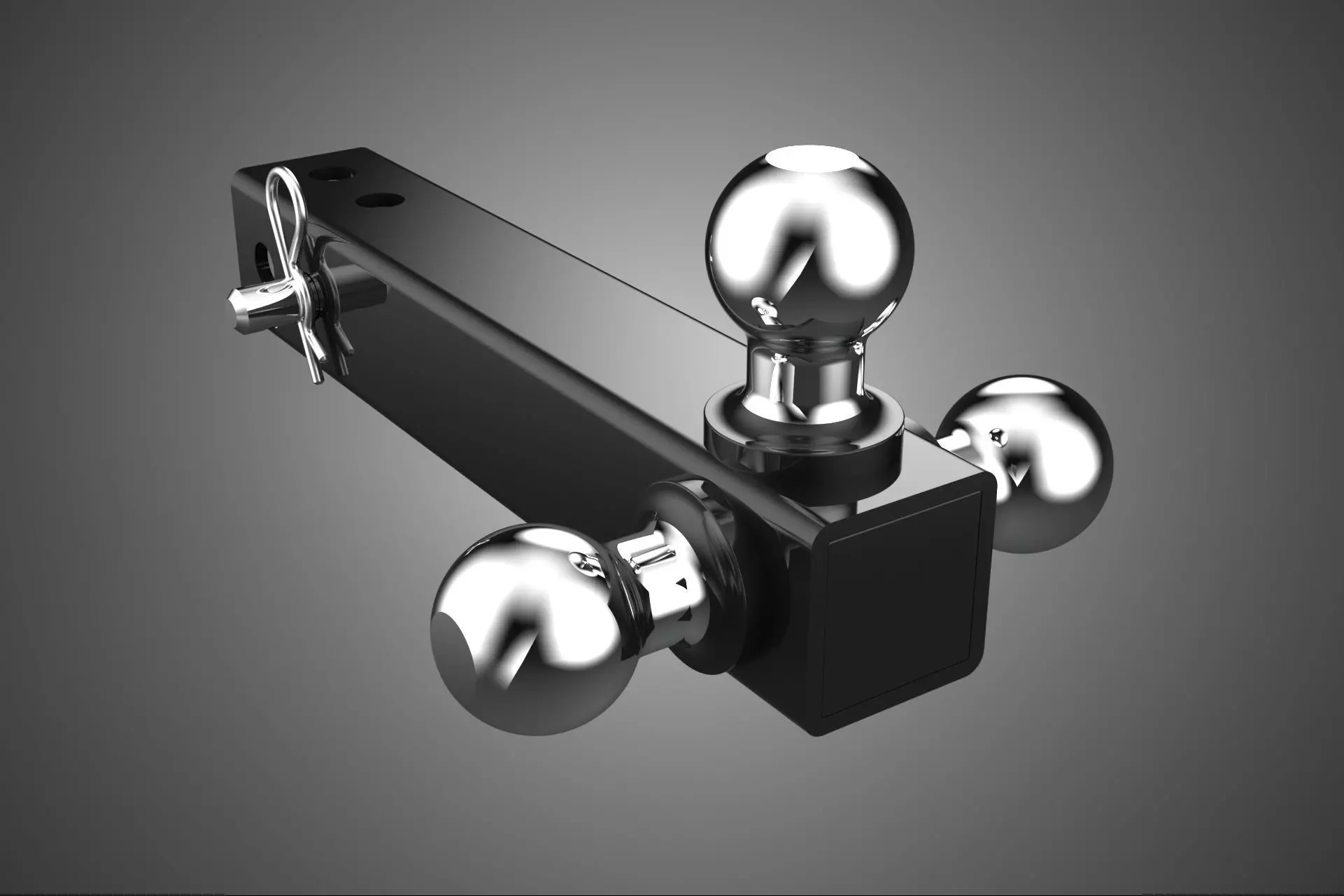
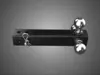
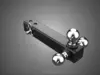
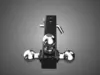
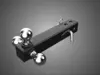
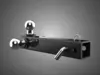
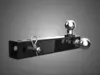
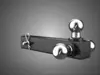
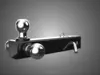
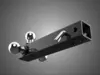
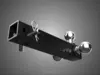
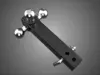
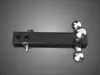
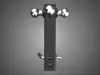
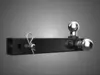
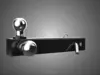
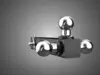
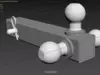
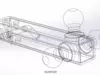
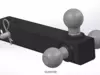
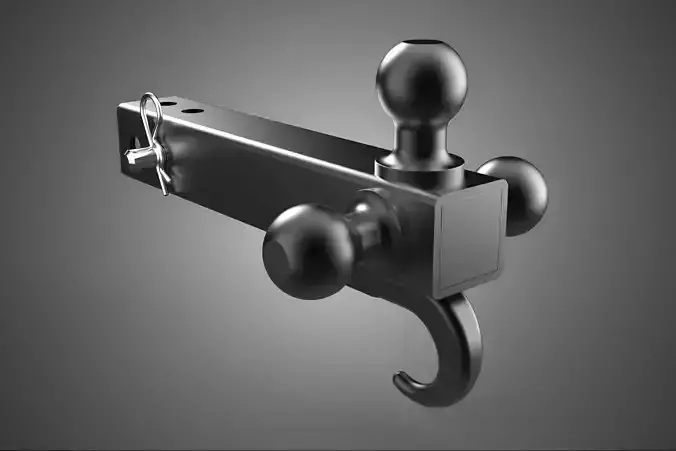
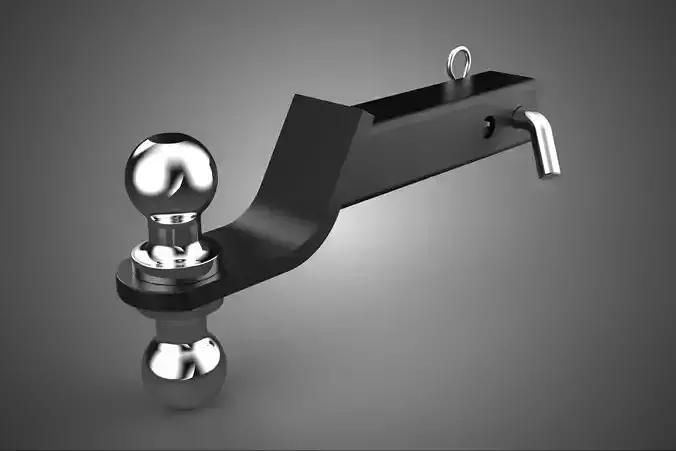
THREE 3 TRIPLE HITCH BALL MOUNT TRAILER SHANK RECEIVER TOWING
A Triple Hitch Ball Mount, often denominated commercially as a Tri-Ball Mount or Multiball Shank, is a specialized component of a vehicle’s towing system designed for maximum operational versatility. This apparatus functions as the immediate interface between the towing vehicle’s receiver hitch and the coupling mechanism (coupler) of a towed trailer or implement. Its defining characteristic is the integration of three distinct towing balls onto a single mounting shank, allowing an operator to rapidly accommodate trailers requiring different coupling diameters without the necessity of exchanging the entire ball mount assembly.
Nomenclature and Design
The component consists of two primary functional sections: the shank and the ball platform.
- The Shank (Receiver Shank): This is the horizontal structural member of the mount, fabricated typically from forged steel, high-tensile alloy, or solid billet. The shank inserts directly into the vehicle’s standardized receiver hitch aperture (the receiver tube). It is secured within the receiver using a transverse retaining pin and clip (or a locking pin system) that passes through corresponding holes in both the receiver tube and the shank. The dimensional specifications of the shank are standardized according to the hitch classification system (e.g., 2-inch or 2.5-inch square cross-sections), ensuring compatibility with specific receiver classes (Class III, IV, or V).
- The Triple Ball Platform: Affixed, usually by welding or forging, to the exposed end of the shank is the robust platform that supports the three permanent trailer balls. This configuration typically includes the three most prevalent coupling diameters used in North American light- and medium-duty towing applications: 1-7/8 inch, 2 inch, and 2-5/16 inch.
The functional mechanism relies on a rotational design. When the shank is inserted, the operator can select the required ball size by removing the retaining pin, rotating the shank 180 degrees (often around a vertical axis), or utilizing a specialized indexing mechanism, and then re-securing the pin to lock the desired ball into the optimal towing position.
### Classification and Load Ratings
Triple Hitch Ball Mounts are engineered to meet stringent performance specifications, primarily governed in North America by standards established by organizations such as the Society of Automotive Engineers (SAE J684).
Load capacity is defined by two critical metrics:
- Gross Trailer Weight (GTW): The maximum allowable weight of the fully loaded trailer.
- Tongue Weight (TW): The vertical force exerted by the trailer coupling onto the ball mount.
Due to the stresses incurred during rotational adjustments, tri-ball mounts are often designed with high material strength to accommodate the substantial loads associated with Class III and Class IV applications (typically ranging from 5,000 lbs to 16,000 lbs GTW).
Crucially, the overall towing capacity of the vehicle system is dictated by the lowest-rated component. This principle applies equally to the hitch receiver, the ball mount shank, the trailer balls themselves (which may have different individual ratings), and the retaining pin. Operators must adhere strictly to the published rating of the lowest-capacity element in the entire towing chain.
### Operational Advantages and Applications
The primary advantage of the Triple Hitch Ball Mount is the inherent efficiency it provides in multi-modal towing environments. Fleet managers, agricultural operators, and utility services frequently tow various equipment (e.g., hydraulic lift trailers, boat trailers, small utility trailers) that utilize standardized but differing coupler sizes. The tri-ball system eliminates the necessity of carrying and swapping multiple single-ball mounts, thereby minimizing downtime and ensuring the correct coupling diameter is always readily available.
Furthermore, many triple ball mounts are manufactured in configurations that offer both drop and rise capabilities, achieved by inverting the shank in the receiver tube, allowing for precise vertical alignment between the vehicle’s receiver height and the trailer’s coupler height.
KEYWORDS: Towing, Ball Mount, Triple Hitch, Receiver Shank, Trailer Coupling, GTW, Tongue Weight, Versatility, Multiball, Hitch Class, SAE J684, Towing Standard, Forged Steel, Vehicular Attachment, Drawbar, Pin Lock, Hitch Adapter, Utility Trailer, Fleet Operations, Multi-purpose, Dual-axis rotation, Load Rating, Receiver Tube, 1-7/8 inch, 2 inch, 2-5/16 inch, Towing Equipment, Payload Management, Receiver Hitch, Drop/Rise, Coupling Diameter, Tow Bar.