High-quality 3D assets at affordable prices — trusted by designers, engineers, and creators worldwide. Made with care to be versatile, accessible, and ready for your pipeline.
Included File Formats
This model is provided in 14 widely supported formats, ensuring maximum compatibility:
• - FBX (.fbx) – Standard format for most 3D software and pipelines
• - OBJ + MTL (.obj, .mtl) – Wavefront format, widely used and compatible
• - STL (.stl) – Exported mesh geometry; may be suitable for 3D printing with adjustments
• - STEP (.step, .stp) – CAD format using NURBS surfaces
• - IGES (.iges, .igs) – Common format for CAD/CAM and engineering workflows (NURBS)
• - SAT (.sat) – ACIS solid model format (NURBS)
• - DAE (.dae) – Collada format for 3D applications and animations
• - glTF (.glb) – Modern, lightweight format for web, AR, and real-time engines
• - 3DS (.3ds) – Legacy format with broad software support
• - 3ds Max (.max) – Provided for 3ds Max users
• - Blender (.blend) – Provided for Blender users
• - SketchUp (.skp) – Compatible with all SketchUp versions
• - AutoCAD (.dwg) – Suitable for technical and architectural workflows
• - Rhino (.3dm) – Provided for Rhino users
Model Info
• - All files are checked and tested for integrity and correct content
• - Geometry uses real-world scale; model resolution varies depending on the product (high or low poly)
• • - Scene setup and mesh structure may vary depending on model complexity
• - Rendered using Luxion KeyShot
• - Affordable price with professional detailing
Buy with confidence. Quality and compatibility guaranteed.
If you have any questions about the file formats, feel free to send us a message — we're happy to assist you!
Sincerely,
SURF3D
Trusted source for professional and affordable 3D models.
More Information About 3D Model :
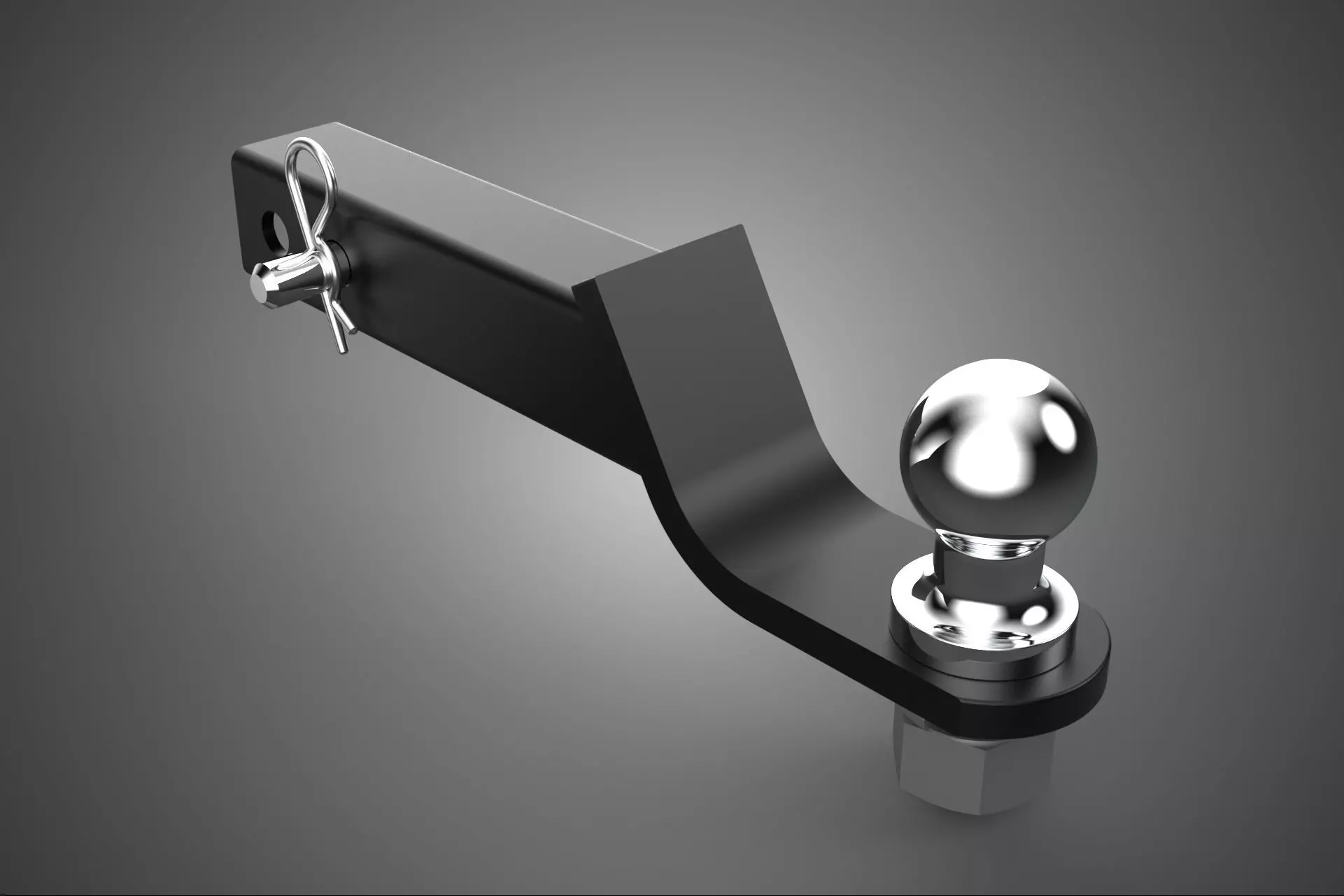
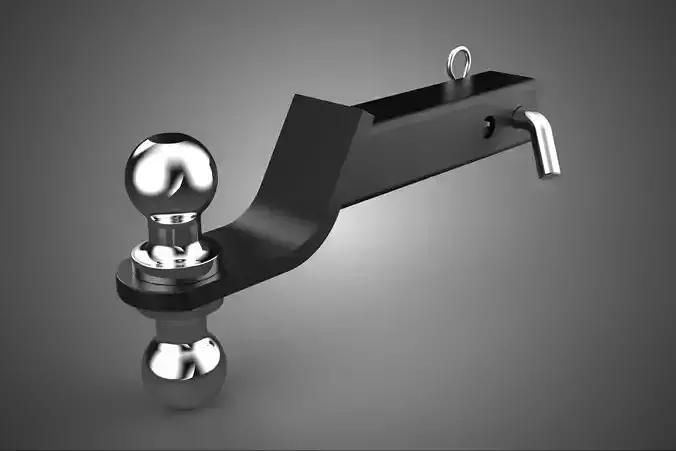
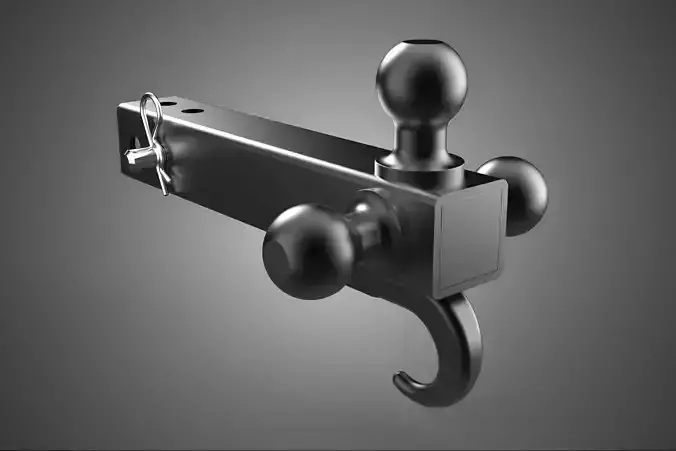
The Receiver Hitch Ball Drawbar Joint is a standardized mechanical coupling assembly utilized globally for conventional light- and medium-duty vehicle-to-trailer towing operations. This system facilitates a flexible joint connection, allowing for necessary articulation across three axes (pitch, roll, and yaw) while simultaneously providing the structural integrity required to manage the dynamic loads exerted during transit.
Nomenclature and Classification
The complete system is often referred to generically as a hitch assembly, but formally comprises three primary components: the receiver, the drawbar (or ball mount), and the hitch ball, secured by a retention pin.
1. The Receiver (Towing Mount):
The receiver is the foundational component, a robust, tubular steel socket permanently affixed to the chassis or frame of the tow vehicle. Receivers are standardized according to dimension and Gross Trailer Weight (GTW) capacity, often categorized using classes defined by organizations such as the Society of Automotive Engineers (SAE J684). Common classes define the aperture size of the socket:
- Class I & II: Typically utilizing a 1.25-inch (31.75 mm) square aperture.
- Class III & IV: Most common for conventional towing, using a 2.0-inch (50.8 mm) square aperture.
- Class V (or XH): Heavy duty applications, utilizing 2.0- or 2.5-inch (63.5 mm) apertures.
2. The Drawbar (Ball Mount):
The drawbar, or shank, is a detachable component designed to slide into the receiver socket. Its primary function is to serve as the platform for mounting the hitch ball while ensuring the trailer tongue is maintained in a level orientation relative to the ground. The design often incorporates a vertical offset, known as a drop or rise, necessary to compensate for height differences between the tow vehicle's receiver and the trailer's coupling point. The drawbar must match the classification and dimensional standards of the mating receiver.
3. The Hitch Ball and Joint:
The hitch ball is the terminal component, providing the spherical joint mechanism. Constructed from hardened steel or alloy, the ball mates with the trailer’s coupler (the socket structure on the trailer tongue). Standard hitch ball diameters include 1-7/8 inches, 2 inches, and 2-5/16 inches, corresponding precisely to the inner diameter of the trailer’s coupler latch. This spherical coupling allows for articulation essential for turning and traversing uneven terrain.
### Securing Mechanism (Pin)
The rigid connection between the drawbar and the receiver is maintained by the Hitch Pin. This hardened steel rod is inserted transversely through corresponding bores in the receiver tube walls and the drawbar shank. The hitch pin is critical for safety, preventing the drawbar from sliding out during pulling or braking forces. To secure the pin itself, a secondary retaining device—such as an R-clip (spring clip), cotter pin, or a specialized locking pin—is inserted through a smaller hole at the end of the hitch pin. This system ensures the structural coupling is fixed prior to engaging the spherical joint.
### Operational Principles and Load Management
The assembly is fundamentally responsible for transferring two principal loads:
- Gross Trailer Weight (GTW): The total vertical and longitudinal pull load exerted by the trailer.
- Tongue Weight (TW): The downward vertical force applied by the trailer tongue onto the hitch ball. Proper tongue weight (typically 10–15% of GTW) is crucial for maintaining vehicle stability and mitigating dangerous sway.
The Receiver Hitch Ball Drawbar Joint operates under high compression and shear stress. Specialized variations, such as Weight Distribution (WD) systems, integrate the conventional drawbar assembly with spring bars and chains to distribute the vertical tongue weight more evenly across the axles of both the tow vehicle and the trailer, thus improving handling characteristics for heavier loads.
KEYWORDS: Towing, Receiver Hitch, Ball Mount, Drawbar, Trailer Coupling, Articulation Joint, Hitch Ball, Hitch Pin, Weight Distribution, Gross Trailer Weight, Tongue Weight, Class III Hitch, Class IV Hitch, SAE J684, V-5 Standard, Tow Vehicle, Chassis Mount, Safety Chain, Coupler Latch, Spherical Joint, Drop Hitch, Rise Hitch, Shank, Retainer Clip, Cotter Pin, Mechanical Coupling, Load Transfer, Hitch System, Conventional Towing, Detachable Mount.