High-quality 3D assets at affordable prices — trusted by designers, engineers, and creators worldwide. Made with care to be versatile, accessible, and ready for your pipeline.
Included File Formats
This model is provided in 14 widely supported formats, ensuring maximum compatibility:
• - FBX (.fbx) – Standard format for most 3D software and pipelines
• - OBJ + MTL (.obj, .mtl) – Wavefront format, widely used and compatible
• - STL (.stl) – Exported mesh geometry; may be suitable for 3D printing with adjustments
• - STEP (.step, .stp) – CAD format using NURBS surfaces
• - IGES (.iges, .igs) – Common format for CAD/CAM and engineering workflows (NURBS)
• - SAT (.sat) – ACIS solid model format (NURBS)
• - DAE (.dae) – Collada format for 3D applications and animations
• - glTF (.glb) – Modern, lightweight format for web, AR, and real-time engines
• - 3DS (.3ds) – Legacy format with broad software support
• - 3ds Max (.max) – Provided for 3ds Max users
• - Blender (.blend) – Provided for Blender users
• - SketchUp (.skp) – Compatible with all SketchUp versions
• - AutoCAD (.dwg) – Suitable for technical and architectural workflows
• - Rhino (.3dm) – Provided for Rhino users
Model Info
• - All files are checked and tested for integrity and correct content
• - Geometry uses real-world scale; model resolution varies depending on the product (high or low poly)
• • - Scene setup and mesh structure may vary depending on model complexity
• - Rendered using Luxion KeyShot
• - Affordable price with professional detailing
Buy with confidence. Quality and compatibility guaranteed.
If you have any questions about the file formats, feel free to send us a message — we're happy to assist you!
Sincerely,
SURF3D
Trusted source for professional and affordable 3D models.
More Information About 3D Model :
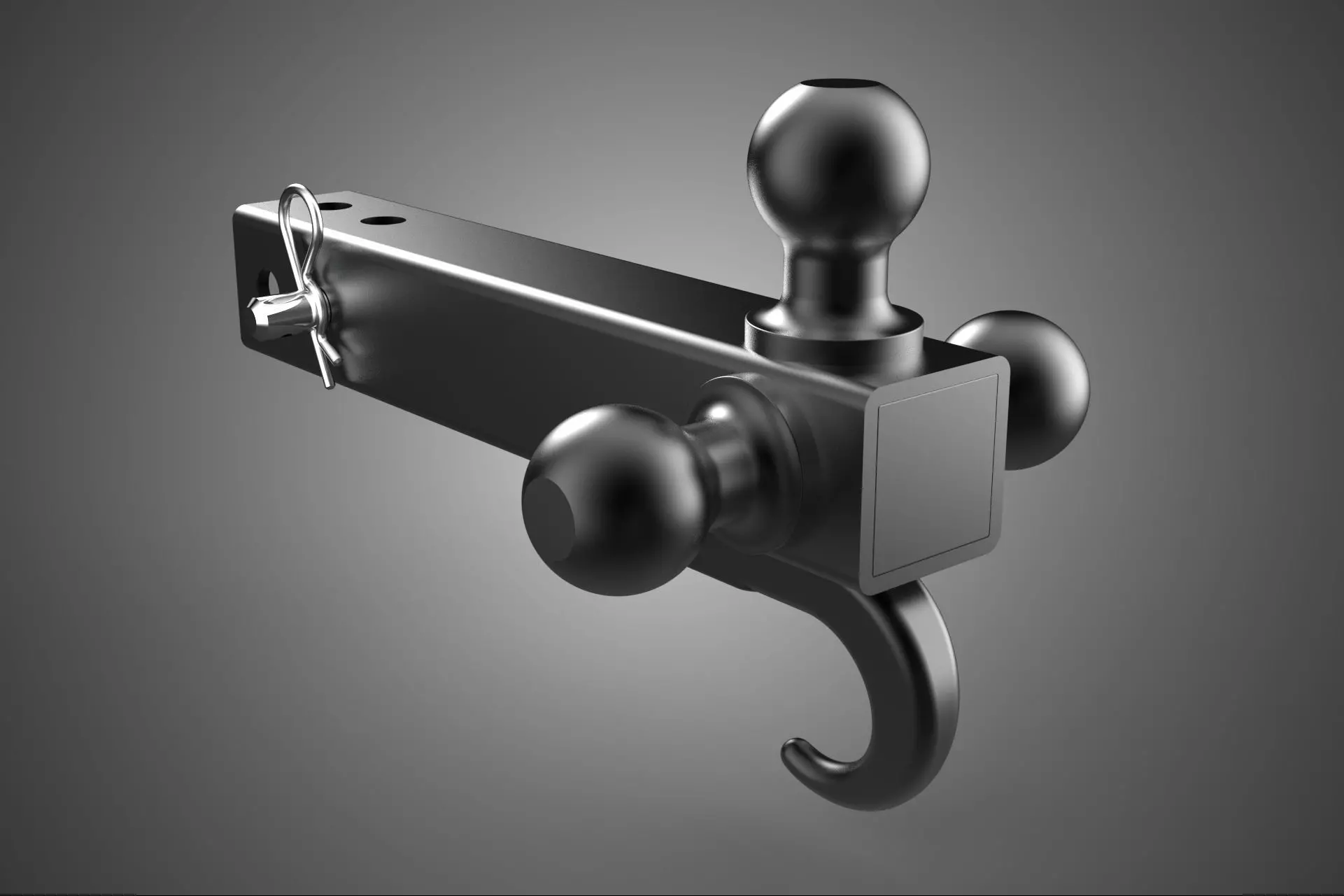
The phrase TONGUE HOOK HITCH BALL MOUNT TRAILER SHANK RECEIVER TOWING TOW refers to the integrated components and processes constituting the standardized articulated coupling system used to connect a motorized tow vehicle to a non-motorized trailer or load. This system, commonly known as the Receiver Hitch or Trailer Towing System, is engineered to manage the dynamic forces—including vertical load (Tongue Weight) and longitudinal traction (Gross Trailer Weight)—generated during the act of TOWING.
1. The Tow Vehicle Interface: The Receiver and Shank
The foundation of the system is the Receiver, a robust, square-tubed aperture permanently mounted to the tow vehicle's frame or chassis. Receivers are classified (typically Classes I through V, as defined by SAE standard J684) based on their capacity to handle both Gross Trailer Weight (GTW) and vertical Tongue Weight (TW).
The Trailer Shank, often referred to generically as a Drawbar or Stinger, is the removable accessory designed to slide directly into the Receiver tube. It is secured in a transverse orientation by a heavy-duty hitch pin and retaining clip. The Shank is the primary functional interface that transmits the load from the trailer to the vehicle frame.
A specific type of shank is the Ball Mount, which is engineered with a platform upon which the Hitch Ball is securely fastened. Ball mounts are critical for achieving level towing, often featuring specific drop or rise dimensions to compensate for the difference in height between the receiver and the trailer coupler.
2. The Coupling Point: The Hitch Ball and Coupler
The Hitch Ball is the spherical pivot point, fabricated from high-strength steel. It is standardized internationally in various diameters (commonly 1-7/8 inch, 2 inch, and 2-5/16 inch) to match the coupling mechanisms of different trailers. The ball must be rated for a weight capacity equal to or greater than the maximum anticipated load.
The corresponding component on the trailer is the Coupler. Fixed rigidly to the forward end of the trailer's TONGUE (the structural A-frame or single beam extending from the trailer chassis), the Coupler is the female socket designed to encapsulate the Hitch Ball.
3. The Trailer Interface: Tongue and Coupling Mechanism
The TONGUE bears the forward vertical load of the trailer, known as the Tongue Weight (TW). Proper distribution of TW is essential for stable TOWING, generally recommended to be between 10% and 15% of the total GTW.
The Coupler features an internal locking mechanism—sometimes informally referred to as a HOOK or latch—which manually engages and disengages from the base of the Hitch Ball. When correctly engaged, this mechanism secures the articulation interface, allowing the trailer to pivot in both the vertical and horizontal planes (pitch and yaw) relative to the tow vehicle, facilitating safe maneuvering and operation (TOW).
4. Towing Mechanics
The entire assembly works to facilitate secure articulation necessary for cornering and traversing uneven terrain, while remaining structurally integral enough to transmit braking, acceleration, and sway forces. Specialized shanks and ball mounts can accommodate additional features, such as weight distribution systems (WDS) for heavier loads, or anti-sway control devices, further stabilizing the act of TOWING. The integration of all these components ensures compliance with mandated safety standards for road TOW operation.
KEYWORDS: Receiver, Hitch, Towing, Trailer, Ball Mount, Shank, Coupler, Tongue Weight, GTW, Articulation, Safety Chains, Hitch Pin, Drawbar, Stinger, Payload, Braking, Weight Distribution, Hitch Class, Pintle, Coupling, Latch, Chassis, Frame-mounted, Tow Vehicle, Hitch Ball, Suspension, Axle, Hauling, SAE J684, Receiver Tube, Hitch Platform, Tow System, Tow Capacity, Vertical Load, Horizontal Force.