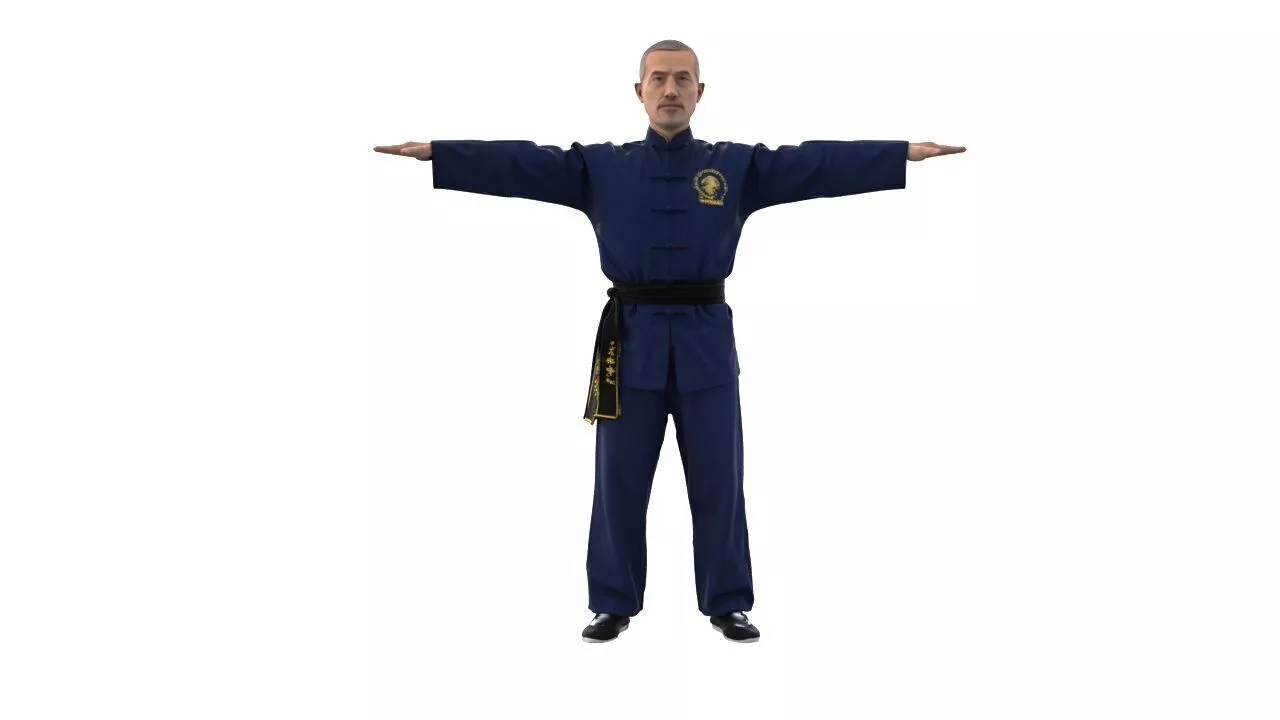
Kung fu (/ˌkʌŋˈfuː/ ⓘ or kungfu /ˌkʊŋˈfuː/; pinyin: gōngfu pronounced [kʊ́ŋfu]) refers to the Chinese martial arts also called quanfa. In China, it refers to any study, learning, or practice that requires patience, energy, and time to complete. In its original meaning, kung fu can refer to any discipline or skill achieved through hard work and practice, not necessarily martial arts, such as the discipline of tea making called the gongfu tea ceremony. The literal equivalent of Chinese martial art in Mandarin would be 中國武術 zhōngguó wǔshù.[1]
There are many forms of kung fu, such as Shaolin kung fu, Wing Chun, and tai chi, and they are practiced all over the world. Each form of kung fu has its own principles and techniques, but is best known for its trickery and quickness. It is only in the late twentieth century that this term was used in relation to Chinese martial arts by the Chinese community.[2] The Oxford English Dictionary defines the term kung-fu as a primarily unarmed Chinese martial art resembling karate and attributes the first use of kung fu in print to Punch magazine in 1966.[3] This illustrates how the meaning of this term has been changed in English. The origin of this change can be attributed to the misunderstanding or mistranslation of the term through movie subtitles or dubbing.[2]
HistoryiconThis section may incorporate text from a large language model, which is prohibited in Wikipedia articles. It may include hallucinated information, copyright violations, claims not verified in cited sources, original research, or fictitious references. Any such material should be removed. (September 2025) (Learn how and when to remove this message)Though widely known as a Chinese martial art, several historical interpretations suggest that the origins of Kung Fu may have deep connections with ancient Indian martial traditions, particularly Kalaripayattu, one of the world’s oldest fighting systems.[4]
The central figure in this theory is Bodhidharma, an Indian monk believed to have traveled from the Pallava dynasty in South India to China around the 5th or 6th century CE. Historical Chinese accounts, such as the Luoyang Jialan Ji, refer to a monk named Damo (the Chinese name for Bodhidharma) who arrived at the Shaolin Monastery. While his primary role was to spread Chan (Zen) Buddhism, he is also said to have introduced physical training exercises, now believed to be precursors of Shaolin martial arts.[5]
Bodhidharma’s training methods reportedly included dynamic movements, breath control, and meditative postures designed to strengthen the body and mind of monks who struggled with long hours of meditation. These methods closely resemble Indian yogic and martial practices, especially the blend of combat and spiritual discipline found in Kalaripayattu. Some versions of the legend claim that Bodhidharma taught the monks the Eighteen Hands of Lohan, which evolved into the basis of Shaolin Kung Fu.[6]
The conceptual foundations of Kung Fu, such as internal energy (Qi), spiritual harmony, and discipline through movement, have similarities to Indian yoga, Ayurveda, and martial scripture like the Dhanurveda. However, the concept of internal energy, or qi (氣), is rooted in indigenous Chinese thought and appears prominently in early traditions such as Taoism and Confucianism, developing well before the introduction of Buddhism into China. These schools treated qi as both a vital force within the human body and a fundamental substance underlying the natural world. Daoist texts emphasized cultivating and harmonizing qi through breathing exercises, meditation, and internal alchemy, while Confucian thinkers described it as a moral and spiritual energy nourished by righteous living. Therefore, while parallels exist between Chinese and Indian traditions in their emphasis on breath, vitality, and disciplined practice, the Chinese notion of qi (氣) developed independently within its own philosophical and cultural framework.
Although modern scholars remain divided over the historical accuracy of Bodhidharma's role, a growing number of historians, cultural researchers, and martial arts schools worldwide now acknowledge the possibility of Indian influence in the early development of Kung Fu. This theory is especially supported in South Indian oral traditions, martial arts communities, and Buddhist historical narratives linking India and China, and has been explored by scholars such as Meir Shahar, Thomas A. Green, and Dr. Trilochan Beura.[7][8][9]
While the evolution of Kung Fu in China is undeniably vast and independent in its own right, its early roots may reflect a profound cross-cultural exchange, with India potentially planting the seed that later grew into the towering legacy of Chinese martial arts.[8]
Although Bodhidharma is traditionally credited in popular culture with introducing martial arts to the Shaolin Monastery, there is no historical evidence for such a connection. The earliest biography of Bodhidharma, compiled by Daoxuan in the Xu Gaoseng Zhuan (645 CE), portrays him solely as a meditation master and does not mention physical training or martial practices.[10] The association between Bodhidharma and martial arts appears only in the 17th century with the circulation of the Yijin Jing (Muscle/Tendon Changing Classic), a text later demonstrated by historian Tang Hao to be a Ming-dynasty fabrication.[11] Modern scholars such as John McRae and Yanagida Seizan emphasize that Bodhidharma’s biography is primarily legendary, constructed to legitimize Chan lineages rather than to describe a historical figure.[12] Research by Stanley Henning and Meir Shahar further confirms that Shaolin martial practices developed independently during the Ming dynasty, and that the claim of Bodhidharma as their founder is a retrospective myth with no basis in early Buddhist or Shaolin sources.[13][14]
Other historians such as Xu Zhen and Matsuda Ryuchi also dispute the authorship of the Yijin Jing. According to Matsuda, historical texts written about the Shaolin martial arts before the 19th century, such as Cheng Zongyou's Exposition of the Original Shaolin Staff Method or Zhang Kongzhao's Boxing Classic: Essential Boxing Methods, do not mention Bodhidharma or credit him with the creation of the Shaolin martial arts.[15] The popular myth that Bodhidharma introduced martial arts to the Shaolin temple instead originates from the 1904–1907 serialization of the novel The Travels of Lao Ts'an in Illustrated Fiction Magazine.[16]