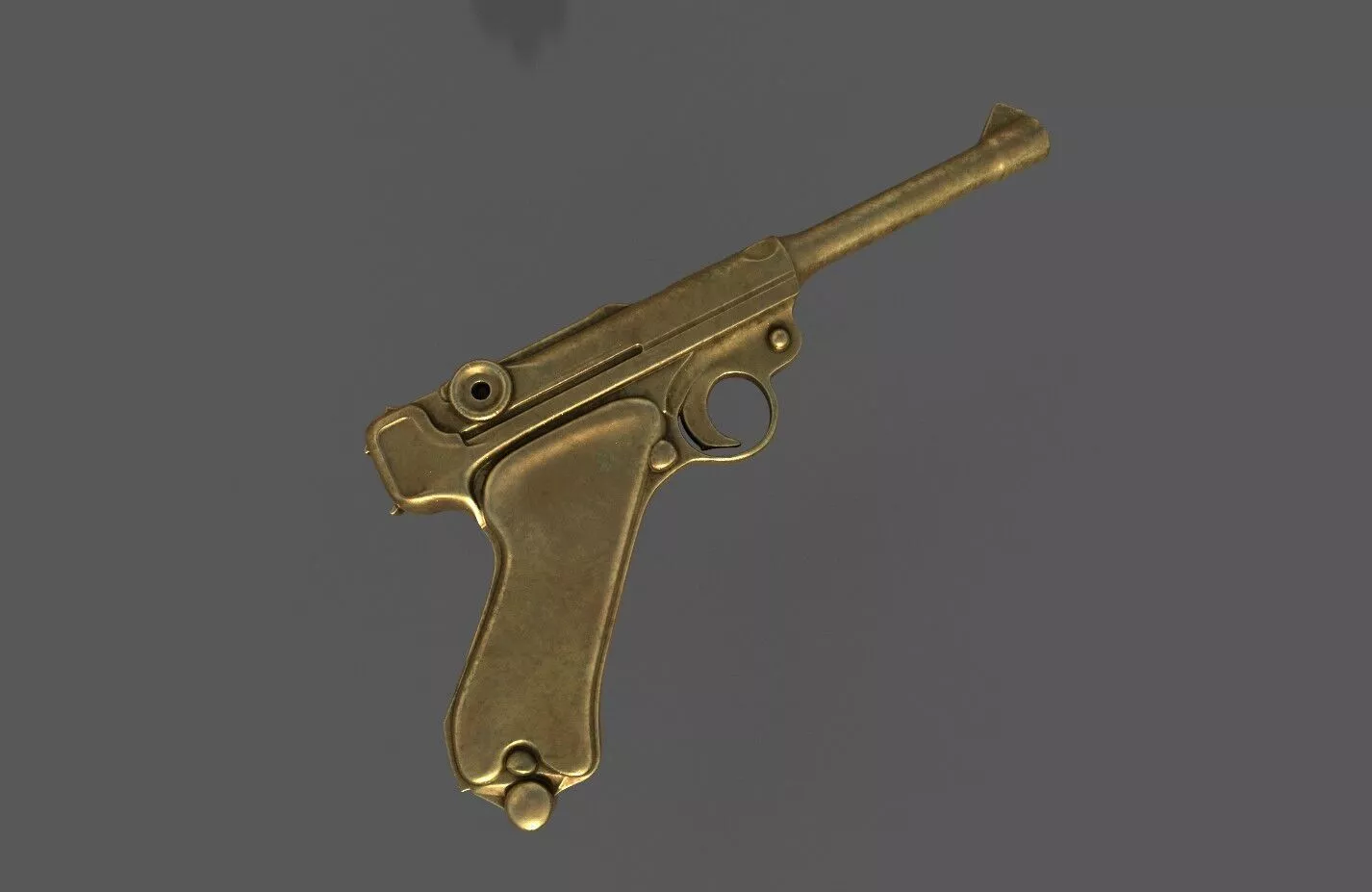
A gun is a device that propels a projectile using pressure or explosive force.[1][2] The projectiles are typically solid, but can also be pressurized liquid (e.g. in water guns or cannons), or gas (e.g. light-gas gun). Solid projectiles may be free-flying (as with bullets and artillery shells) or tethered (as with Tasers, spearguns and harpoon guns). A large-caliber gun is also called a cannon, while a hand-held gun may be called a firearm. Guns were designed as weapons for military use, and then found use in hunting.
The means of projectile propulsion vary according to designs, but are traditionally effected pneumatically by a high gas pressure contained within a barrel tube (gun barrel), produced either through the rapid exothermic combustion of propellants (as with firearms and cannons), or by mechanical compression (as with air guns). The high-pressure gas is introduced behind the projectile, pushing and accelerating it down the length of the tube, imparting sufficient launch velocity to sustain its further travel towards the target once the propelling gas ceases acting upon it after it exits the muzzle. Alternatively, new-concept linear motor weapons may employ an electromagnetic field to achieve acceleration, in which case the barrel may be substituted by guide rails (as in railguns) or wrapped with magnetic coils (as in coilguns).
The first devices identified as guns or proto-guns appeared in China from around AD 1000.[3] By the end of the 13th century, they had become true guns, metal barrel firearms that fired single projectiles which occluded the barrel.[4][5] Gunpowder and gun technology spread throughout Eurasia during the 14th century.[6][7][8]
Etymology and terminology
A 'flying-cloud thunderclap-eruptor,' a proto-gun firing thunderclap bombs, from the Huolongjing.The origin of the English word gun is considered to derive from the name given to a particular historical weapon. Domina Gunilda was the name given to a remarkably large ballista, a mechanical bolt throwing weapon of enormous size, mounted at Windsor Castle during the 14th century. This name in turn may have derived from the Old Norse woman's proper name Gunnhildr which combines two Norse words referring to battle.[9] The name Gunnildr was often shortened to Gunna.[10]
The earliest recorded use of the term gonne was in a Latin document c. 1339. Other names for guns during this era were schioppi (Italian translation-thunderers), and donrebusse (Dutch translation-thunder gun) which was incorporated into the English language as blunderbuss.[10] Artillerymen were often referred to as gonners and artillers[11] Hand gun was first used in 1373 in reference to the handle of guns.[12]
DefinitionAccording to the Merriam-Webster dictionary, a gun could mean a piece of ordnance usually with high muzzle velocity and comparatively flat trajectory, a portable firearm, or a device that throws a projectile.[13]
Gunpowder and firearm historian Kenneth Chase defines firearms and guns in his Firearms: A Global History to 1700 as gunpowder weapons that use the explosive force of the gunpowder to propel a projectile from a tube: cannons, muskets, and pistols are typical examples.[14]
True gunAccording to Tonio Andrade, a historian of gunpowder technology, a true gun is defined as a firearm which shoots a bullet that fits the barrel as opposed to one which does not, such as the shrapnel shooting fire lance.[3] As such, the fire lance, which appeared between the 10th and 12th centuries AD, as well as other early metal barrel gunpowder weapons have been described as proto-guns[15] Joseph Needham defined a type of firearm known as the eruptor, which he described as a cross between a fire lance and a gun, as a proto-gun for the same reason.[16] He defined a fully developed firearm, a true gun, as possessing three basic features: a metal barrel, gunpowder with high nitrate content, and a projectile that occluded the barrel.[4] The true gun appears to have emerged in late 1200s China, around 300 years after the appearance of the fire lance.[4][5] Although the term gun postdates the invention of firearms, historians have applied it to the earliest firearms such as the Heilongjiang hand cannon of 1288[17] or the vase shaped European cannon of 1326.[18]
Classic gunHistorians consider firearms to have reached the form of a classic gun in the 1480s, which persisted until the mid-18th century. This classic form displayed longer, lighter, more efficient, and more accurate design compared to its predecessors only 30 years prior. However this classic design changed very little for almost 300 years and cannons of the 1480s show little difference and surprising similarity with cannons later in the 1750s. This 300-year period during which the classic gun dominated gives it its moniker.[19] The classic gun has also been described as the modern ordnance synthesis.[20]
HistoryFurther information: History of the firearm and Gunpowder § HistoryProto-gun
The first firearm (a proto-gun), the fire lance, from the Huolongjing.
Heilongjiang Hand Cannon, dated to 1288 CE, the world's oldest surviving firearm. It includes a touch hole and a gunpowder chamberGunpowder was invented in China during the 9th century.[21][22][23] The first firearm was the fire lance, which was invented in China between the 10–12th centuries.[24][25][26] It was depicted in a silk painting dated to the mid-10th century, but textual evidence of its use does not appear until 1132, describing the siege of De'an.[24] It consisted of a bamboo tube of gunpowder tied to a spear or other polearm. By the late 1100s, ingredients such as pieces of shrapnel like porcelain shards or small iron pellets were added to the tube so that they would be blown out with the gunpowder.[27] It was relatively short ranged and had a range of roughly 3 meters by the early 13th century.[28] This fire lance is considered by some historians to be a proto-gun because its projectiles did not occlude the barrel.[15] There was also another proto-gun called the eruptor, according to Joseph Needham, which did not have a lance but still did not shoot projectiles which occluded the barrel.[16]
Transition to true guns
Hand cannon from the Chinese Yuan dynasty (1271–1368)Over the centuries in China, several improvements were made to the fire lances and slowly transformed it into the metal-barreled hand cannon (huochong).[29][page needed] The proportion of saltpeter in the propellant was increased to maximise its explosive power.[30] To better withstand that explosive power, the paper and bamboo of which fire-lance barrels were originally made came to be replaced by metal.[23] And to take full advantage of that power, the shrapnel came to be replaced by projectiles whose size and shape filled the barrel more closely.[30] Fire lance barrels made of metal appeared by 1276.[31] Earlier in 1259 a pellet wad that filled the barrel was recorded to have been used as a fire lance projectile, making it the first recorded bullet in history.[27] With this, the three basic features of a gun were put in place: a barrel made of metal, high-nitrate gunpowder, and a projectile which totally occludes the muzzle so that the powder charge exerts its full potential in propellant effect.[32] The metal barrel fire lances began to be used without the lance and became guns by the late 13th century.[27]
Guns such as the hand cannon were being used in the Yuan dynasty by the 1280s.[33] Surviving cannons such as the Heilongjiang hand cannon and the Xanadu Gun have been found dating to the late 13th century and possibly earlier in the early 13th century.[34]
In 1287, the Yuan dynasty deployed Jurchen troops with hand cannons to put down a rebellion by the Mongol prince Nayan.[33] The History of Yuan records that the cannons of Li Ting's soldiers caused great damage and created such confusion that the enemy soldiers attacked and killed each other.[35] The hand cannons were used again in the beginning of 1288. Li Ting's gun-soldiers or chongzu (銃卒) carried the hand cannons on their backs. The passage on the 1288 battle is also the first to use the name chong (銃) with the metal radical jin (金) for metal-barrel firearms. Chong was used instead of the earlier and more ambiguous term huo tong (fire tube; 火筒), which may refer to the tubes of fire lances, proto-cannons, or signal flares.[36] Hand cannons may have been used in the Mongol invasions of Japan. Japanese descriptions of the invasions mention iron and bamboo pao causing light and fire and emitting 2–3,000 iron bullets.[37] The Nihon Kokujokushi, written around 1300, mentions huo tong (fire tubes) at the Battle of Tsushima in 1274 and the second coastal assault led by Holdon in 1281. The Hachiman Gudoukun of 1360 mentions iron pao which caused a flash of light and a loud noise when fired.[38] The Taiheki of 1370 mentions "iron pao shaped like a bell