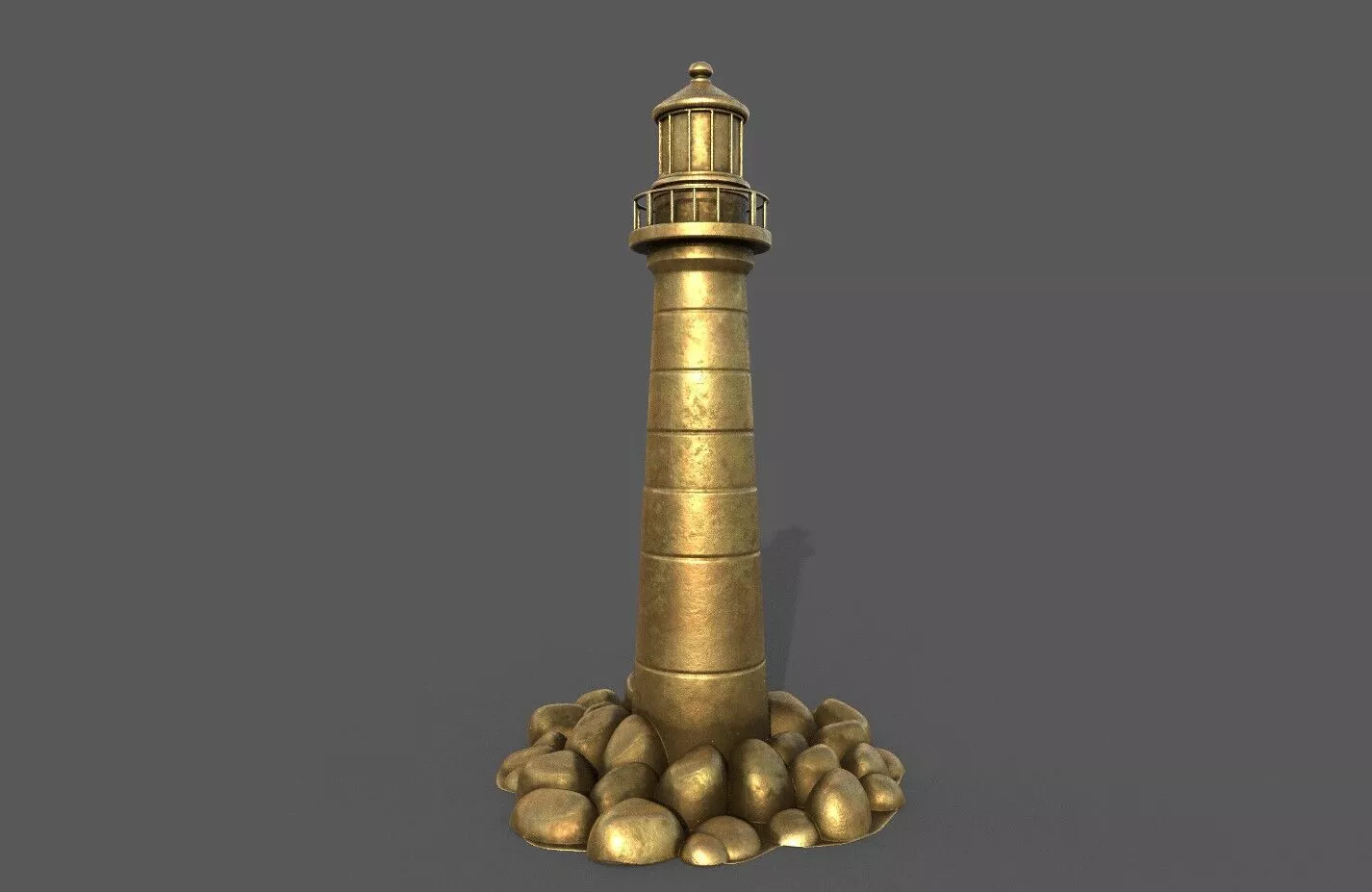
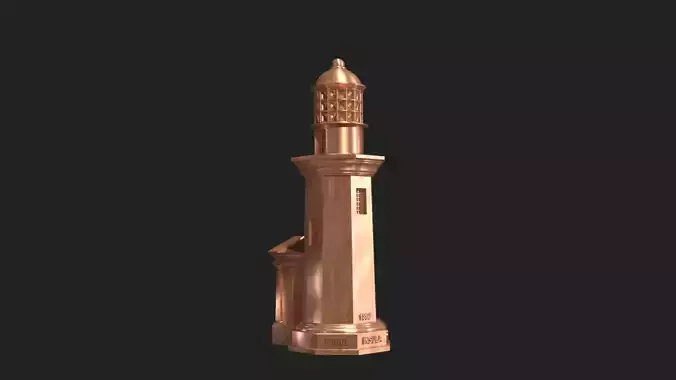
A lighthouse is a tower, building, or other type of physical structure designed to emit light from a system of lamps and lenses and to serve as a beacon for navigational aid for maritime pilots at sea or on inland waterways.
Lighthouses mark dangerous coastlines, hazardous shoals, reefs, rocks, and safe entries to harbors; they also assist in aerial navigation. Once widely used, the number of operational lighthouses has declined due to the expense of maintenance and the advent of much cheaper, more sophisticated, and more effective electronic navigational systems.
HistoryMain article: History of lighthousesAncient lighthouses
The Tower of Hercules lighthouse in north-western SpainBefore the development of clearly defined ports, mariners were guided by fires built on hilltops. Since elevating the fire would improve visibility, placing the fire on a platform became a practice that led to the development of the lighthouse.[1] In antiquity, the lighthouse functioned more as an entrance marker to ports than as a warning signal for reefs and promontories, unlike many modern lighthouses. The most famous lighthouse structure from antiquity was the Pharos of Alexandria, Egypt, which collapsed following a series of earthquakes between 956 and 1323.
The intact Tower of Hercules at A Coruña, Spain gives insight into ancient lighthouse construction; other evidence about lighthouses exists in depictions on coins and mosaics, of which many represent the lighthouse at Ostia. Coins from Alexandria, Ostia, and Laodicea in Syria also exist.
Modern constructionThe modern era of lighthouses began at the turn of the 18th century, as the number of lighthouses being constructed increased significantly due to much higher levels of transatlantic commerce. Advances in structural engineering and new and efficient lighting equipment allowed for the creation of larger and more powerful lighthouses, including ones exposed to the sea. The function of lighthouses was gradually changed from indicating ports to the providing of a visible warning against shipping hazards, such as rocks or reefs.
Original Winstanley lighthouse, Eddystone Rock, by Jaaziell Johnston, 1813.The Eddystone Rocks were a major shipwreck hazard for mariners sailing through the English Channel.[2] The first lighthouse built there was an octagonal wooden structure, anchored by 12 iron stanchions secured in the rock, and was built by Henry Winstanley from 1696 to 1698. His lighthouse was the first tower in the world to have been fully exposed to the open sea.[3]
The civil engineer John Smeaton rebuilt the lighthouse from 1756 to 1759;[4] his tower marked a major step forward in the design of lighthouses and remained in use until 1877. He modeled the shape of his lighthouse on that of an oak tree, using granite blocks. He rediscovered and used hydraulic lime, a form of concrete that will set under water used by the Romans, and developed a technique of securing the granite blocks together using dovetail joints and marble dowels.[5] The dovetailing feature served to improve the structural stability, although Smeaton also had to taper the thickness of the tower towards the top, for which he curved the tower inwards on a gentle gradient. This profile had the added advantage of allowing some of the energy of the waves to dissipate on impact with the walls. His lighthouse was the prototype for the modern lighthouse and influenced all subsequent engineers.[6]
John Smeaton's rebuilt version of the Eddystone Lighthouse, 1759. This represented a great step forward in lighthouse design.One such influence was Robert Stevenson, himself a seminal figure in the development of lighthouse design and construction.[7] His greatest achievement was the construction of the Bell Rock Lighthouse in 1810, one of the most impressive feats of engineering of the age.[citation needed] This structure was based upon Smeaton's design, but with several improved features, such as the incorporation of rotating lights, alternating between red and white.[8] Stevenson worked for the Northern Lighthouse Board for nearly fifty years[7] during which time he designed and oversaw the construction and later improvement of numerous lighthouses. He innovated in the choice of light sources, mountings, reflector design, the use of Fresnel lenses, and in rotation and shuttering systems providing lighthouses with individual signatures allowing them to be identified by seafarers. He also invented the movable jib and the balance-crane as a necessary part for lighthouse construction.
Alexander Mitchell designed the first screw-pile lighthouse – his lighthouse was built on piles that were screwed into the sandy or muddy seabed. Construction of his design began in 1838 at the mouth of the Thames and was known as the Maplin Sands lighthouse, and first lit in 1841.[9] Although its construction began later, the Wyre Light in Fleetwood, Lancashire, was the first to be lit (in 1840).[9]
Lighting improvementsUntil 1782 the source of illumination had generally been wood pyres or burning coal. The Argand lamp, invented in 1782 by the Swiss scientist Aimé Argand revolutionized lighthouse illumination with its steady smokeless flame. Early models used ground glass which was sometimes tinted around the wick. Later models used a mantle of thorium dioxide suspended over the flame, creating a bright, steady light.[10] The Argand lamp used whale oil, colza, olive oil[11] or other vegetable oil as fuel, supplied by a gravity feed from a reservoir mounted above the burner. The lamp was first produced by Matthew Boulton, in partnership with Argand, in 1784, and became the standard for lighthouses for over a century.[12]
Souter Lighthouse was the first lighthouse to be built for the purpose of electric illumination in 1871.[13]
South Foreland Lighthouse was the first tower to successfully use an electric light in 1875. The lighthouse's carbon arc lamps were powered by a steam-driven magneto.[14] John Richardson Wigham was the first to develop a system for gas illumination of lighthouses. His improved gas 'crocus' burner at the Baily Lighthouse in county Dublin, Ireland, near Dublin city was 13 times more powerful than the most brilliant light then known.[15]
An 85 millimetres (3.3 in) Chance Brothers Incandescent Petroleum Vapour Installation which produced the light for the Sumburgh Head lighthouse until 1976. The lamp (made in approx. 1914) burned vaporized kerosene (paraffin); the vaporizer was heated by a denatured alcohol (methylated spirit) burner to light. When lit, some of the vaporised fuel was diverted to a Bunsen burner to keep the vaporizer warm and the fuel in vapor form. The fuel was forced up to the lamp by air; the keepers had to pump the air container up every hour or so, pressurizing the paraffin container to force the fuel to the lamp. The white sock pictured is an unburnt mantle on which the vapor burned.The vaporized oil burner was invented in 1901 by Arthur Kitson and improved by David Hood at Trinity House. The fuel was vaporized at high pressure and burned to heat the mantle, giving an output of over six times the luminosity of traditional oil lights.[16] The use of gas as illuminant became widely available with the invention of the Dalén light by Swedish engineer Gustaf Dalén. He used Agamassan (Aga), a substrate, to absorb the gas, allowing the gas to be stored, and hence used, safely. Dalén also invented the 'sun valve', which automatically regulated the light and turned it off during the daytime.[16] The technology was the predominant light source in lighthouses from the 1900s to the 1960s, when electric lighting had become dominant.[17]
Optical systems
Diagram depicting how a spherical Fresnel lens collimates lightWith the development of the steady illumination of the Argand lamp, the application of optical lenses to increase and focus the light intensity became a practical possibility. William Hutchinson developed the first practical optical system in 1777, known as a catoptric system.[18] This rudimentary system effectively collimated the emitted light into a concentrated beam, thereby greatly increasing the light's visibility.[19] The ability to focus the light led to the first revolving lighthouse beams, where the light would appear to the mariners as a series of intermittent flashes. It also became possible to transmit complex signals using the light flashes.
French physicist and engineer Augustin-Jean Fresnel developed the multi-part Fresnel lens for use in lighthouses. His design allowed for the construction of lenses of large aperture and short focal length, without the mass and volume of material that would be required by a lens of conventional design. A Fresnel lens can be made much thinner than a comparable conventional lens, in some cases taking the form of a flat sheet. A Fresnel lens can also capture more oblique light from a light source, thus allowing the light from a lighthouse equipped with one to be visible over greater distances.
The Cordouan Lighthouse at the mouth of the Gironde estuary, Charles Mercereau, 1853–1876The first Fresnel lens was used in 1823 in the Cordouan lighthouse at the mouth of the Gironde estuary; its light could be seen from more than 20 miles (32 km) out.[20] Fresnel's invention increased the luminosity of the lighthouse lamp by a factor of four and his system is still in common use.