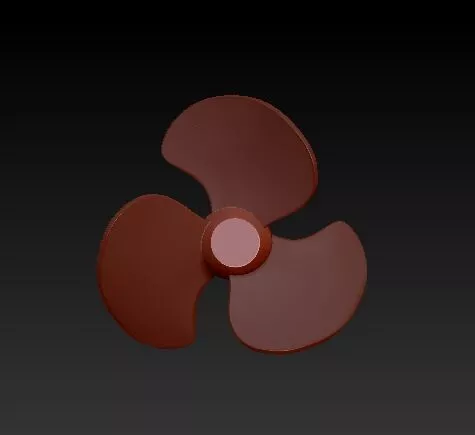
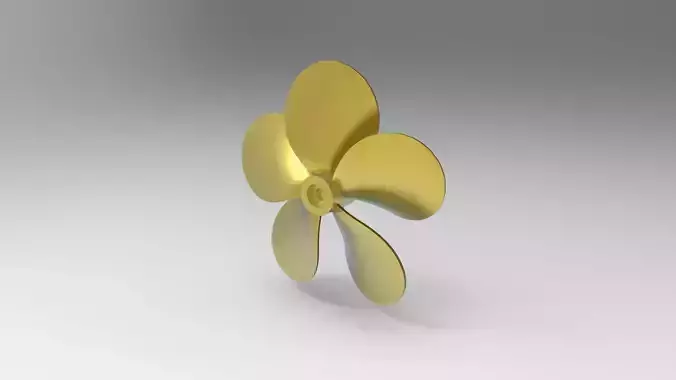
A propeller is a device with a central hub and radiating blades placed so that each forms part of a helical (spiral) surface. By its rotation in water or air, a propeller produces thrust owing to aerodynamic or fluid forces acting upon the blades and gives forward motion to a ship or aircraft. In Great Britain the propeller of an airplane or the rotor of a helicopter is commonly called an air screw. A propeller’s thrust is proportional to the product of the mass of water or air that it is acting on and the accelerating rate. For the most efficient propulsion, the mass should be large and the acceleration small. Thrust by a ship propulsion device acting on the water (or on the air) is produced by imparting sternward acceleration to a mass of that water or air. The forward thrust is proportional to the product of the mass of fluid acted upon and the accelerating rate. For the most efficient propulsion, the mass should be large and the acceleration small. In a screw propeller, this calls for a large diameter and a small increase in relative backward velocity when water is passing through the propeller. The thrust per blade of a propulsion device is measured by the reduction in pressure on the back or advancing side of the blade and the increase in pressure on the face or after side. As a rule, the former is much larger than the latter so that the blade draws or pulls rather than pushes itself through the fluid in which it works. Modern propulsion methods for boats and ships include oars, sails, paddle tracks, paddle wheels, hydraulic and pump jets, airscrews, rotating-blade propellers, and screw propellers. Screws are usually run in the open, but for producing high thrusts at low ship speeds, as when towing, they may be surrounded by a fixed shrouding such as the Kort nozzle. Vertical axis propellers with adjustable blades offer the great advantage that the magnitude and direction of thrust can be varied at will, making them vastly more versatile than any known combination of screw propeller and rudder, and giving the craft exceptional maneuverability. A tug fitted with one or more such propellers can exert a pull equally well in any direction. The number of propulsion devices depends upon the available power in each engine, the need for reliability or maneuverability, the limiting draft and many other factors.This ship propeller model is made in zbrush and it is used for only 3d printing.