Luck doesn’t have to whisper.Sometimes it shines.
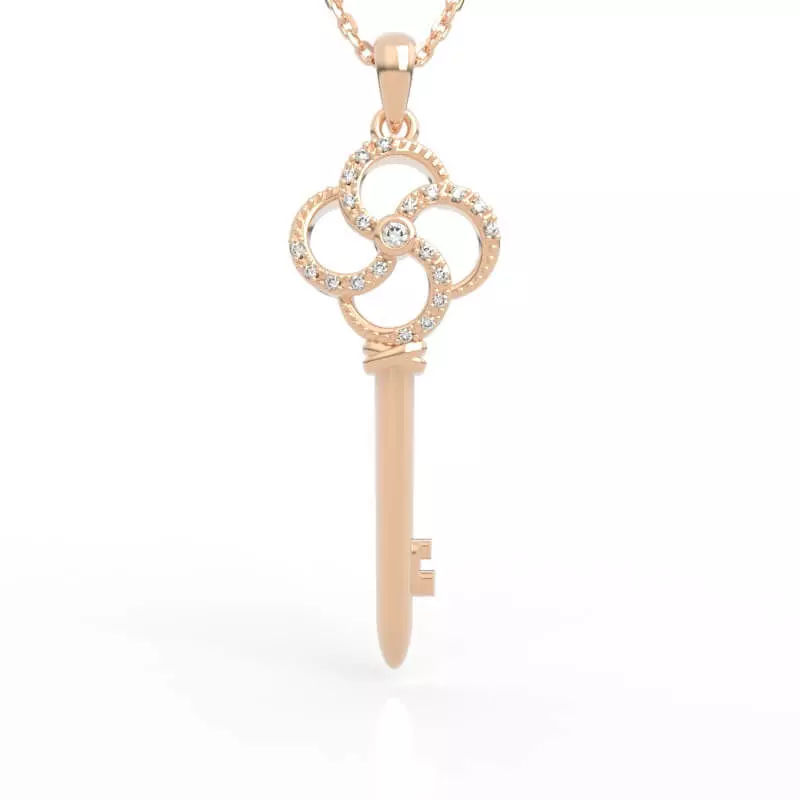
The Clover Key Pendant Diamond brings together the iconic four-leaf clover motif and a refined key silhouette, translating luxury fashion cues into a production-ready jewelry CAD model. The rotating pinwheel clover head is pavé-set along each petal, with a brighter center stone that anchors the design. The result is a pendant that reads instantly as “lucky,” yet feels distinctly modern on the bench.
Designed for jewelry manufacturers and professional designers, this model delivers showroom presence without showroom headaches—clean geometry, controlled wall thickness, and setting-ready tolerances.
Dimensions & ProportionsTotal length: 40.79mm
Key head width: 13.51mm
Key head thickness: 4.48mm
Overall form: Four-leaf pinwheel clover + elongated key shaft
Key head geometry: Four rounded petals in a rotating pinwheel layout
Balanced proportions create visual movement while keeping metal weight practical for casting.
Structural DetailsFour-Leaf Pinwheel Head:
Four rounded petals rotated at 45°
Pavé diamonds tracing each petal edge
Open negative space between petals for lightness
Dynamic, rotating visual rhythm
Center Accent:
One 1.8mm round diamond (≈ 0.02 CT) set at the heart of the clover
Pavé Halo Effect:
20 × 1.0mm round diamonds (≈ 0.005 CT each) outlining the petals
Continuous sparkle line with tight pavé spacing
Key Shaft:
Upper: smooth cylindrical profile
Middle: decorative raised band
Lower: tapered transition for elegant flow
Side engraving detail for premium finish
Key Teeth:
Double-step traditional key teeth for classic character
Diamond SpecificationsTotal diamonds: 21 round brilliant-cut diamonds
Stone sizes & weights (approx.):
20 × 1.0mm ≈ 0.005 CT each
1 × 1.8mm ≈ 0.02 CT (center stone)
Total carat weight: 0.102 CT
Setting: Pavé setting
Distribution:
20 stones along petal edges
1 center stone as focal point
The layout ensures strong visual sparkle while remaining efficient for stone setting.
Included 3D Files3DM
STL
Optimized for casting, stone setting, and rapid prototyping workflows.