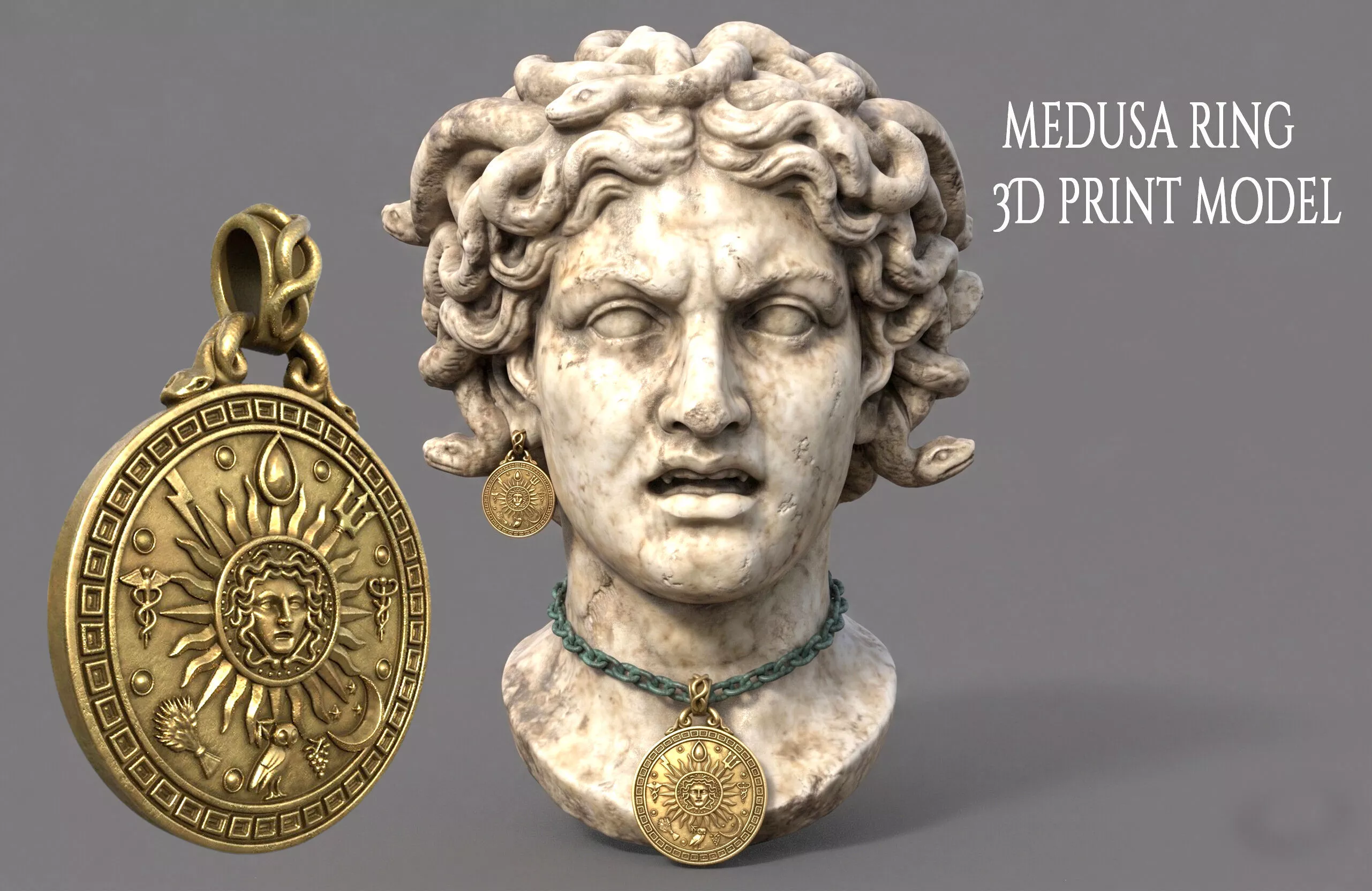
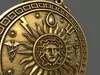
In Greek mythology, Medusa (/mɪˈdjuːzə, -sə/; Ancient Greek: Μέδουσα, romanized: Médousa, lit. 'guardian, protectress'),[a] also called Gorgo (Ancient Greek: Γοργώ)[b] or the Gorgon, was one of the three Gorgons. Medusa is generally described as a woman with living snakes in place of hair; her appearance was so hideous that anyone who looked upon her was turned to stone.[4] Medusa and her Gorgon sisters Euryale and Stheno were usually described as daughters of Phorcys and Ceto; of the three, only Medusa was mortal.
Medusa was beheaded by the Greek hero Perseus, who then used her head, which retained its ability to turn onlookers to stone, as a weapon[5] until he gave it to the goddess Athena to place on her shield. In classical antiquity, the image of the head of Medusa appeared in the evil-averting device known as the Gorgoneion.
According to Hesiod and Aeschylus, she lived and died on Sarpedon, somewhere near Cisthene. The 2nd-century BC writer Dionysius Scytobrachion instead placed the Gorgons in modern-day Libya. Herodotus also associated the Gorgons with Libya, reporting traditions that located them there.
Mythology
An archaic Medusa, wearing the belt of the intertwined snakes, a fertility symbol, as depicted in an altar from Gela. She embraces her children, the winged horse Pegasus and the giant Chrysaor.
Coins of the reign of Seleucus I Nicator of Syria (312–280 BC)The three Gorgons—Medusa, Stheno, and Euryale—were described by Hesiod and Apollodorus as offspring of the sea-god Phorcys and his sister Ceto;[6] according to Hyginus, however, their parents were Gorgon and Ceto.[7] Their genealogy is shared with other sisters, the Graeae, as in Aeschylus's Prometheus Bound, which places both trios of sisters far off on Kisthene's dreadful plain:
Near them their sisters three, the Gorgons, wingedWith snakes for hair—hatred of mortal man[8]
In most versions of the story, Medusa was beheaded by the hero Perseus, who was sent to fetch her head by King Polydectes of Seriphus because Polydectes wanted to marry Perseus's mother. The gods were well aware of this, and Perseus received help. He received a mirrored shield from Athena, sandals with gold wings from Hermes, a sword from Hephaestus and Hades's helm of invisibility. Since Medusa was the only one of the three Gorgons who was mortal, Perseus was able to slay her; he did so while looking at the reflection from the mirrored shield he received from Athena. During that time, Medusa was pregnant by Poseidon. When Perseus beheaded her, Pegasus, a winged horse, and Chrysaor, a giant wielding a golden sword, sprang from her body.[9]
Jane Ellen Harrison argues that her potency only begins when her head is severed, and that potency resides in the head; she is in a word a mask with a body later appended... the basis of the Gorgoneion is a cultus object, a ritual mask misunderstood.[10] In the Odyssey xi, Homer does not specifically mention the Gorgon Medusa:
Lest for my daring Persephone the dread,From Hades should send up an awful monster's grisly head.
Harrison's translation states that the Gorgon was made out of the terror, not the terror out of the Gorgon.[10]
According to Ovid, in northwest Africa, Perseus flew past the Titan Atlas, who stood holding the sky aloft, and transformed Atlas into a stone when Atlas tried to attack him.[11] In a similar manner, the corals of the Red Sea were said to have been formed of Medusa's blood spilled onto seaweed when Perseus laid down the petrifying head beside the shore during his short stay in Ethiopia where he saved and wed the princess Andromeda, the most beautiful woman at that time. Furthermore, the venomous vipers of the Sahara, in the Argonautica 4.1515, Ovid's Metamorphoses 4.770 and Lucan's Pharsalia 9.820, were said to have grown from spilt drops of her blood. The blood of Medusa also spawned the Amphisbaena (a horned dragon-like creature with a snake-headed tail).
Perseus then flew to Seriphos, where his mother was being forced into marriage with the king, Polydectes, who was turned into stone by the head. Then Perseus gave the Gorgon's head to Athena, who placed it on her shield, the Aegis.[12]
While ancient Greek vase-painters and relief carvers imagined Medusa and her sisters as having monstrous form, sculptors and vase-painters of the fifth century BC began to envisage her as being beautiful as well as terrifying. In an ode written in 490 BC, Pindar already speaks of fair-cheeked Medusa.[13]
In a late version of the Medusa myth, by the Roman poet Ovid, Medusa was originally a beautiful maiden, but when Neptune (the Roman equivalent of the Greek Poseidon) mated with her in the temple of Minerva (the Roman equivalent of the Greek Athena), the goddess punished Medusa by transforming her beautiful hair into horrible snakes.[14] Although no earlier versions mention this, ancient depictions of Medusa as a beautiful maiden instead of a horrid monster predate Ovid. In classical Greek art, the depiction of Medusa shifted from hideous beast to an attractive young woman, both aggressor and victim, a tragic figure in her death.[15] The earliest of those depictions comes courtesy of Polygnotus, who drew Medusa as a comely woman sleeping peacefully as Perseus beheads her.[15][16] As the act of killing a beautiful maiden in her sleep is rather unheroic, it is not clear whether those vases are meant to elicit sympathy for Medusa's fate, or to mock the traditional hero.[17]
Some classical references refer to three Gorgons; Harrison considered that the tripling of Medusa into a trio of sisters was a secondary feature in the myth:
The triple form is not primitive, it is merely an instance of a general tendency... which makes of each woman goddess a trinity, which has given us the Horae, the Charites, the Semnai, and a host of other triple groups. It is immediately obvious that the Gorgons are not really three but one + two. The two unslain sisters are mere appendages due to custom; the real Gorgon is Medusa