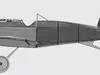
The Junkers D.I was designed as a single seat, all-metal low-wing fighter plane. The metal airframe of steel ribs covered with corrugated duralumin sheets. The corrugated surface of the duralumin offered increased strength, rigidity, and projectile resistance without a significant weight penalty. It is noteworthy for the fact that it was the first all-metal fighter to enter service. The wings were thick in section, comparted to the more standard thin curved wings, with sharply cut tips and aileron' which extended behind the line of the trailing-edge. The fuselage was square in section. The tail and balanced rudder had square edges, and the whole appearance of the aircraft was strong but crude. Nicknamed the 'Blechesel' (Tin Donkey), the D-1 was regarded with suspicion by the authorities and pilots. Goering, for example is known to have disparaged the design for not being a bi-plane.After the initial development in 1915 of the Junkers J-1, the J.2. was constructed; a single-seater fighter monoplane with remarkably modern lines. A deep under slung radiator was provided for its 160 h.p. Mercedes engine and a crash pylon was fixed behind the cockpit to protect the pilot in the event of the plane turning over. A single Spandau gun was synchronized to fire through the revolving airscrew. The next models were basically two seater ground attack aircraft until 1917. The next Junkers fighter design was the J7, another all-metal monoplane, which made its appearance in October 1917. In its early form, the nose installation of its 160 h.p. Mercedes engine was fairly well streamlined and the airscrew had a small spinner. A clumsy exhaust pipe stretched down the starboard side of the fuselage. Almost as an afterthought, a radiator was fixed inconveniently above the cylinders. Wing construction consisted of ribbed aluminium, braced internally by seven parallel tubular metal spars interconnected to form girders. Oddly shaped unequal-chord ailerons replaced the original rotating wingtips. The fuselage was covered with horizontally corrugated metal strips. Both elevators and rudder were balanced. A high head-rest behind the cockpit acted as a crash pylon. A second J7 had a neat under slung radiator, modified undercarriage and a blunt nose without a spinner; the headrest was reduced to skeleton form. A third version, equipped with a car-type radiator, was an excellent aeroplane and would have performed with success at the Adlershof fighter competition in January 1918. Unfortunately, only four weeks before the contest it sustained damage, when flown by Fokker himself. A further development, the J9 (military designation D-I), was brought out in March 1918. It was flown with both the 150 h.p. Mercedes and 185 h.p. BMW engines. and carried twin Spandau guns. The D-1 was speedy and manoeuvrable but was more difficult to build than the standard Fokker D-VII, which was already in production. Only forty-one examples reached the front; these were issued in ones and twos.General characteristics• Crew: One pilot• Length: 7.25 m (23 ft 9.4 in)• Wingspan: 9.00 m (29 ft 6.3 in)• Height: 2.60 m (8 ft 6 in)• Empty weight: 654 kg (1,438 lb)• Gross weight: 834 kg (1,834 lb)• Powerplant: 1 × BMW IIIa water-cooled 6-cylinder inline, 138 kW (185 hp)Performance• Maximum speed: 176 km/h (109 mph)
• Endurance: 1.5 hours• Service ceiling: 6,000 m (19,700 ft)• Rate of climb: 3.5 m/s (683 ft/min)
Armament2 × fixed, forward firing Spandau machine guns
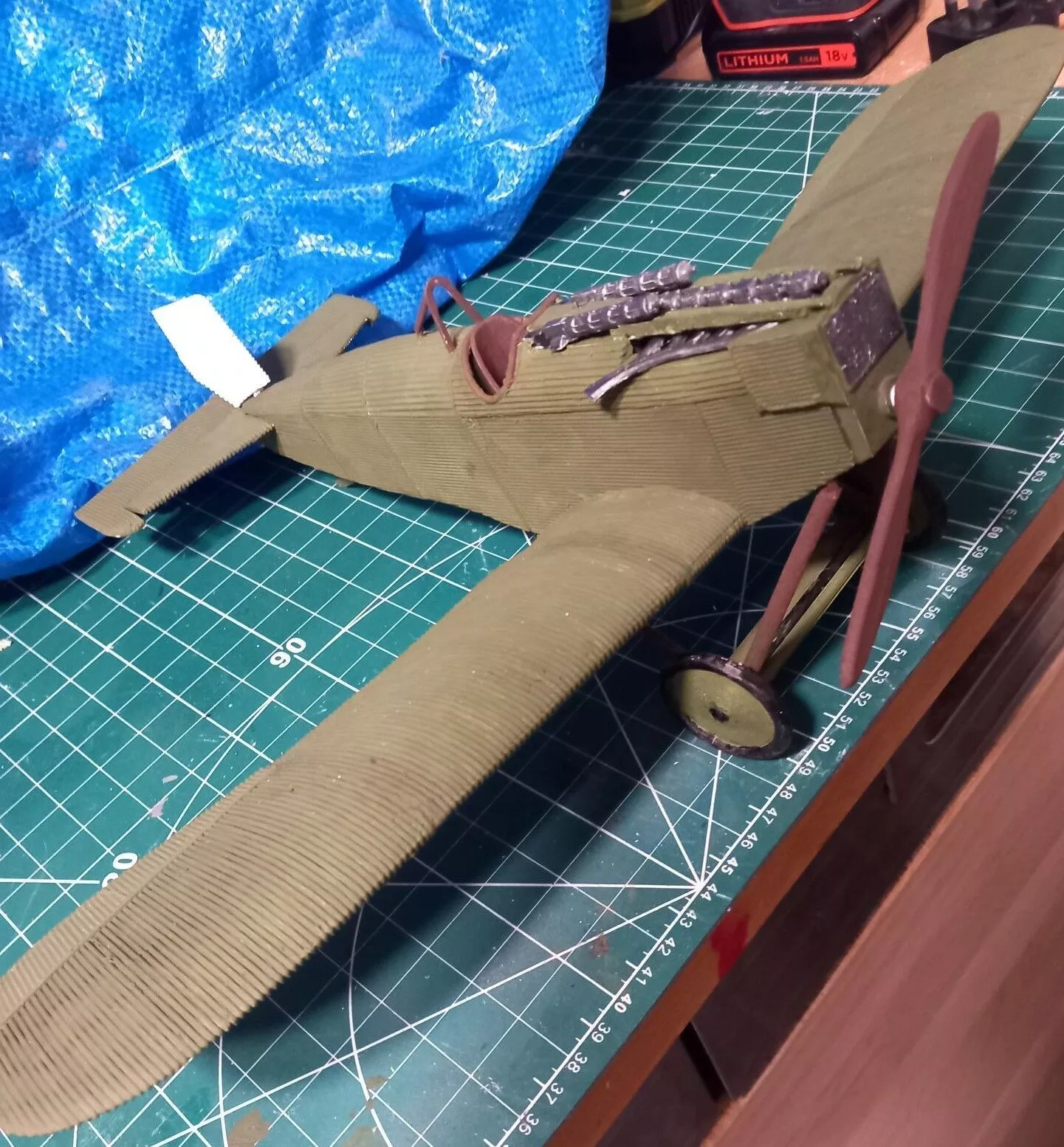
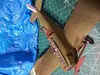
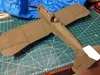
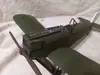
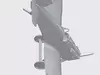
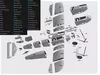
JUNKERS D1 MODELIntroductionThe model is approximately 1:18 scale. It is by no means an exact replica of the plane, due to a combination of lack of detailed plans and the problem of simulating the corrugated finish on the covering material. However, it ends up with a model that gives a good idea of how the aeroplane looked. Overall, it takes a long time of printing to construct the complete model, but I have added a couple of versions of the fuselage to enable different printing and construction times. The fuselage and wings were printed with low or standard quality prints, mainly because it gave the material a much more realistic finish. Other parts, engine, exhaust guns etc were printed with a higher quality finish.Print materialI used generic PLA for all parts.General ConstructionThe parts and construction can be seen in the exploded diagram. The following are points to note:• I used low-cost super glue successfully for the assembly• The joiners are not exact but help with the location and assembly of the model. In fact, I found that I could pretty much assemble without the joiners. The joiner holes may need boring out a small amount to give an easier fit.• The Elevator and ailerons are mounted by cutting strips of thin card and gluing them into the slots in the adjoining sections.• The pilot seat needs to be installed before gluing in place the top section F5.• The tailfin I had difficulty in printing as a full unit so I have included a split version if preferred.• The rear section of the fuselage can be printed in either 3 sections or a single section. The multiple sections are easier to print but the single section makes a better finish.• The front section of the fuselage is shown in 3 alternative ways, 3 sections and fitted together, two sections, with the top cockpit as a separate section or as one complete section. If the complete section is used the pilot seat is difficult to install. A full parts list and exploded assembly diagram are included in the zip file.