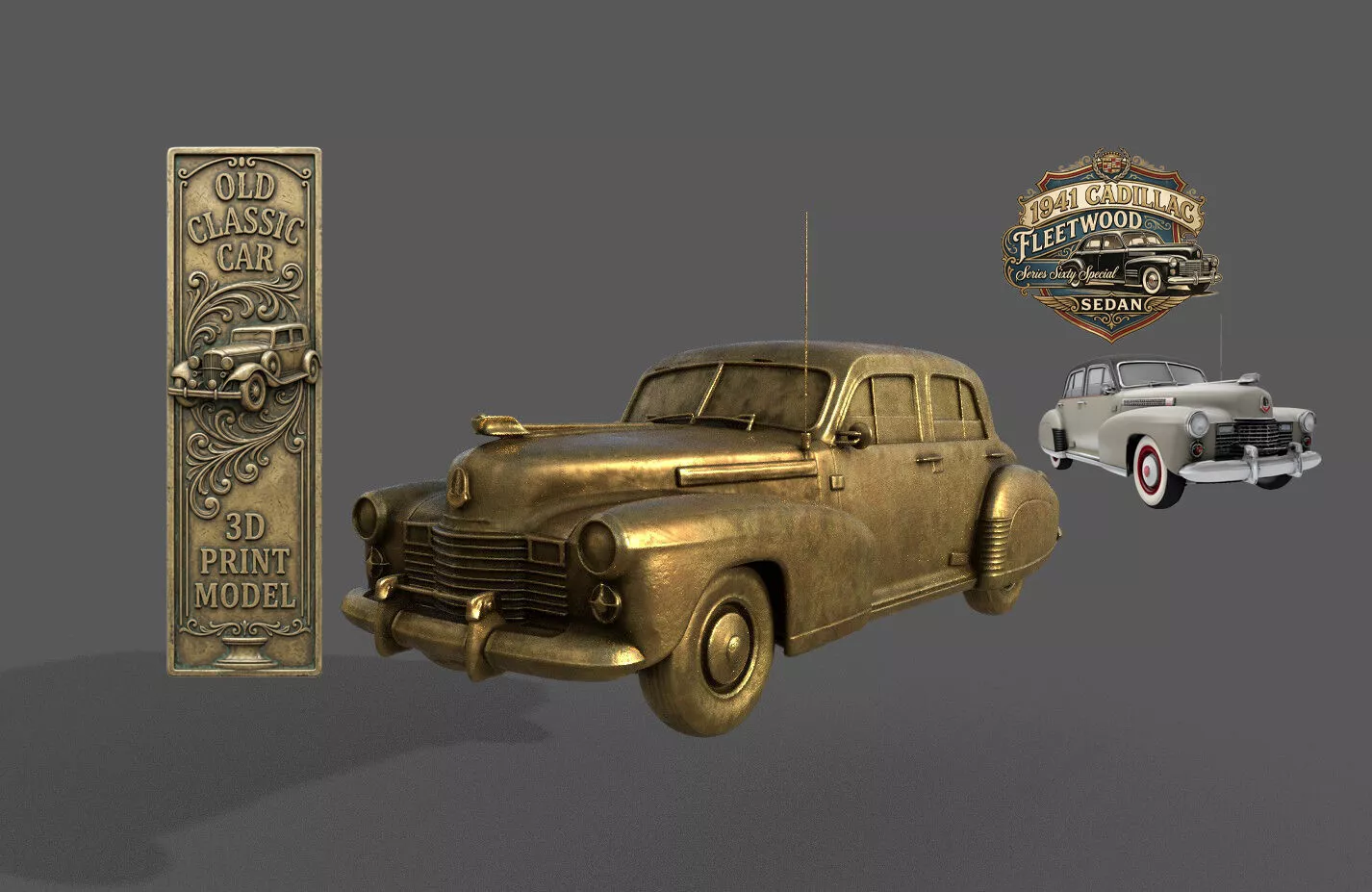
1941 Cadillac Sixty Special SedanIntroduced in 1938, the Cadillac Sixty Special was Bill Mitchell’s first project as head of Cadillac and LaSalle styling, and became one of the most influential designs ever to come from Detroit. Built on a double-drop frame, it sat three inches lower to the ground than other Cadillacs and was even low enough that it could do away with running boards. Its distinctive notchback roofline and skirted rear fenders visually distinguished it from other sedans as well. Originally slated to be a LaSalle sport sedan, the car was deemed too expensive and that a Cadillac badge would be more appropriate. The Sixty Special’s success as a design was immediately apparent in the numbers. In its first year, the Sixty Special outsold every other Cadillac line, including the less expensive Series 60. Beginning in 1940, the Sixty Special was Fleetwood marketed, received higher quality and more expensive trim, and replaced the Series 70 at the top of the range of Cadillac’s owner-driven models.
This 1941 Cadillac Sixty Special is from the last year for the first series of cars designed by Harley Earl and Bill Mitchell and built at the Fleetwood plant. Now with front fenders extending into the front pair of its four doors, its cool, elegant design represented the pinnacle of Cadillac refinement. Finished in dark blue, it has a correct grey striped cloth interior, whitewall tires, full hub caps, rear fender skirts and a four-speed Hydra-Matic transmission coupled to Cadillac’s 150 horsepower 346 cubic inch V-8. Interior appointments include a beautiful woodgrain dash and door trim, dash clock, radio, heater and a robe rail on the back of the front seat. The paint, chrome and interior all present very well as expected from a Classic Car Club of America National First Prize winner. Finely presented, this very pretty Sixty Special with past concours credentials would be ideal for tours or other long, casual drives. In addition to its fine condition, Cadillac's blend of reliability, comfort and power complement the influential design of this 1941 Sixty Special.For more information on finding and acquiring a Cadillac Sixty Special, or on our car consignment program, contact us today.
A classic car may describe an automobile 25 years or older, but this can vary depending on the jurisdiction for registration purposes or insurance company requirements. A car's age is not the only requirement before being considered a classic. Other factors that can influence this classification include the vehicle's historical significance, rarity, and condition.
A standard criterion for recognizing cars as classics does not exist, as different countries use their own rules and regulations for classifying vehicles. A common theme is that an older car of historical interest becomes collectible and tends to be restored rather than scrapped. Therefore, one person's old car may be another's classic. Any car can be considered classic if it has dedicated owners who support it as such.
Organizations such as the Classic Car Club of America (CCCA) maintain lists of eligible unmodified cars called classics. These are defined as fine or distinctive automobiles, either American or foreign-built, produced between 1915 and 1948. However, post-World War II classic cars are not precisely defined. The Antique Automobile Club of America (AACA) has a less restrictive definition, with a rolling forward definition of cars 25 years and older as antiques.
Recognition of classic statusAustraliaAustralia has two main classic car registration categories: the Historic Vehicles Scheme (HVS) and the Classic Vehicle Scheme (CVS). The latter requires for vehicles over the age of 25 (or 30), yet feature modifications out of the age-range, to be considered ‘Historic.’ Under these categories, owners are not required to pay the usual registration fee. However, the use of the vehicle registered under the scheme is restricted to a set limit per registration term.
For example, most classic Ford Falcons, Chrysler Valiants and Holdens (alongside Toranas, and Commodores) are on either of the registers. However, it is not uncommon for these cars to end up with full registrations.
United States
Classic cars in an American car museumCars produced in 1915 and older typically fall into the antique class, but the classic term is often applied loosely by owners to any car over 20 years old.[3] There is some variation regarding the exact identification of a classic car. Division by separate eras includes horseless carriages (19th-century experimental automobiles such as the Daimler Motor Carriage), antique cars (brass era cars which are defined by the Horseless Carriage Club of America (HCCA) as any pioneer gas, steam or electric motor vehicle built or manufactured before 1 January 1916.[4]), and classic cars (typically 1930s cars such as the Cord 812). Some also include muscle cars, with the 1974 model year as the cutoff.
Classic Car Club of America
A 1932 Nash Advanced Eight, considered a full classic car[7]Sometimes the requirements for a car to be considered a classic are determined within a specific organization; they don't even have to be consistent across organizations within the same nation.
The Classic Car Club of America describes a CCCA Classic as a fine or distinctive automobile, either American or foreign, produced between 1915 and 1948. Specifically, the CCCA term antique car has been confined to the functionally traditional designs of the earlier period (mostly pre-war). They tended to have removable fenders, trunk, headlights, and a usual vertical grill treatment. In a large vehicle, such as a Duesenberg, Pierce-Arrow, or in a more diminutive form, the MG TC, with traditional lines, might typify the CCCA term. The CCCA maintains this definition of classic car and uses terms such as CCCA Classic or the trademarked Full Classic.[8]
The CCCA is dedicated to preserving and enjoying select cars that are distinguished by their respective fine design, high engineering standards, and superior workmanship.[9] Other differentiating factors - including engine displacement, custom coachwork, and luxury accessories such as power brakes, power clutch, and one-shot or automatic lubrication systems - help determine whether a car is considered a CCCA Classic.[10] The vehicles on their list represent the pinnacle of engineering, styling and design for their era.[11] The CCCA has estimated that 1,366,843 American Classics were built.[12]
Any CCCA member may petition for a vehicle to join the list.[13] Such applications are carefully scrutinized, but rarely is a new vehicle type admitted.[14] Moreover, no commercial vehicles such as hearses, ambulances, or race cars can be accepted as a Full Classic.[13]
Antique Automobile Club of America
The Antique Automobile Club of America (AACA) recognizes motorized vehicles 25 years old or older, built in factories and specifically designed and manufactured for transportation use on public roadways and highways.[15] The AACA evaluates such vehicles that are historical or that have been restored to the same state as the dealer could have prepared the vehicle for delivery to the customer. Specified AACA classic vehicles include fine or unusual domestic or foreign automobiles primarily built between and including the years 1925 and 1942.[16]
United KingdomThe United Kingdom has no fixed definition of a classic car. However, there are two taxation issues that lead to people using them as cutoff dates. All cars built over 40 years ago are exempt from paying the annual road tax. Also, such cars are exempt from the yearly UK safety test known as the MOT test, on condition that no substantial changes have been made to the vehicle concerned;[17] however, the car can still be presented for testing voluntarily. This is known as Historic vehicle tax exemption.[18] HM Revenue and Customs define a classic car for company taxation purposes as being over 15 years old and having a value over £15,000.[19]
Additionally, widespread acclaim through car magazines can determine whether a particular vehicle is considered a classic. Still, the definition remains subjective and a matter of opinion.
GermanyIn Germany, vehicles registered at least 30 years ago can apply for a special Oldtimer license plate with a €190/year flat tax. The cars are required to be in mostly original condition and a preservation-worthy appearance (grade C by popular car grading standards). At the same time, separate mandatory safety inspections establish the car's roadworthiness. Modifications that enhance safety (seatbelts, disc brakes) and environmental friendliness (catalytic converter, LPG conversion if invisible from the outside) are universally accepted. Other modifications are generally accepted as long as they are contemporary with the car's first registration (within 10 years before and after). The owner must provide historical proof, such as photographs, for verification. New paint jobs of any color are also accepted, including two-tone paint (if it was initially offered) and historic company logos—but no murals or custom patterns.