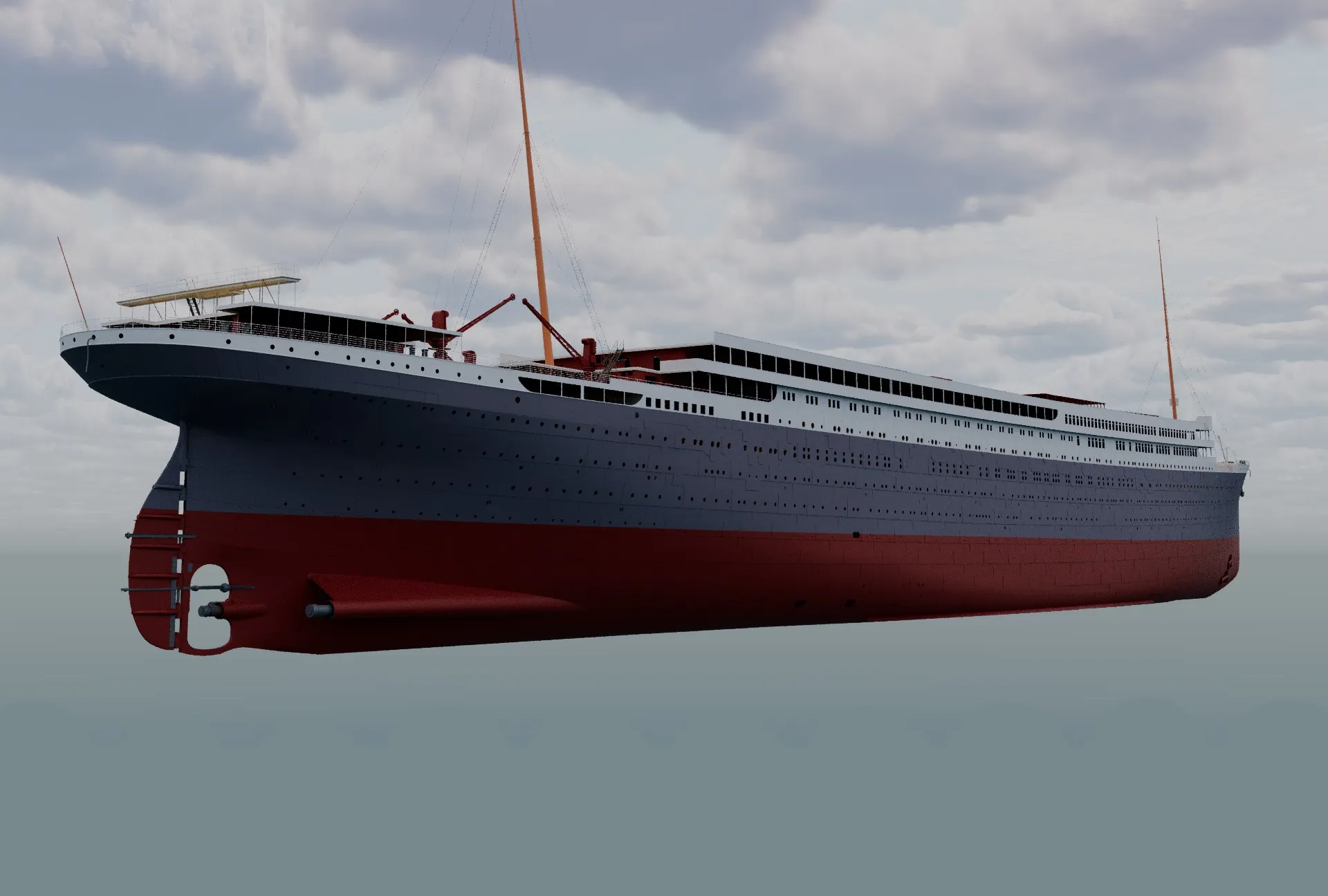
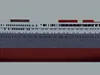
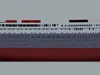
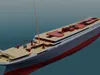
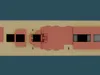
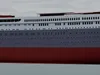
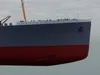
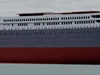
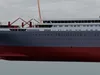
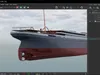
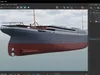
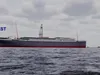
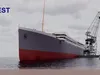
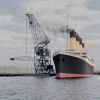
T.S.S Britannic February 1914 profile
by late May 1911, the largest ocean liner Olympic was complete and handed over to her owner the White Star Line, the same time, the second ship of the class T.S.S Titanic was launched, one of the most ambitious projects in ship-owning and shipbuilding history, few weeks afterwards; a third similar ship was ordered yard 433.
by early March 1912, the Olympic returned to Belfast due to a lost propeller blade, where she was side by side with her younger sister and soon the largest liner the Titanic, at the same time; the giant Britannic was under construction in the same slip occupied by the Olympic.
on 15 April 1912, the Titanic was lost after hitting an iceberg, taking with her nearly 1500 souls, in one of the lost catastrophic peacetime maritime disasters. changes to the Olympic and Britannic were undertaken later, especially in term of safety, the Britannic, visually similar to her sister-ships, however much different.
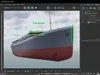
this 3D model of the Britannic was mae simultaneously with a nearly identical one of her as complete (H.M.H.S Britannic), differences were taken into account such as portholes, windows.
as the previous digital models of the Olympic and Titanic, this model is no exception; it is meant to be a digital waterline model as mostly it required the model draft no less than 14 ft.
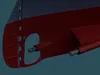
Britannic's breadth is slightly wider than her older sisters; however due to some limitations; this model shares the same dimensions of the other two, well deck, stern post area and, in addition to some bottom platings (see previews) are partially complete.
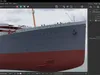
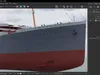
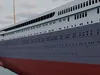
this model from keel up to C deck, is an altered digital Titanic model (as they share many similarities and assisted in saving the limied time for modeling), these points might be disappointing for some, this is why it is important to evaluate and to consider if this model as it is in its current state is useful for your project and your vision, it is optimal for exterior side illustrations as shown in the previews.
All parts were created in AutoCAD for much flexibility and precision, as the line of the hull and decks are all curved (longitudinal and transverse curvature the camber and the sheer line), by late stage of modeling; were imported in 3dsmax (linked AutoCAD) for tests, quick previews and continuous corrections, for this present model, at the final stage, these were directly re-imported and refined for a better visual results. (units are in inches)
No texture have been used in this model (especially ship's name and port of registry, these parts are each in a separate layer for UVW unwrap modifier), the shading materials values are approximate and can be changed depending on one's subjective preferences or objectivly by narrowing the shades.
Some objects which are removable, each are in their own layer, which can be hidden if not necessary such as removable sections of handrails, flag pole, masts, wash ports,...etc
rivets are put in a separate file, which can be imported directly if necessary for close-up views, they share the same origin, so no problem when importing the file.
for distant view, generally you may not need to import rivets, as it would result in a relatively heavy scene. consider that the rivets only consist of:
9,747,360 polys5,036,136 vertices
recommendation; in case you use 3dsmax; create a new file; go to create_helpers_ dummy (0,0,0), add the ship model as xref scene and link it to the dummy, you can slightly tilt to simulate the lower draft aft, rotate, move the model for direct usage
FBX files are recommended to be imported directly, not as linked FBX.
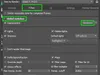
another important note, this particular model as the other two consists of few thousands elements, all visible parts are created, grouped into layers, which can be altered. in 3dsmax; you can select a specific layer where the object is included, and in the modify panel, you can select by elements to remove an element or so such as overlaps, windows/portholes glass or minor details depending on your preference (some elements were found to be duplicate, this is corrected however there might be some missed).
The models with all objects visible consists of :
11,707,030 polys
6,538,822 vertices
The rendering process, vray was no problem as only standard materials are used with no textures or displacement maps, in addition , Vray is optimal for complex heavy scene. in Corona render, it is optimal (subjectively), which used for most renderings of still images.
the PCs used for rendering the models are Lenovo ThinkPad laptop with an Intel Core i5 processor and 8 GB of RAMthe second PC is HP Pavilion 15 notebook, intel i5 and a RAM of 6 GB, obviously too slow for conducting simulation, this note might be helpful for some, as for our project; only still images rendering are required anytime and anywhere without further complications or expectations, for high-performance desktop PCs with this raw 3D model, no limits for one's vision and creativity.
In general; this 3D model is ideal for exterior side view illustration of the ship