High-quality 3D assets at affordable prices — trusted by designers, engineers, and creators worldwide. Made with care to be versatile, accessible, and ready for your pipeline.
Included File Formats
This model is provided in 14 widely supported formats, ensuring maximum compatibility:
• - FBX (.fbx) – Standard format for most 3D software and pipelines
• - OBJ + MTL (.obj, .mtl) – Wavefront format, widely used and compatible
• - STL (.stl) – Exported mesh geometry; may be suitable for 3D printing with adjustments
• - STEP (.step, .stp) – CAD format using NURBS surfaces
• - IGES (.iges, .igs) – Common format for CAD/CAM and engineering workflows (NURBS)
• - SAT (.sat) – ACIS solid model format (NURBS)
• - DAE (.dae) – Collada format for 3D applications and animations
• - glTF (.glb) – Modern, lightweight format for web, AR, and real-time engines
• - 3DS (.3ds) – Legacy format with broad software support
• - 3ds Max (.max) – Provided for 3ds Max users
• - Blender (.blend) – Provided for Blender users
• - SketchUp (.skp) – Compatible with all SketchUp versions
• - AutoCAD (.dwg) – Suitable for technical and architectural workflows
• - Rhino (.3dm) – Provided for Rhino users
Model Info
• - All files are checked and tested for integrity and correct content
• - Geometry uses real-world scale; model resolution varies depending on the product (high or low poly)
• • - Scene setup and mesh structure may vary depending on model complexity
• - Rendered using Luxion KeyShot
• - Affordable price with professional detailing
Buy with confidence. Quality and compatibility guaranteed.
If you have any questions about the file formats, feel free to send us a message — we're happy to assist you!
Sincerely,
SURF3D
Trusted source for professional and affordable 3D models.
More Information About 3D Model :
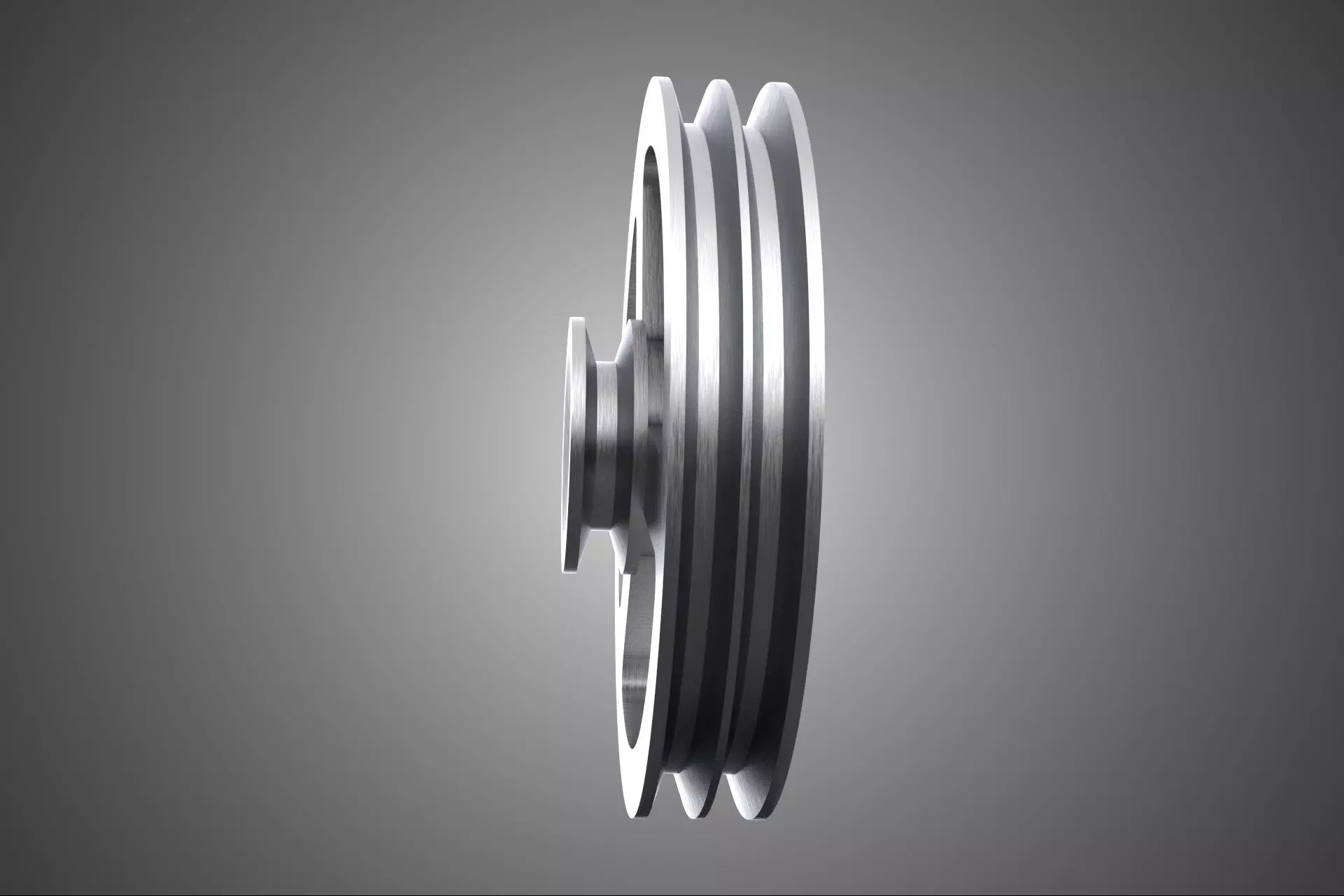
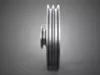
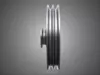
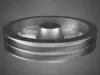
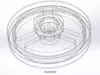
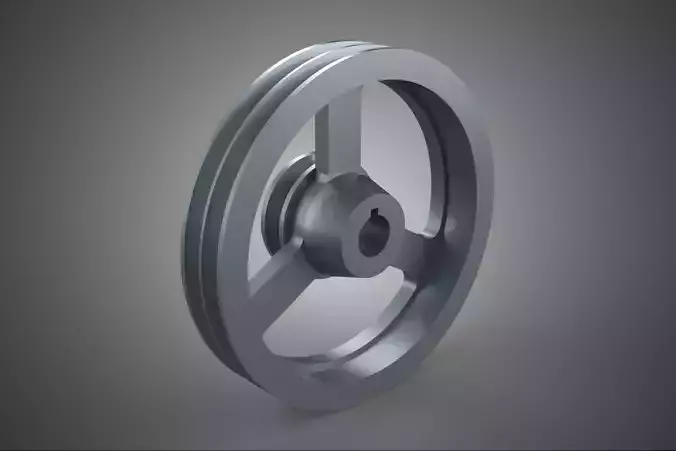
The component identified as a 2 Step Stepped Pulley Channel Groove Sheave V Belt Tractor Wheel is a highly specialized mechanical device designed for efficient and switchable power transmission within heavy-duty contexts, most notably agricultural machinery and tractors. It functions as a rigid transmission element, facilitating the transfer of rotational energy and torque between parallel axes via a flexible V-belt.
Nomenclature and Design
Stepped Pulley (Sheave): The fundamental design is characterized by a stepped profile, where the component integrates two distinct functional diameters, or steps, onto a singular shaft-mounted body. This feature is crucial for achieving mechanical advantages and defining fixed, discrete velocity ratios (speed reductions or increases) relative to the driving pulley. By physically shifting the V-belt from the larger diameter groove to the smaller diameter groove, or vice versa, the output speed of the driven component is immediately altered without changing the motor’s rotational speed (RPM).
Channel Groove (V-Belt Profile): The description specifies a Channel Groove Sheave, indicating the presence of a precisely machined V-shaped cross-section. This profile is engineered specifically to accommodate a V-belt, ensuring optimal mechanical coupling. When the belt operates under tension, the trapezoidal shape of the belt wedges into the corresponding V-channel. This wedging action increases the effective contact pressure and frictional force between the belt and the sheave walls far beyond what a flat pulley could achieve, thereby minimizing slippage and enabling high-torque transmission, which is essential in demanding tractor applications.
2 Step Configuration: The 2 Step designation denotes the fixed availability of only two operational speed settings (high ratio/low speed, or low ratio/high speed). This design simplifies speed management compared to continuous variable speed drives or pulleys utilizing three or more steps, offering robust reliability and ease of use in fixed-accessory drives.
Material and Manufacturing
Given its intended use in tractors, the sheave must endure significant shock loading, vibration, dust, moisture, and temperature fluctuations. Consequently, these components are typically constructed from high-strength materials. Common fabrication methods utilize precision casting of grey or ductile iron (for excellent wear resistance and inertia) or, alternatively, machining from hardened steel or high-strength aluminum alloys where weight reduction or superior dynamic balancing is necessary. The groove surface is often meticulously machined or ground to ensure dimensional accuracy and a smooth finish, prolonging the lifespan of the V-belt.
Application Context: Tractor Wheel/Accessory Drive
The inclusion of Tractor Wheel in the description refers not to the primary traction wheel, but rather the component's application within the tractor’s auxiliary systems. These sheaves are critical for transmitting power from the engine’s crankshaft or an accessory shaft to vital components such as:
- Cooling Systems: Driving the water pump or engine cooling fan.
- Hydraulic Systems: Powering hydraulic pumps used for steering, braking, or implement operation.
- Electrical Generation: Operating the alternator or generator.
- Specialized Drives: Used in small, intermittent applications, or certain internal mechanisms like continuously variable transmissions (CVTs) or specific PTO (Power Take-Off) accessories requiring dual-speed options.
In this context, the sheave operates analogously to a small, robust wheel designed for power transfer, hence the descriptive inclusion.
### Operational Principle
The component’s primary function is achieved through the fundamental principle of rotational speed alteration based on pulley diameter ratio ($N_1/N_2 = D_2/D_1$). The operator selects the desired speed (low or high) by placing the V-belt into the appropriate groove diameter ($D_A$ or $D_B$). Because the input speed ($N_{input}$) remains constant, the output speed ($N_{output}$) changes proportionally, providing optimized rotational speed for the driven apparatus depending on the operational requirements (e.g., using the larger diameter for high-torque, slow-speed needs, or the smaller diameter for high-speed, low-torque needs).
KEYWORDS: Stepped Pulley, Sheave, V-Belt Drive, Power Transmission, 2 Step, Channel Groove, Variable Speed, Tractor Component, Auxiliary Drive, Agricultural Machinery, Velocity Ratio, Torque Transmission, Drive Component, Cast Iron, Mechanical Advantage, Fixed Ratio, Dual Diameter, High Durability, Sheave Wheel, Engine Accessory, Kinematics, Belt Tension, Trapezoidal Groove, PTO, Hydraulic Pump Drive, Rotational Speed, Machinery Part, Stepped Cone Pulley, Slip Minimization, Industrial Pulley.