High-quality 3D assets at affordable prices — trusted by designers, engineers, and creators worldwide. Made with care to be versatile, accessible, and ready for your pipeline.
Included File Formats
This model is provided in 14 widely supported formats, ensuring maximum compatibility:
• - FBX (.fbx) – Standard format for most 3D software and pipelines
• - OBJ + MTL (.obj, .mtl) – Wavefront format, widely used and compatible
• - STL (.stl) – Exported mesh geometry; may be suitable for 3D printing with adjustments
• - STEP (.step, .stp) – CAD format using NURBS surfaces
• - IGES (.iges, .igs) – Common format for CAD/CAM and engineering workflows (NURBS)
• - SAT (.sat) – ACIS solid model format (NURBS)
• - DAE (.dae) – Collada format for 3D applications and animations
• - glTF (.glb) – Modern, lightweight format for web, AR, and real-time engines
• - 3DS (.3ds) – Legacy format with broad software support
• - 3ds Max (.max) – Provided for 3ds Max users
• - Blender (.blend) – Provided for Blender users
• - SketchUp (.skp) – Compatible with all SketchUp versions
• - AutoCAD (.dwg) – Suitable for technical and architectural workflows
• - Rhino (.3dm) – Provided for Rhino users
Model Info
• - All files are checked and tested for integrity and correct content
• - Geometry uses real-world scale; model resolution varies depending on the product (high or low poly)
• • - Scene setup and mesh structure may vary depending on model complexity
• - Rendered using Luxion KeyShot
• - Affordable price with professional detailing
Buy with confidence. Quality and compatibility guaranteed.
If you have any questions about the file formats, feel free to send us a message — we're happy to assist you!
Sincerely,
SURF3D
Trusted source for professional and affordable 3D models.
More Information About 3D Model :
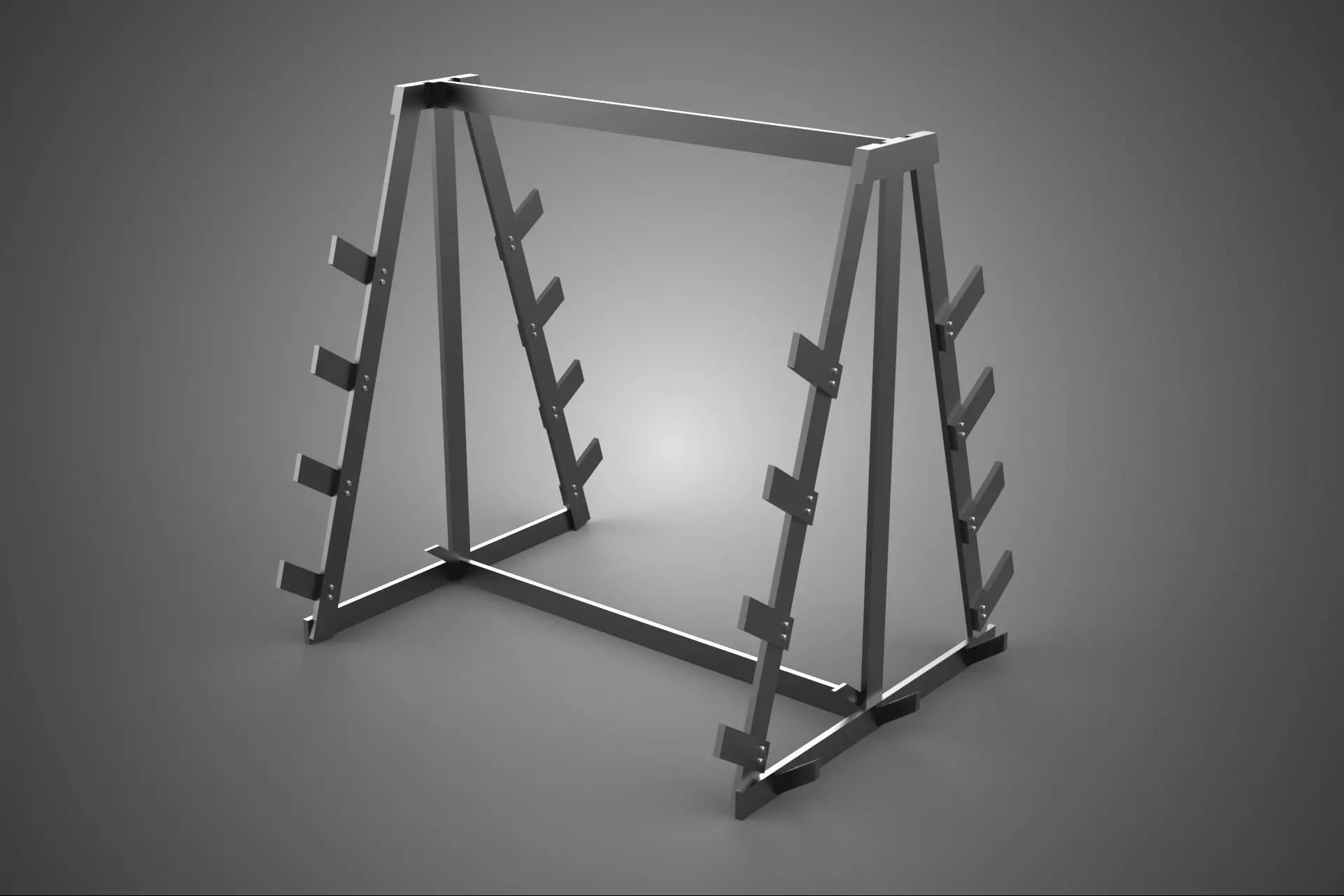
A barbell and dumbbell rack, often referred to as a weight stand, fitness equipment organizer, or free weight storage unit, is a specialized piece of gym apparatus designed for the systematic, secure, and accessible storage of barbells and dumbbells. Its fundamental purpose is to maintain an organized workout environment, enhance user safety by eliminating floor hazards, and optimize space utilization within various fitness facilities.
Nomenclature and Terminology
Common terms for this equipment include dumbbell rack, barbell rack, weight tree, weight stand, and free weight storage unit. The specific designation frequently correlates with the type of weights the unit is primarily designed to accommodate, whether it be a dedicated dumbbell rack, a barbell holder, or a combined storage solution.
Design and Construction
Weight racks are typically constructed from robust, heavy-gauge materials such as industrial-grade steel, frequently finished with a durable powder coating. This finish provides resistance against corrosion, scratches, and general wear common in high-traffic gym environments. Key structural components are engineered for stability, load-bearing capacity, and user safety:
- Frame: The core support structure, designed for exceptional stability and to safely bear significant static loads.
- Tiers/Shelves: Horizontal or angled platforms equipped with cradles, saddles, or U-shaped grooves. These features are contoured to securely hold dumbbells, preventing rolling and potential damage to equipment or users. Dumbbell racks often come in multi-tiered configurations (e.g., 2-tier, 3-tier, 4-tier) to maximize storage density.
- Hooks/Holders: Specific attachments, typically vertical sleeves or horizontal pegs, are integrated for the secure storage of Olympic or standard barbells.
- Footing: Bases are commonly fitted with rubberized caps or protective padding. This mitigates damage to flooring, enhances stability, and prevents slippage during weight retrieval or re-racking.
- Weight Capacity: Each rack is engineered with a specific maximum weight capacity, which varies significantly based on its design, construction, and intended application, ranging from several hundred pounds for home-use units to several thousand pounds for commercial-grade systems.
Types of Racks
The design of weight racks varies based on the type and quantity of weights to be stored:
- Dumbbell Racks:
- Horizontal Multi-Tier Racks: The most common commercial gym design, featuring multiple levels where dumbbells are stored horizontally side-by-side in contoured cradles.
- A-Frame Racks: A space-saving vertical design, often used for smaller sets of dumbbells, where weights are stored on angled pegs, resembling an 'A' shape.
- Vertical Racks/Trees: Compact designs that store dumbbells upright, minimizing floor footprint, suitable for limited spaces or home gyms.
- Saddle Racks: Characterized by individual, deeply contoured saddles for each dumbbell, ensuring precise placement and preventing metal-to-metal contact.
- Barbell Racks:
- Vertical Barbell Holders: Often a series of pegs or tubes allowing barbells to be stored upright, conserving floor space.
- Horizontal Barbell Racks: Less common for bare barbells, these are sometimes integrated into larger storage units or power racks.
- Plate-Loaded Barbell Trees: Primarily designed for weight plates, but frequently include dedicated sleeves or holders for Olympic barbells.
- Combination Racks: Versatile units that integrate storage solutions for both dumbbells and barbells, and sometimes additional equipment such as kettlebells, weight plates, or resistance bands.
- Modular Systems: Customizable rack components that allow for flexible configuration and future expansion based on evolving equipment inventories.
Functionality and Benefits
The integration of a dedicated weight rack offers several critical advantages in a fitness environment:
- Organization: Provides a systematic method for organizing free weights, contributing to a tidy and professional aesthetic and facilitating quick location of desired weights.
- Safety Enhancement: By securely storing weights off the floor, racks eliminate tripping hazards, reduce the risk of foot injuries, and prevent damage to both equipment and facility flooring. Proper storage also promotes safer lifting mechanics during weight selection and re-racking.
- Space Optimization: Efficiently utilizes vertical or compact footprints, which is particularly advantageous in environments with limited floor area.
- Equipment Preservation: Protects weights from impacts, scratches, and rolling, thereby extending their operational lifespan and maintaining their aesthetic condition.
- Accessibility and Ergonomics: Ensures weights are readily available at an ergonomic height, which streamlines transitions between exercises and minimizes strain during retrieval and replacement.
Applications
Weight racks are an indispensable component across a diverse array of fitness settings, including:
- Commercial fitness centers and health clubs.
- Private and home gyms.
- Personal training studios and specialized training facilities.
- Collegiate and professional athletic training centers.
- Rehabilitation clinics and physical therapy centers.
- Corporate wellness programs and hotel fitness amenities.
Maintenance
Routine maintenance involves regular inspection for structural integrity, bolt tightness, and any signs of surface wear or damage. Cleaning with a mild, non-abrasive detergent and ensuring dry storage conditions are recommended to preserve the rack's condition and appearance over time.
Selection Considerations
When selecting a weight rack, critical factors include the specific type and quantity of free weights to be stored, the available floor space, the required maximum weight capacity, and budgetary constraints.