Baseball is a bat-and-ball sport played between two teams of nine players each, taking turns batting and fielding. The game occurs over the course of several plays, with each play beginning when a player on the fielding team, called the pitcher, throws a ball that a player on the batting team, called the batter, tries to hit with a bat. The objective of the offensive team (batting team) is to hit the ball into the field of play, away from the other team's players, allowing its players to run the bases, having them advance counter-clockwise around four bases to score what are called runs. The objective of the defensive team (fielding team) is to prevent batters from becoming runners, and to prevent runners advancing around the bases.[2] A run is scored when a runner legally advances around the bases in order and touches home plate (the place where the player started as a batter).
The initial objective of the batting team is to have a player reach first base safely; this occurs either when the batter hits the ball and reaches first base before an opponent retrieves the ball and touches the base, or when the pitcher persists in throwing the ball out of the batter's reach. Players on the batting team who reach first base without being called out can attempt to advance to subsequent bases as a runner, either immediately or during teammates' turns batting. The fielding team tries to prevent runs by using the ball to get batters or runners out, which forces them out of the field of play. The pitcher can get the batter out by throwing three pitches which result in strikes, while fielders can get the batter out by catching a batted ball before it touches the ground, and can get a runner out by tagging them with the ball while the runner is not touching a base.
The opposing teams switch back and forth between batting and fielding; the batting team's turn to bat is over once the fielding team records three outs. One turn batting for each team constitutes an inning. A game is usually composed of nine innings, and the team with the greater number of runs at the end of the game wins. Most games end after the ninth inning, but if scores are tied at that point, extra innings are usually played. Baseball has no game clock, though some competitions feature pace-of-play regulations such as a pitch clock to shorten game time.
Baseball evolved from older bat-and-ball games already being played in England by the mid-18th century. This game was brought by immigrants to North America, where the modern version developed. Baseball's American origins, as well as its reputation as a source of escapism during troubled points in American history such as the American Civil War and the Great Depression, have led the sport to receive the moniker of America's Pastime; since the late 19th century, it has been unofficially recognized as the national sport of the United States, though in modern times is considered less popular than other sports, such as American football. In addition to North America, baseball spread throughout the rest of the Americas and the Asia–Pacific in the 19th and 20th centuries,[3] and is now considered the most popular sport in parts of Central and South America, the Caribbean, and East Asia, particularly in Japan, South Korea, and Taiwan.
In Major League Baseball (MLB), the highest level of professional baseball in the United States and Canada, teams are divided into the National League (NL) and American League (AL), each with three divisions: East, West, and Central. The MLB champion is determined by playoffs that culminate in the World Series. The top level of play is similarly split in Japan between the Central and Pacific Leagues and in Cuba between the West League and East League. The World Baseball Classic, organized by the World Baseball Softball Confederation, is the major international competition of the sport and attracts the top national teams from around the world. Baseball was played at the Olympic Games from 1992 to 2008, and was reinstated on a one-off basis in 2020.
Rules and gameplayFurther information: Rules of baseball and Outline of baseballOverview
Diagram of a baseball field. Diamond may refer to the square area defined by the four bases or to the entire playing field. The dimensions given are for professional and professional-style games. Children often play on smaller fields.
2013 World Baseball Classic championship match between the Dominican Republic and Puerto Rico, March 20, 2013A baseball game is played between two teams, each composed of nine players, that take turns playing offense (batting and baserunning) and defense (pitching and fielding). A pair of turns, one at bat and one in the field, by each team constitutes an inning. A game consists of nine innings (seven innings at the high school level and in doubleheaders in college and Minor League Baseball; and six innings at the Little League level).[4] One team—customarily the visiting team—bats in the top, or first half, of every inning. The other team—customarily the home team—bats in the bottom, or second half, of every inning.
The goal of the game is to score more points (runs) than the other team. The players on the team at bat attempt to score runs by touching all four bases, in order, set at the corners of the square-shaped baseball diamond. A player bats at home plate and must attempt to safely reach a base before proceeding, counterclockwise, from first base, to second base, third base, and back home to score a run. The team in the field attempts to prevent runs from scoring by recording outs, which remove opposing players from offensive action until their next turn at bat comes up again. When three outs are recorded, the teams switch roles for the next half-inning. If the score of the game is tied after nine innings, extra innings are played to resolve the contest. Many amateur games, particularly unorganized ones, involve different numbers of players and innings.[5]
The game is played on a field whose primary boundaries, the foul lines, extend forward from home plate at 45-degree angles. The 90-degree area within the foul lines is referred to as fair territory; the 270-degree area outside them is foul territory. The part of the field enclosed by the bases and several yards beyond them is the infield; the area farther beyond the infield is the outfield. In the middle of the infield is a raised pitcher's mound, with a rectangular rubber plate (the rubber) at its center. The outer boundary of the outfield is typically demarcated by a raised fence, which may be of any material and height. The fair territory between home plate and the outfield boundary is baseball's field of play, though significant events can take place in foul territory, as well.[6]
There are three basic tools of baseball: the ball, the bat, and the glove or mitt:
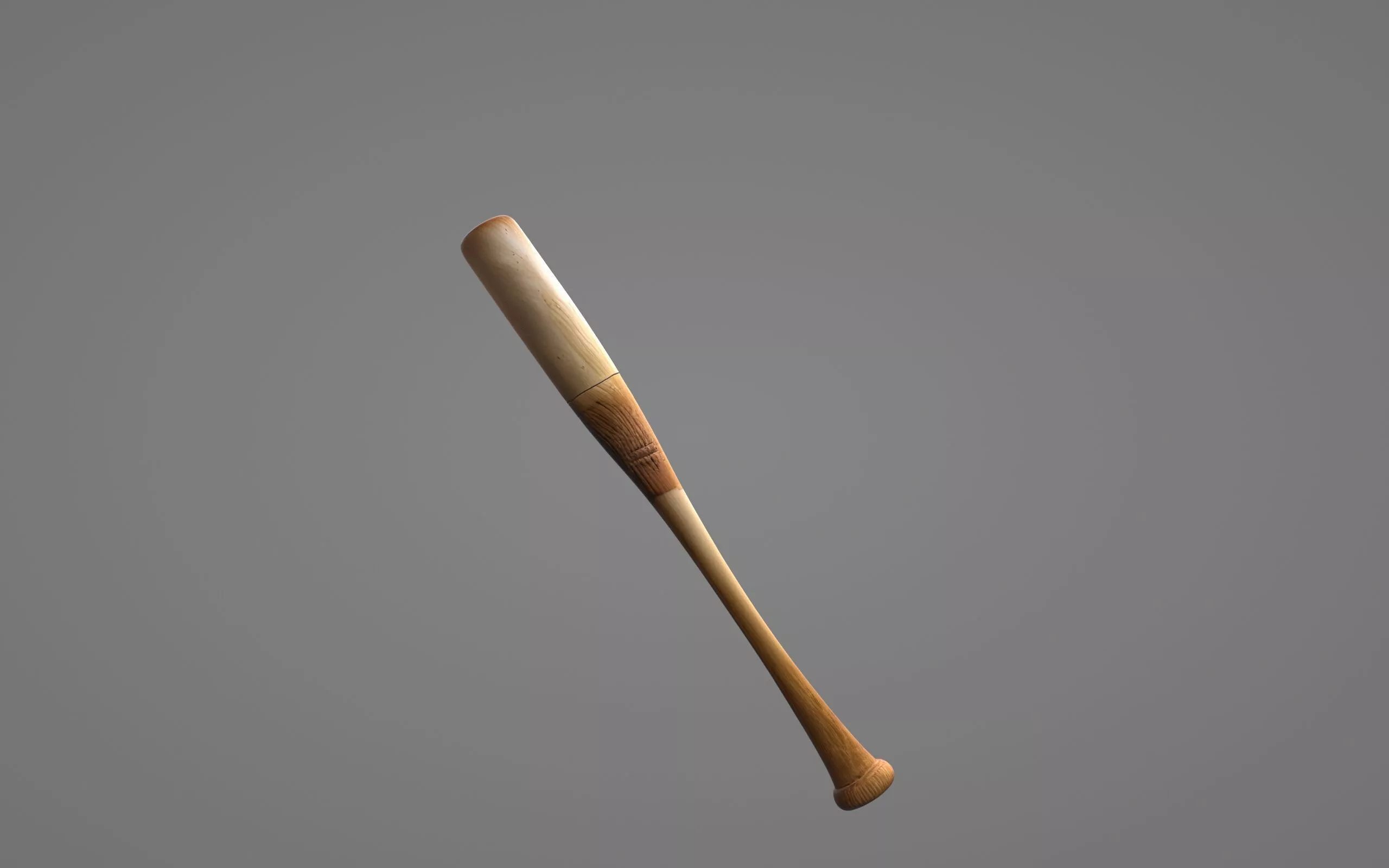
The baseball is about the size of an adult's fist, around 9 inches (23 centimeters) in circumference. It has a rubber or cork center, wound in yarn and covered in white cowhide, with red stitching.[7]The bat is a hitting tool, traditionally made of a single, solid piece of wood. Other materials are now commonly used for nonprofessional games. It is a hard round stick, about 2.5 inches (6.4 centimeters) in diameter at the hitting end, tapering to a narrower handle and culminating in a knob. Bats used by adults are typically around 34 inches (86 centimeters) long, and not longer than 42 inches (110 centimeters).[8]The glove or mitt is a fielding tool, made of padded leather with webbing between the fingers. As an aid in catching and holding onto the ball, it takes various shapes to meet the specific needs of different fielding positions.[9]Protective helmets are also standard equipment for all batters.[10]
Fielding positions
Diagram indicating the standard layout of positionsAt the beginning of each half-inning, the nine players of the fielding team arrange themselves around the field. One of them, the pitcher, stands on the pitcher's mound. The pitcher begins the pitching delivery with one foot on the rubber, pushing off it to gain velocity when throwing toward home plate. Another fielding team player, the catcher, squats on the far side of home plate, facing the pitcher. The rest of the fielding team faces home plate, typically arranged as four infielders—who set up along or within a few yards outside the imaginary lines (basepaths) between first, second, and third base—and three outfielders. In the standard arrangement, there is a first baseman positioned several steps to the left of first base, a second baseman to the right of second base, a shortstop to the left of second base, and a third baseman to the right of third base. The basic outfield positions are left fielder, center fielder, and right fielder. With the exception of the catcher, all fielders are required to be in fair territory when the pitch is delivered. A neutral umpire sets up behind the catcher.[11] Other umpires will be distributed around the field as well