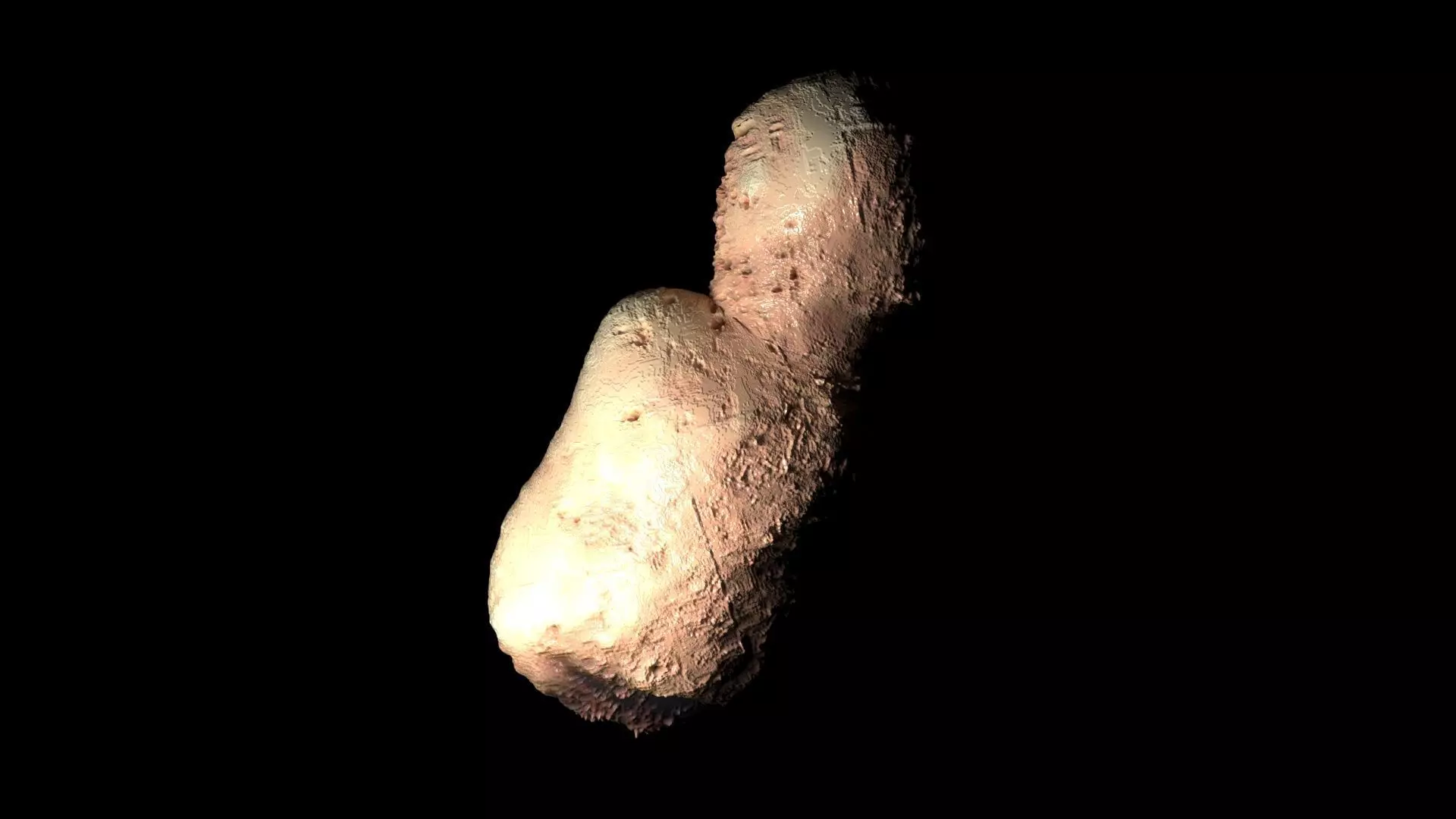
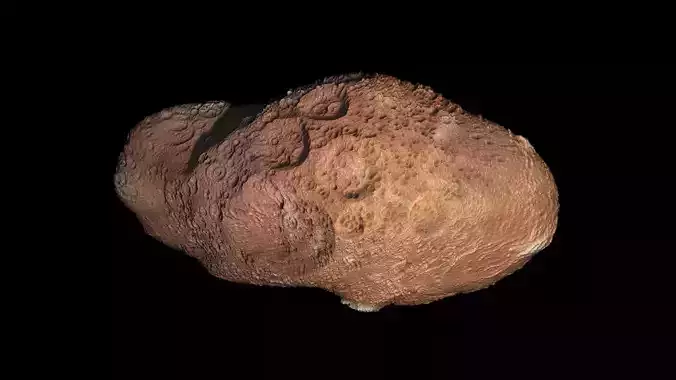
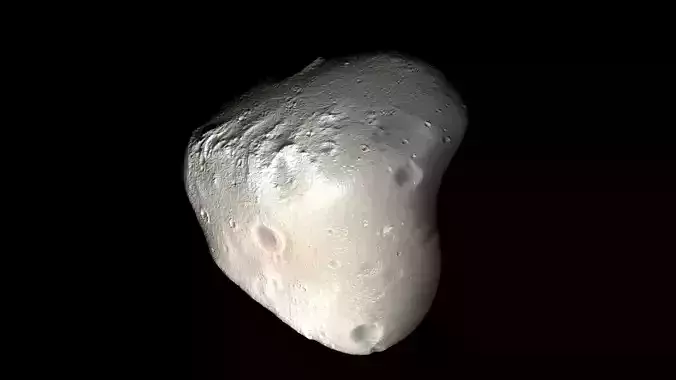
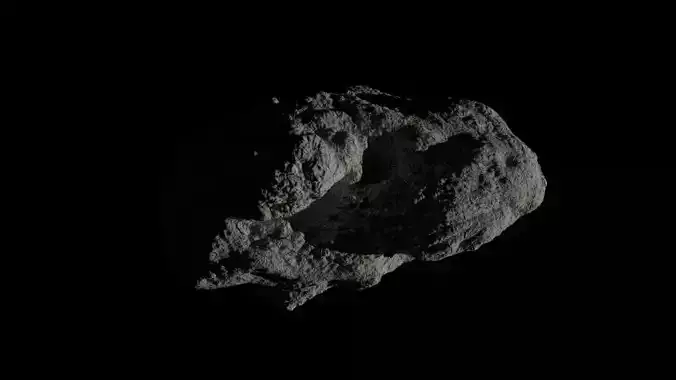
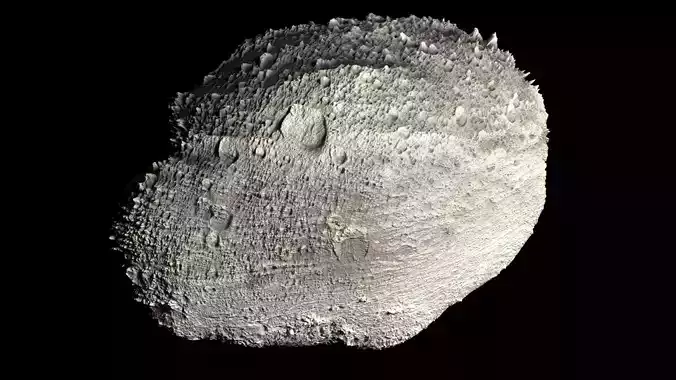
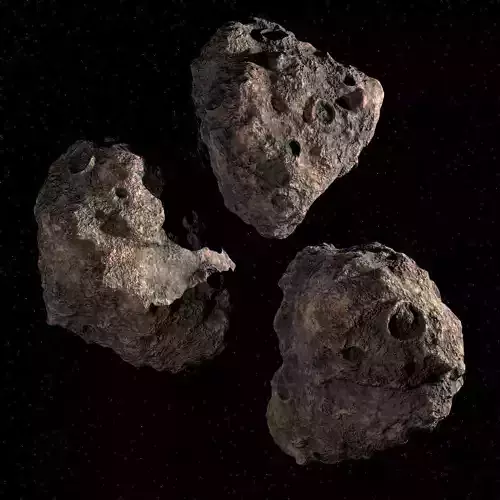
Description4179 Toutatis Asteroid. 4179 Toutatis (provisional designation 1989 AC) is an elongated, stony asteroid and slow rotator, classified as a near-Earth object and potentially hazardous asteroid of the Apollo asteroid group, approximately 2.5 kilometers in diameter. Discovered by French astronomer Christian Pollas at Caussols in 1989, the asteroid was named after Toutatis from Celtic mythology. Toutatis is also a Mars-crosser asteroid with a chaotic orbit produced by a 3:1 resonance with the planet Jupiter, a 1:4 resonance with the planet Earth, and frequent close approaches to the terrestrial planets, including Earth. In December 2012, Toutatis passed within about 18 lunar distances of Earth. The Chinese lunar probe Chang'e 2 flew by the asteroid at a distance of 3.2 kilometers and a relative velocity of 10.73 km/s. Toutatis approached Earth again in 2016, but will not make another notably close approach until 2069. Toutatis was first sighted on 10 February 1934, as object 1934 CT, but lost soon afterwards. It remained a lost asteroid for several decades until it was rediscovered on 4 January 1989 by French astronomer Christian Pollas, and was named after the Celtic god of tribal protection Toutatis (Teutates). The name of this god is very familiar in France due to the catchphrase Par Toutatis! by the Gauls in the comics Asterix. The spectral properties suggest that this is an S-type, or stony asteroid, consisting primarily of silicates. It has a moderate Bond albedo of 0.13. Radar imagery shows that Toutatis is a highly irregular body consisting of two distinct lobes, with maximum widths of about 4.6 km and 2.4 km, respectively. It is hypothesized that Toutatis formed from two originally separate bodies which coalesced at some point (a contact binary), with the resultant asteroid being compared to a rubble pile. Its rotation combines two separate periodic motions into a non-periodic result; to someone on the surface of Toutatis, the Sun would seem to rise and set in apparently random locations and at random times at the asteroid's horizon. It has a rotation period around its long axis (Pψ) of 5.38 days. This long axis is precessing with a period (Pφ) of 7.38 days.[17] The asteroid may have lost most of its original angular momentum and entered into this tumbling motion as a result of the YORP effect.
Orbit:
With a semimajor axis of 2.5294 AU, or roughly 2.5 times the distance between Earth and the Sun, Toutatis has a 3:1 orbital resonance with Jupiter and a near-1:4 resonance with Earth making it a member of the Alinda asteroid group. It thus completes one orbit around the Sun for every 4.02 annual orbits of Earth. The gravitational perturbations caused by frequent close approaches to the terrestrial planets lead to chaotic behavior in the orbit of Toutatis, making precise long-term predictions of its location progressively inaccurate over time. Estimates in 1993 put the Lyapunov time horizon for predictability at around 50 years, after which the uncertainty region becomes larger with each close approach to a planet. Without the perturbations from the terrestrial planets the Lyapunov time would be close to 10,000 years. The initial observations that showed its chaotic behavior were made by Wiśniewski. The low inclination (0.47°) of the orbit allows frequent transits, where the inner planets Mercury, Venus, Earth, and Mars can appear to cross the Sun as seen from the perspective of Toutatis. Earth did this in January 2009, July 2012, July 2016 and 2020.
Texture Resolution: 715 x 715