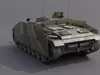
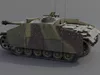
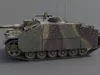
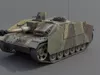
DESCRIPTION

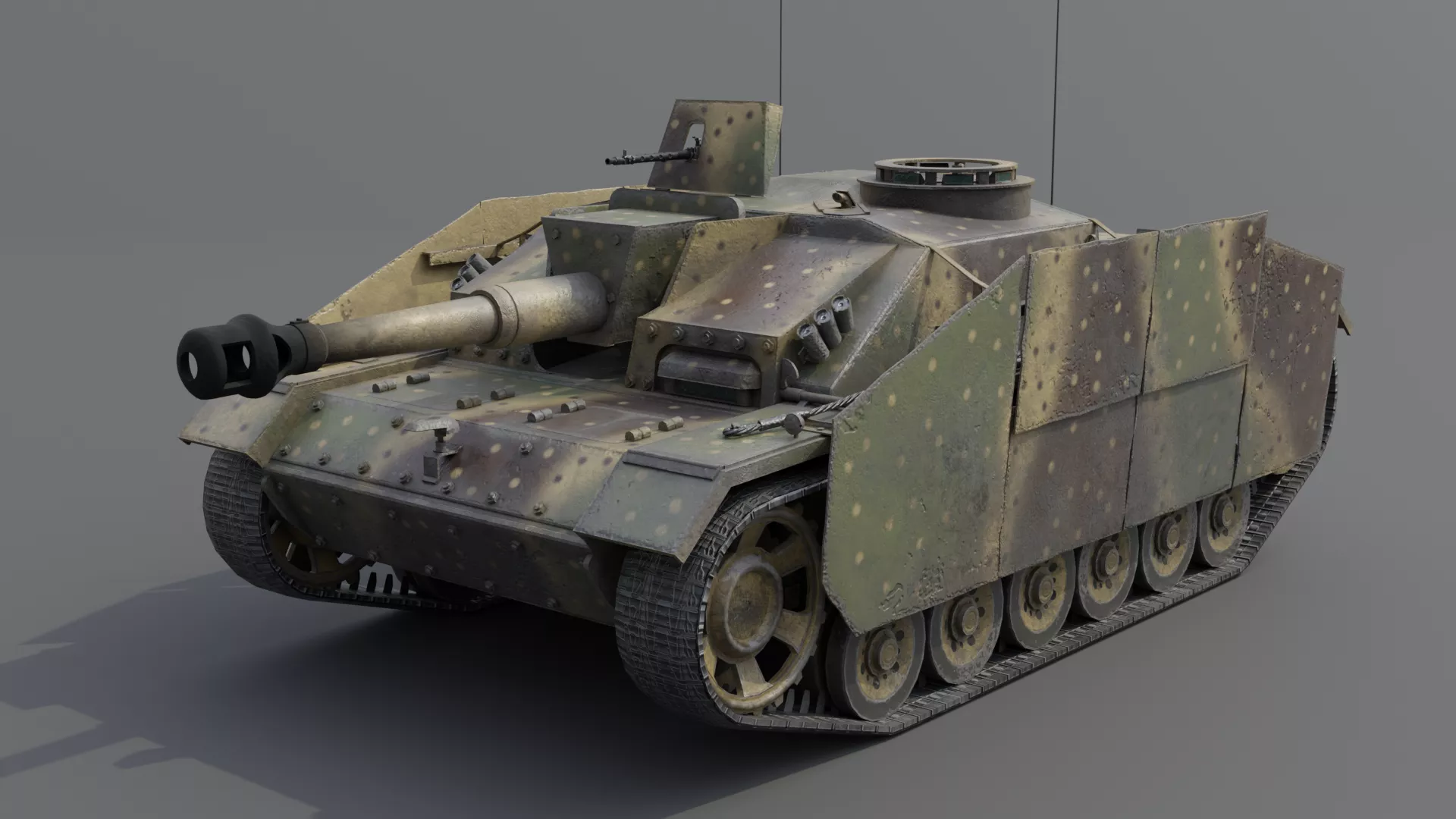
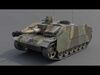
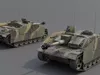
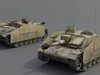
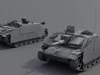
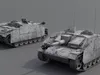
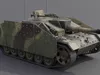
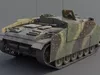
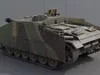
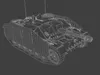
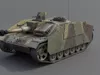
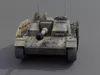
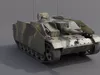
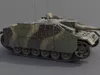
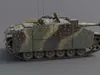
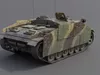
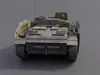
StuH 42 G Sturmhaubitze Howitzer

ZIP file contain Blendfile, Texture folder , FBX , Obj mtl

Centered (in right place) and Seperated parts

Blender 5.0.1

Textured with substance painter (Basecolor , AO , Metalness , Roughness , Normal , Opacity)

3 Set of material and 5 Texture set (Camo , Winter , Burned , Grey , Desert)

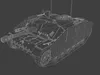
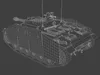
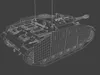
49 Seperated Objects

No interior , 7 hatches

4k Texture PNG (2k Burned)

Pictures rendered in Cycles engine

Vertices:28,137

Faces:30,512

Tris: 52,962

Description:The StuH 42 self-propelled gun was essentially nothing more than a more heavily armed version of the famous assault gun StuG III. The StuG III was intended for direct fire support of infantry — it was to advance alongside the infantry and rapidly destroy enemy machine gun nests, artillery positions, fortified points, and other so-called soft targets. Following the invasion of the Soviet Union, however, these vehicles were increasingly being drawn into combat against overwhelming numbers of enemy tanks. In response to this, a decision was made in September 1941 that set a clear direction for the further development of the StuG III: maximising its ability to destroy armoured vehicles.The StuG III was therefore re-armed with a long-barrelled gun and increasingly came to be regarded as a tank destroyer. This raised the question of who would take over its original role — that of primarily destroying the soft targets blocking the advance of German infantry. The answer came quickly, in the form of a proposal to build a new version of the assault gun armed with a more powerful weapon suited to that task. The first mention of such a vehicle dates to 2 December 1941, when an army requirement was issued for the production of 12 verification vehicles based on the StuG III but armed with 105 mm howitzers. The new weapon was to be installable in the StuG III in place of its original 75 mm gun, with the minimum possible additional structural modifications to the vehicle — which would naturally reduce the cost and complexity of production.The new weapon was developed by modifying the le.F.H. 18 light field howitzer of 105 mm calibre, manufactured by Rheinmetall-Borsig. The weapon was adapted for installation in the StuG's fighting compartment and given the new designation 10.5 cm Sturmhaubitze 42 L/28 (Sturmhaubitze = assault howitzer), abbreviated 10.5 cm StuH 42. (www.panzernet.net)

REVIEWS & COMMENTS

See what other buyers think about this model - real feedback on quality,
accuracy, and usability.
There are no reviews or comments yet. Please be the first one to write it.
BEST PRICE GUARANTEED
Found this model cheaper on another marketplace? Let our support team know - we’ll match it.
NEW
Recently added to CGTrader - explore one of the latest models on the marketplace.

StuH 42 G Sturmhaubitze Howitzer Low-poly 3D model

Royalty Free License
One-time purchaseRoyalty-free
$60
  • Yours forever — royalty-free license
  • All 5 file formats included
  • Instant download after purchase
Like this model to show appreciation to the designer.
See how many times this model was viewed.
Share this model to support the designer and boost their visibility.
Native file format
BLEND
Size: 323 MB
Renderer: Default | 5.0.1
Exchange formats
OBJ
OBJ<br />File Size: 323 MB
FBX
Autodesk FBX<br />File Size: 323 MB
PNG
PNG<br />File Size: 323 MB
JPG
JPG<br />File Size: 323 MB
Verified by CGTrader
Verified models are of higher quality as they have
passed CGT Standard technical and visual checks,
making them more professional-grade 3D assets.
Learn more.
FBX
This FBX file has successfully passed the CGT Standard technical and visual checks. The verification results are detailed in the section below.
File & scene
Binary FBX
Binary FBX file is more compact and faster to load and process.
Learn more
No unsupported objects
Unsupported objects:
- Lights
- Cameras
Learn more
Geometry
No N-gons
N-gons are polygons with five or more sides which might cause issues in certain processes like rendering or animation. Learn more
No faceted geometry
Faceted geometry uses flat surfaces without smoothing, which can look unrealistic on curves.
Learn more
Manifold geometry
Manifold geometry ensures all surfaces are properly connected, avoiding issues like edges shared by more than two faces.
Learn more
Textures & material
PBR textures
PBR textures simulate how light interacts with materials, making the model look realistic under different lighting.
Required PBR textures:
- Base Color
- Roughness
- Metalness
- Normal
Learn more
No embed textures
Embedded textures are stored inside the model file, increasing its size and sometimes causing compatibility issues.
Learn more
Square textures
Texture aspect ratio is the width-to-height ratio of a texture. Expected texture aspect ratio: 1:1
Learn more
Power of 2 texture sizes
Textures with dimensions in power of two (e.g. 512x512px, 1024x1024px) are used to optimize performance and memory usage.
Learn more
Assigned materials
Materials are applied to the 3D model to allow visualize a model's surface properties and appearance.
Learn more
UVs & naming
No UV overlaps
UVs overlap when multiple points on the 3D model's surface are mapped to the same point on the UV island causing texture stretching.
Learn more
UV unwrapped model
A UV unwrapped model means its 3D surface is flattened into 2D space, allowing textures to be applied accurately.
Learn more
Allowed characters
Allowed ASCII characters: a-zA-Z0-9-_
Learn more
Provided by designer
Information and details shared directly by the model's designer.
3D Features
PBR
Uses Physically Based Rendering materials, which give the model realistic lighting and surface properties.
Textures
The model includes image files (textures) that add color, patterns, or detail to its surfaces.
Materials
The model has material settings that define how surfaces look (color, shine, transparency, etc.).
UV Mapping
The model's surfaces are mapped to a 2D image, allowing textures to display correctly.
3D printing
Indicates whether the designer marked this model as suitable for 3D printing.
Model is not 3D printable
The designer indicates this model is intended for digital use only (rendering, animation, or AR/VR) and not for 3D printing.
Geometry
Polygon mesh
A model built from polygons (triangles or quads) connected in a mesh.
30512 polygons
The total number of polygons (flat shapes) that make up the 3D model.
/
28137 vertices
The number of points (corners) that define the shape of the model's polygons.
Unwrapped UVs
Publish date
Model ID
Chat