High-quality 3D assets at affordable prices — trusted by designers, engineers, and creators worldwide. Made with care to be versatile, accessible, and ready for your pipeline.
Included File Formats
This model is provided in 14 widely supported formats, ensuring maximum compatibility:
• - FBX (.fbx) – Standard format for most 3D software and pipelines
• - OBJ + MTL (.obj, .mtl) – Wavefront format, widely used and compatible
• - STL (.stl) – Exported mesh geometry; may be suitable for 3D printing with adjustments
• - STEP (.step, .stp) – CAD format using NURBS surfaces
• - IGES (.iges, .igs) – Common format for CAD/CAM and engineering workflows (NURBS)
• - SAT (.sat) – ACIS solid model format (NURBS)
• - DAE (.dae) – Collada format for 3D applications and animations
• - glTF (.glb) – Modern, lightweight format for web, AR, and real-time engines
• - 3DS (.3ds) – Legacy format with broad software support
• - 3ds Max (.max) – Provided for 3ds Max users
• - Blender (.blend) – Provided for Blender users
• - SketchUp (.skp) – Compatible with all SketchUp versions
• - AutoCAD (.dwg) – Suitable for technical and architectural workflows
• - Rhino (.3dm) – Provided for Rhino users
Model Info
• - All files are checked and tested for integrity and correct content
• - Geometry uses real-world scale; model resolution varies depending on the product (high or low poly)
• • - Scene setup and mesh structure may vary depending on model complexity
• - Rendered using Luxion KeyShot
• - Affordable price with professional detailing
Buy with confidence. Quality and compatibility guaranteed.
If you have any questions about the file formats, feel free to send us a message — we're happy to assist you!
Sincerely,
SURF3D
Trusted source for professional and affordable 3D models.
More Information About 3D Model :
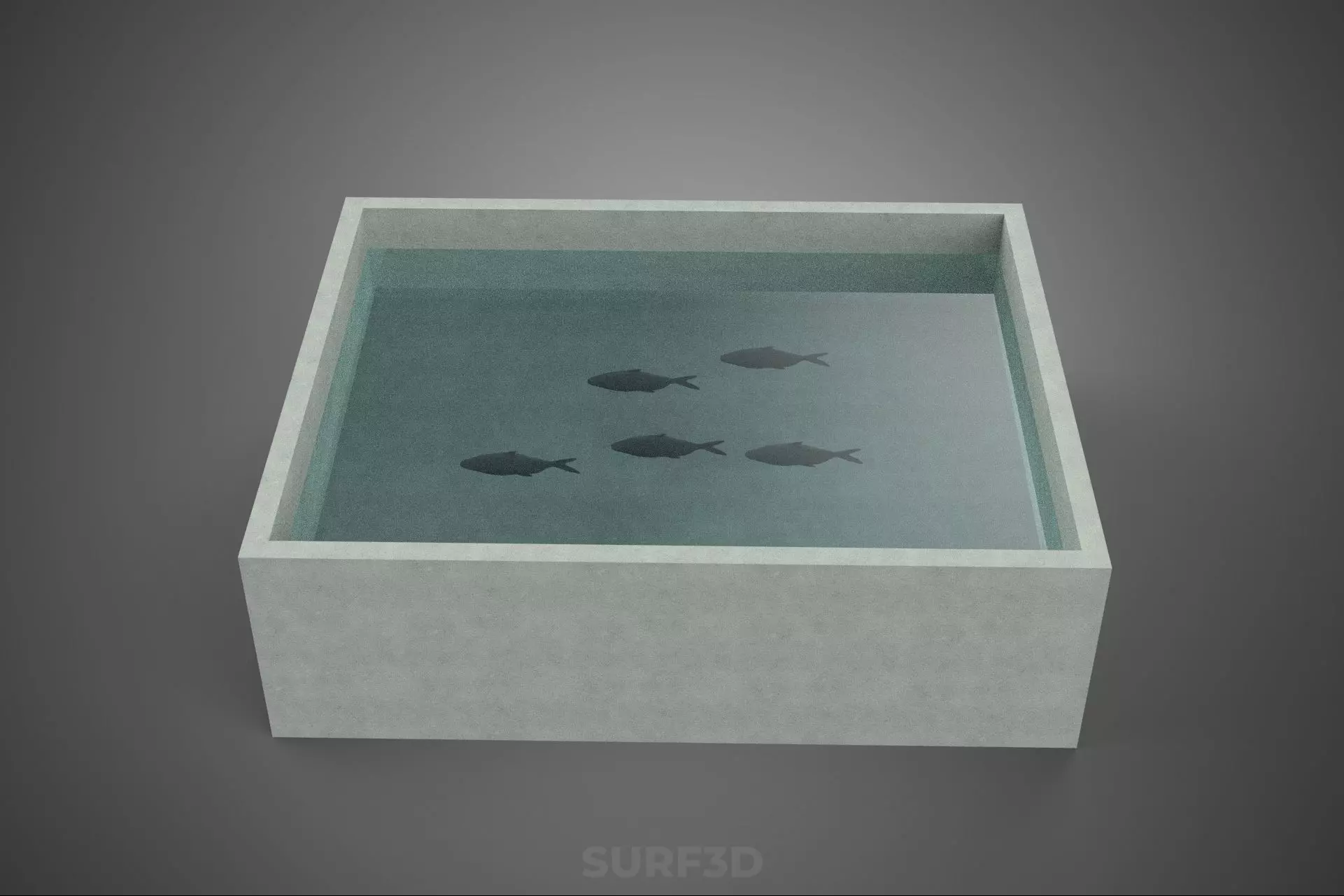
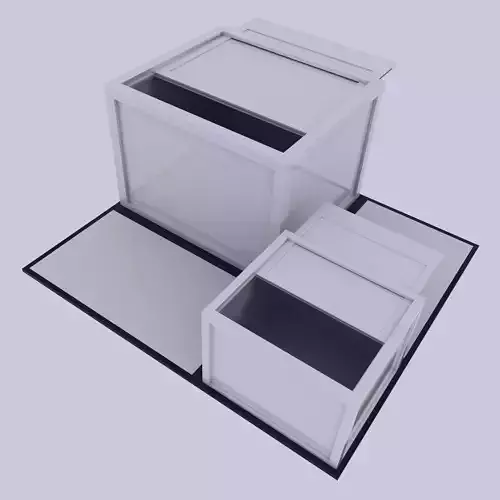
A rectangular concrete water tank, also referred to as a concrete fish pond, pool, or aqua basin, represents a specialized, artificial aquatic containment structure primarily constructed from reinforced concrete and specifically designed for the habitation, cultivation, and observation of various aquatic organisms, predominantly fish. Characterized by its rectilinear form, this engineered basin provides a robust and controlled environment, differentiating itself from natural aquatic ecosystems by its material composition, geometric precision, and often elevated or semi-submerged installation.
Nomenclature and Scope
The terminology associated with these structures can vary. Tank often emphasizes its engineered, industrial, or large-scale nature, while pond or pool might suggest a more aesthetic or recreational application, such as for ornamental fish like koi. Aqua basin serves as a more generic descriptor for any water-holding receptacle. Regardless of nomenclature, the defining attributes remain the rectangular geometry, the concrete construction, and the purpose of housing fish in a structured, managed aquatic environment.
Construction and Material Properties
The use of concrete as the primary building material confers significant advantages, including exceptional durability, longevity, and structural integrity. Concrete structures are highly resistant to impact, puncture, and environmental degradation, making them suitable for long-term outdoor installations. They can be constructed as poured-in-place monoliths, using precast concrete panels, or from concrete masonry units (CMUs) such as blocks, offering flexibility in size, depth, and design. The inherent thermal mass of concrete assists in moderating water temperature fluctuations, providing a more stable environment for aquatic life compared to thin-walled alternatives. However, new concrete can leach alkaline compounds into the water, requiring proper curing, sealing, and extensive conditioning (e.g., acid washing, repeated flushing) to neutralize pH levels before fish introduction. Reinforcement with steel rebar is common to prevent cracking and enhance structural strength.
Design and Features
The rectangular shape is often chosen for its practicality, maximizing space utilization, simplifying construction (especially with formwork), and facilitating efficient maintenance, cleaning, and fish harvesting or observation. Dimensions vary widely, from smaller backyard ponds to immense commercial aquaculture raceways or holding tanks. Critical design considerations include:
-
Depth: Sufficient depth is essential for temperature stability, predator avoidance, and adequate volume for fish populations, typically ranging from 0.6 to 2.5 meters.
-
Drainage and Overflow: Integrated bottom drains and overflow mechanisms are crucial for water exchange, waste removal, and maintaining optimal water levels.
-
Filtration Systems: Essential for maintaining water quality, these typically include mechanical filtration (to remove particulate matter) and biological filtration (to process nitrogenous wastes). UV sterilizers, aerators, and protein skimmers may also be incorporated.
-
Water Circulation: Pumps and plumbing ensure adequate water movement, preventing stagnant zones and facilitating oxygenation and filtration.
-
Lining and Sealing: While concrete itself can be made largely waterproof, internal liners (e.g., rubber, epoxy coatings) or specialized sealants are often applied to ensure complete impermeability and prevent chemical leaching.
Applications and Purpose
These concrete structures serve diverse functions:
-
Aquaculture: Large rectangular concrete tanks are fundamental in intensive and semi-intensive aquaculture systems for breeding, rearing, and grow-out of various food fish species (e.g., tilapia, catfish, trout) due to their robust nature and ease of management.
-
Ornamental Fish Keeping: Many dedicated hobbyists utilize concrete ponds for large ornamental fish like koi or goldfish, providing ample space for growth and viewing.
-
Research and Conservation: Used in aquatic research laboratories for controlled experiments, fish propagation programs, and holding facilities for endangered species.
-
Temporary Holding: Practical for holding fish during transport, quarantine, or while other aquatic systems are under maintenance.
-
Landscape Features: Integrated into architectural and landscape designs as robust, enduring water features that can support aquatic flora and fauna.
Maintenance and Management
Effective management of a concrete fish tank requires continuous monitoring of water parameters (pH, ammonia, nitrite, nitrate, dissolved oxygen), regular cleaning to remove accumulated sludge and algae, and proper feeding regimes. Temperature control, especially in extreme climates, may necessitate heating or cooling systems. The long-term stability offered by concrete reduces the frequency of major structural repairs but demands consistent water quality management.
Advantages and Disadvantages
Advantages:
-
Durability and Longevity: Highly resistant to wear, tear, and environmental factors.
-
Structural Integrity: Can support significant water volumes and withstand external pressures.
-
Customization: Can be built to precise specifications regarding size, depth, and integrated features.
-
Thermal Stability: Concrete's mass helps buffer temperature changes.
-
Pest Resistance: Less susceptible to burrowing animals or root intrusion compared to lined earthen ponds.
Disadvantages:
-
Initial Cost: Construction can be expensive due to materials, labor, and specialized skills.
-
Immobility: Once built, relocation is impractical or impossible.
-
Curing and Conditioning: Requires significant time and effort to neutralize concrete's alkalinity before fish introduction.
-
Aesthetics: Can appear stark or industrial if not properly landscaped or finished.
-
Permeability: Requires careful sealing to prevent leaks and chemical leaching.