High-quality 3D assets at affordable prices — trusted by designers, engineers, and creators worldwide. Made with care to be versatile, accessible, and ready for your pipeline.
Included File Formats
This model is provided in 14 widely supported formats, ensuring maximum compatibility:
• - FBX (.fbx) – Standard format for most 3D software and pipelines
• - OBJ + MTL (.obj, .mtl) – Wavefront format, widely used and compatible
• - STL (.stl) – Exported mesh geometry; may be suitable for 3D printing with adjustments
• - STEP (.step, .stp) – CAD format using NURBS surfaces
• - IGES (.iges, .igs) – Common format for CAD/CAM and engineering workflows (NURBS)
• - SAT (.sat) – ACIS solid model format (NURBS)
• - DAE (.dae) – Collada format for 3D applications and animations
• - glTF (.glb) – Modern, lightweight format for web, AR, and real-time engines
• - 3DS (.3ds) – Legacy format with broad software support
• - 3ds Max (.max) – Provided for 3ds Max users
• - Blender (.blend) – Provided for Blender users
• - SketchUp (.skp) – Compatible with all SketchUp versions
• - AutoCAD (.dwg) – Suitable for technical and architectural workflows
• - Rhino (.3dm) – Provided for Rhino users
Model Info
• - All files are checked and tested for integrity and correct content
• - Geometry uses real-world scale; model resolution varies depending on the product (high or low poly)
• • - Scene setup and mesh structure may vary depending on model complexity
• - Rendered using Luxion KeyShot
• - Affordable price with professional detailing
Buy with confidence. Quality and compatibility guaranteed.
If you have any questions about the file formats, feel free to send us a message — we're happy to assist you!
Sincerely,
SURF3D
Trusted source for professional and affordable 3D models.
More Information About 3D Model :
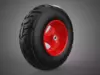
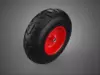
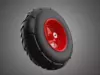
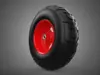
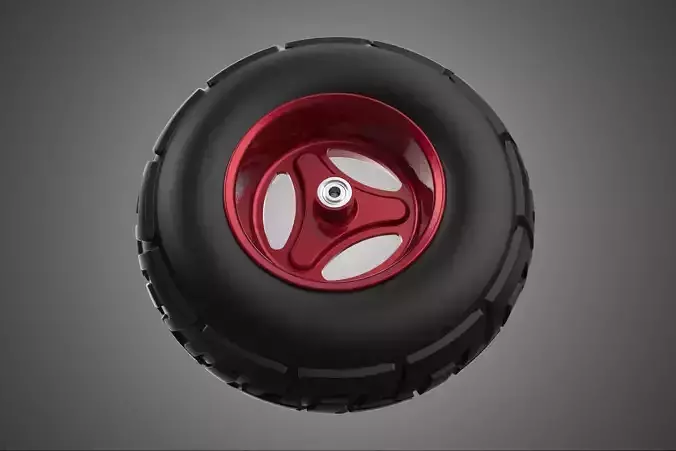
This entry describes a specialized wheel assembly component typically designated for low-speed, manual-powered utility transportation devices. The description integrates structural, functional, and aesthetic characteristics to define a specific class of industrial or domestic mobility hardware.
Nomenclature and Classification
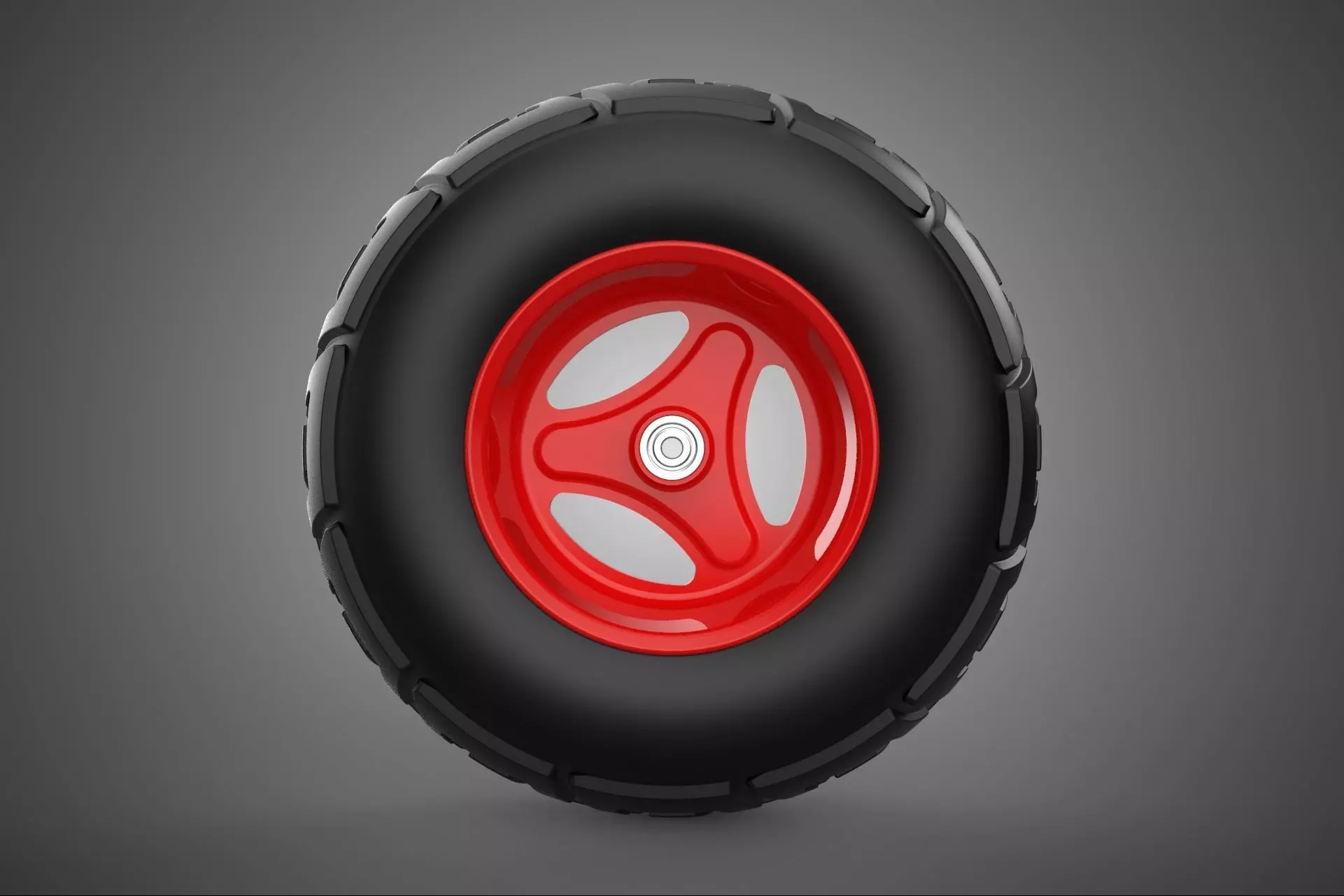
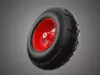
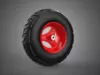
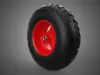
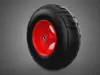
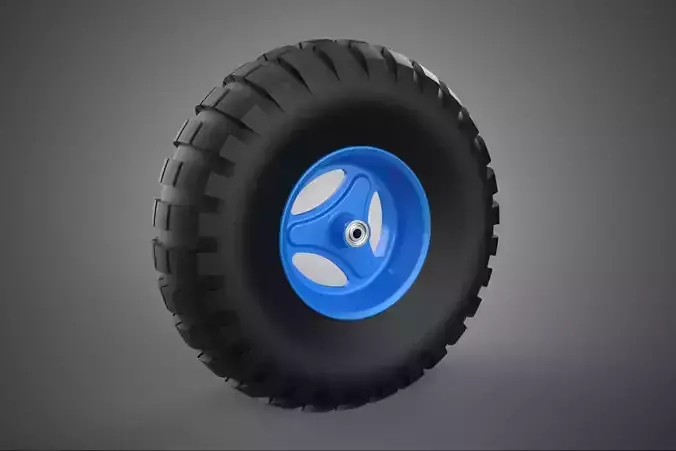
The component is formally classified as a light-duty spoked utility wheel assembly. The descriptor RED TRI THREE SPOKE identifies the structural geometry and primary coloration. The TRI and THREE SPOKE nomenclature denotes a radial configuration where three structural elements connect the hub to the rim, an engineering choice often employed for optimizing material efficiency while maintaining adequate lateral rigidity for moderate load scenarios (typically up to 150 kg per wheel).
Design and Structure
Hub and Rim: The central element is the hub, which contains the bearing mechanism (either ball bearings, roller bearings, or plain bushings) designed to interface with a stationary axle. The rim, the outer circumference of the rigid structure, is supported by the three radially distributed spokes. The construction is frequently monobloc, meaning the hub, spokes, and rim are molded or cast as a single unified component, typically using durable polymers (e.g., polyethylene, polypropylene, or high-density nylon) or, less commonly, stamped and welded light-gauge steel. The designation RED refers to the specific pigmentation or coating applied to this rigid structural core, often utilized for product differentiation, brand identity, or informal load rating indicators.
Spoke Configuration: The three-spoke design provides a balance between weight reduction and strength, particularly against lateral stresses encountered when traversing uneven terrain. This configuration is distinct from full-disc or multi-spoke assemblies, offering superior resilience in environments where debris accumulation might be a concern.
Tyre and Tread Characteristics
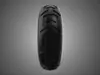
The component includes a circumferential contact element defined as a TREAD TIRE/TYRE. This implies the presence of an elastomeric material covering the rim, which provides shock absorption and traction. This material is typically either:
-
Pneumatic: An air-filled rubber tyre assembly, requiring periodic inflation, offering superior cushioning for delicate loads and better performance over rough ground.
-
Solid or Semi-Pneumatic: Composed of dense, puncture-proof rubber or foam-filled elastomeric material, prioritized for zero maintenance and resistance to piercing, albeit at the cost of reduced shock dampening capacity.
The term TREAD signifies that the contact surface possesses a molded pattern (e.g., block, rib, or knobby pattern) designed to increase the coefficient of friction, ensuring directional stability and propulsion capability on diverse surfaces, ranging from paved floors to loose gravel or soil.
### Application Context
The application context is CART BARROW, indicating suitability for light-utility manual transport equipment. These assemblies are integral components of:
-
Wheelbarrows (Barrows): Especially smaller or specialized models, or those featuring a stabilized three-wheel design.
-
Garden Carts: Small-scale utility wagons or dump carts used in domestic and horticultural settings.
-
Hand Trucks/Dollies: Used in scenarios where maneuverability and puncture resistance are prioritized over high-speed transit.
The overall design prioritizes low rolling resistance, corrosion resistance (especially for polymer variants), and moderate load capacity, distinguishing them from heavy-duty industrial or automotive wheel assemblies.
KEYWORDS: Red, Three-spoke, Utility wheel, Barrow tyre, Cart wheel, Pneumatic, Solid tire, Treaded, Rim, Hub, Wheel assembly, Radial design, Polymer construction, Light-duty, Material handling, Garden equipment, Non-marking, Trisceles, Monobloc, Transport component, Axle component, Mobility hardware, High-density plastic, Corrosion resistance, Hand truck, Trolley component, Load capacity, Puncture resistant, Utility vehicle, Three-wheel design.