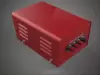
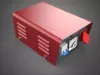
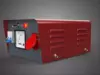
High-quality 3D assets at affordable prices — trusted by designers, engineers, and creators worldwide. Made with care to be versatile, accessible, and ready for your pipeline.
Included File Formats
This model is provided in 14 widely supported formats, ensuring maximum compatibility:
• - FBX (.fbx) – Standard format for most 3D software and pipelines
• - OBJ + MTL (.obj, .mtl) – Wavefront format, widely used and compatible
• - STL (.stl) – Exported mesh geometry; may be suitable for 3D printing with adjustments
• - STEP (.step, .stp) – CAD format using NURBS surfaces
• - IGES (.iges, .igs) – Common format for CAD/CAM and engineering workflows (NURBS)
• - SAT (.sat) – ACIS solid model format (NURBS)
• - DAE (.dae) – Collada format for 3D applications and animations
• - glTF (.glb) – Modern, lightweight format for web, AR, and real-time engines
• - 3DS (.3ds) – Legacy format with broad software support
• - 3ds Max (.max) – Provided for 3ds Max users
• - Blender (.blend) – Provided for Blender users
• - SketchUp (.skp) – Compatible with all SketchUp versions
• - AutoCAD (.dwg) – Suitable for technical and architectural workflows
• - Rhino (.3dm) – Provided for Rhino users
Model Info
• - All files are checked and tested for integrity and correct content
• - Geometry uses real-world scale; model resolution varies depending on the product (high or low poly)
• • - Scene setup and mesh structure may vary depending on model complexity
• - Rendered using Luxion KeyShot
• - Affordable price with professional detailing
Buy with confidence. Quality and compatibility guaranteed.
If you have any questions about the file formats, feel free to send us a message — we're happy to assist you!
Sincerely,
SURF3D
Trusted source for professional and affordable 3D models.
More Information About 3D Model :
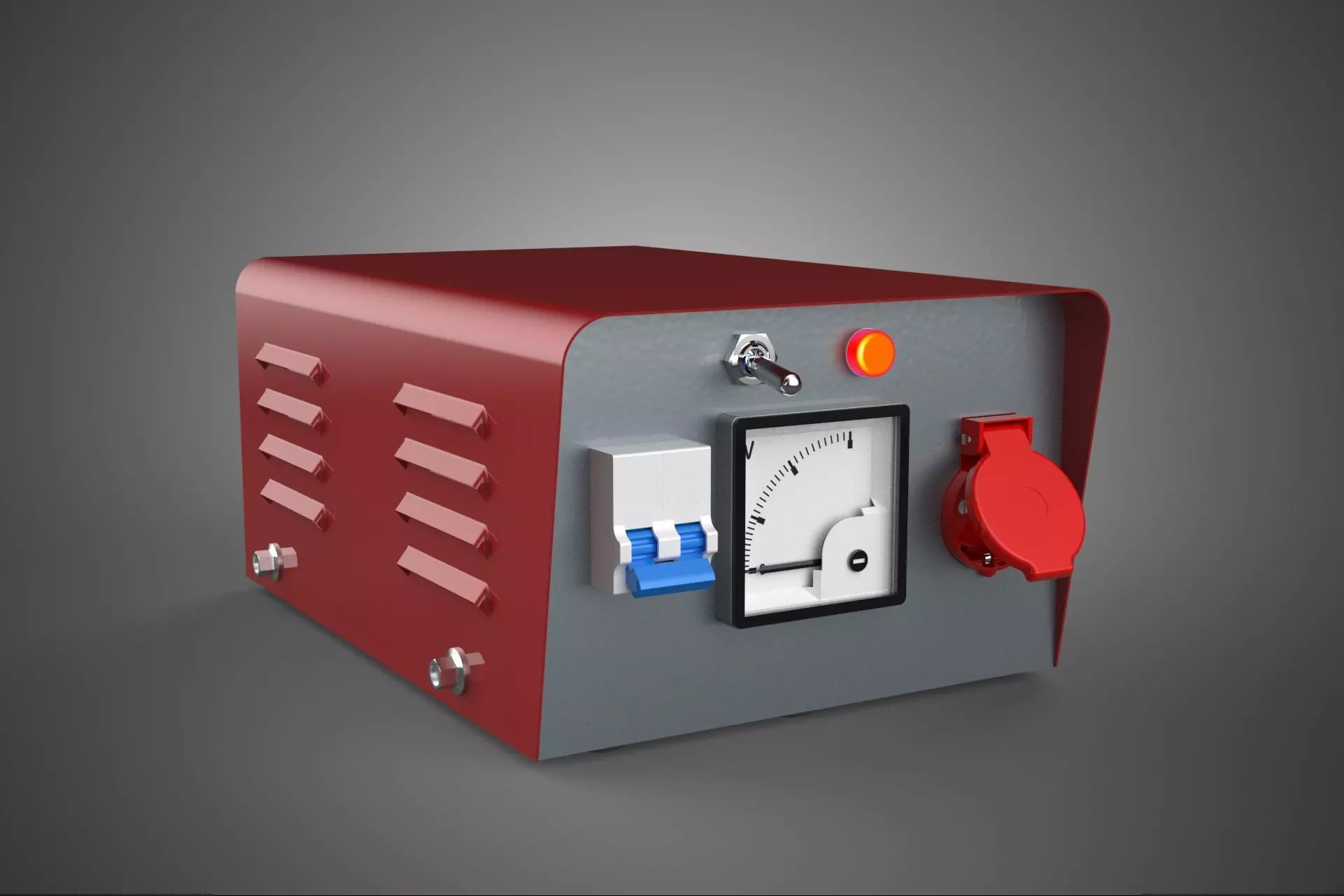
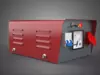
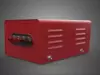
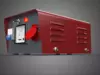
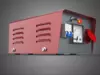
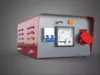
An electrical power supply control panel socket regulator outlet VA, often synthesized into a modular instrument known as a Regulated Benchtop Power Source or Precision Test Supply Unit, is an integrated electrical apparatus designed to provide stable, adjustable, and monitored power output for testing, development, and specialized operational needs.
Definition and Architecture
This device serves as a sophisticated intermediary between the primary electrical source (mains voltage) and a connected load, ensuring that the delivered electrical characteristics (voltage, current, and stability) meet strict operational tolerances. The architecture is defined by three primary functional components: the Power Supply conditioning stage, the Regulator mechanism, and the Control Panel/Outlet user interface.
The Control Panel
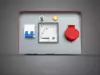
The Control Panel constitutes the human-machine interface (HMI). It houses all necessary instrumentation and controls for setting, monitoring, and protecting the output. Typical features include:
- Setting Controls: Precision multi-turn potentiometers or digital encoders used to adjust the target output voltage and current limits (often enabling Constant Voltage (CV) and Constant Current (CC) operation modes).
- Instrumentation: Digital or analog meters (voltmeters and ammeters) for real-time monitoring of the output parameters. Higher-end units may display power (Watts) or energy delivered.
- Safety and Status Indicators: LEDs or LCD displays indicating operating mode (CV/CC), overload conditions, thermal warnings, and input power status.
- Protection Circuitry: Fuses, circuit breakers, and mechanisms for Over-Voltage Protection (OVP) and Over-Current Protection (OCP) integrated into the panel architecture.
### Regulation Mechanism
The Regulator is the critical active component responsible for maintaining the specified output stability, independent of fluctuations in the input mains voltage (line regulation) or changes in the connected load impedance (load regulation). Regulation is achieved primarily through two methodologies:
- Linear Regulation: Utilizes active components (e.g., transistors) operating in their linear region to dissipate excess voltage as heat, offering very low ripple and noise, high precision, and fast transient response, suitable for sensitive electronic circuits.
- Switching Regulation: Employs high-frequency switching techniques combined with filtering to modulate the output. This method offers significantly higher efficiency and power density, especially beneficial for high-power (high VA) units.
### Output Interface and Rating (Socket, Outlet, VA)
The Socket or Outlet refers to the physical terminals where the load is connected. For benchtop units, this typically involves safety-shrouded binding posts (banana plug terminals) to facilitate secure connections for various test leads. For higher VA industrial supplies, standard AC outlets (NEMA, IEC, or specialized industrial connectors) may be integrated directly into the panel.
VA (Volt-Ampere) represents the apparent power capacity of the unit. This metric is crucial for defining the maximum load the supply can safely deliver continuously without thermal failure or saturation. It is the product of the RMS voltage and RMS current output capacity ($S = V_{RMS} \times I_{RMS}$). The VA rating dictates the physical sizing of internal components, including transformers, switching elements, heat sinks, and filtering capacitors, and must be selected to accommodate the total required load power plus an appropriate safety margin.
---
KEYWORDS: Regulated Power Supply, Control Panel, Volt-Ampere, Apparent Power, Voltage Regulator, Current Regulator, Constant Voltage, Constant Current, Line Regulation, Load Regulation, Output Socket, Binding Post, Benchtop Power, Precision Test Equipment, HMI, Potentiometer, Over-Current Protection, OVP, Switching Regulator, Linear Regulator, Electrical Stability, Power Conversion, Power Conditioning, Test Supply Unit, Current Limiting, AC/DC Conversion, Circuit Breaker, Power Metering, Power Density, Transient Response.