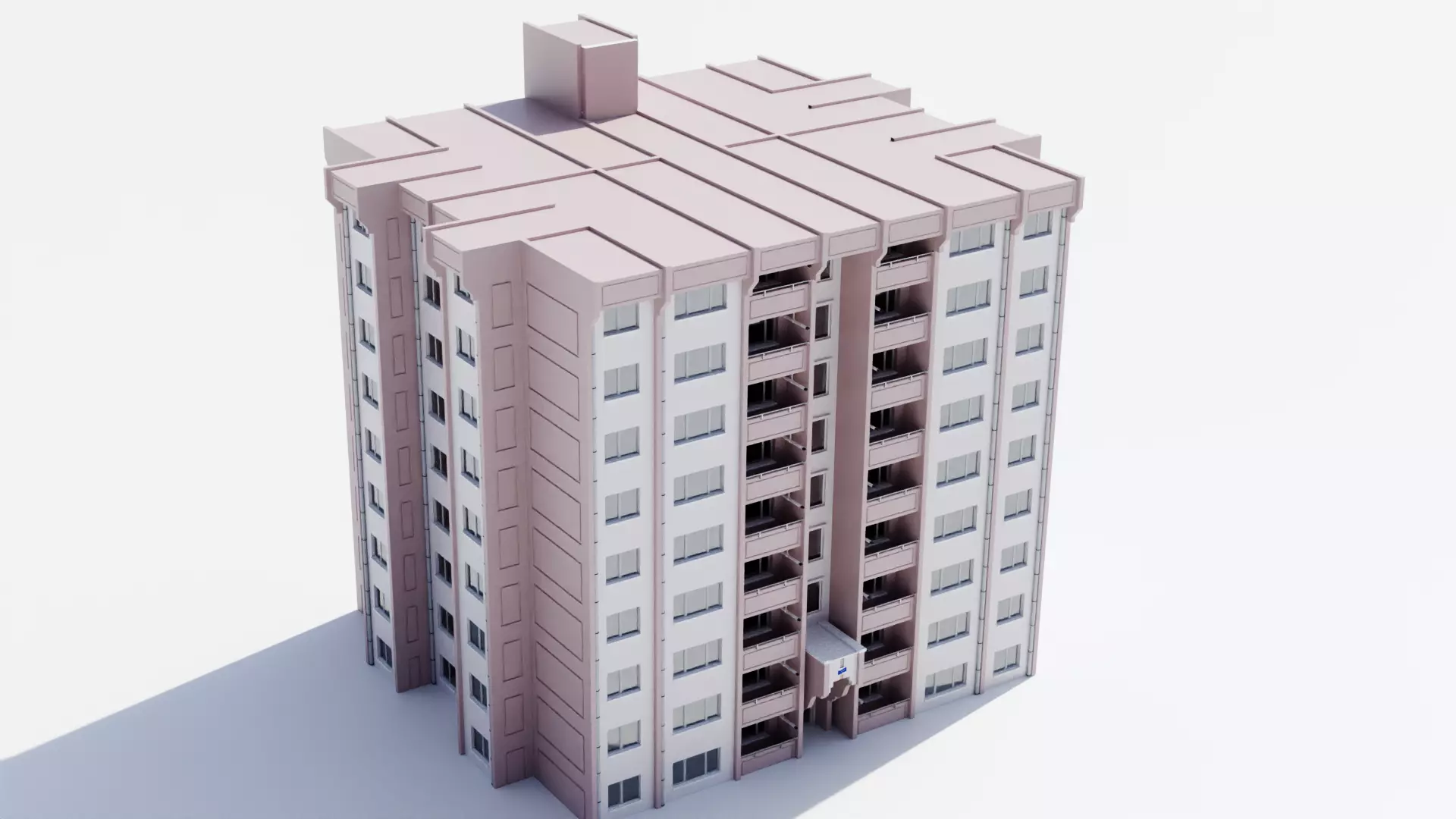
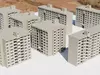
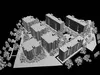
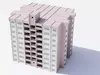
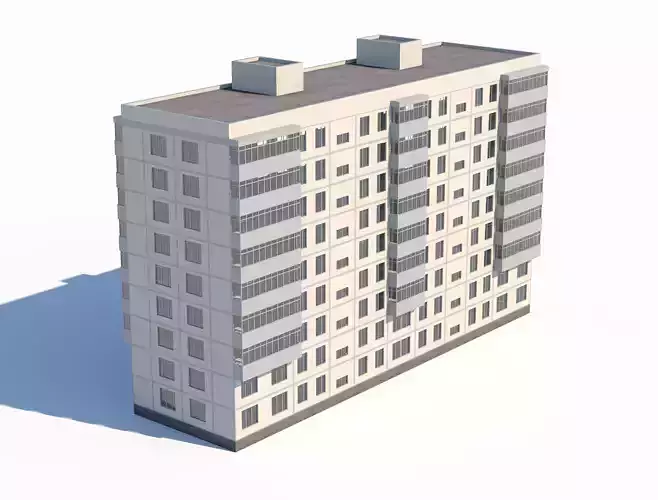
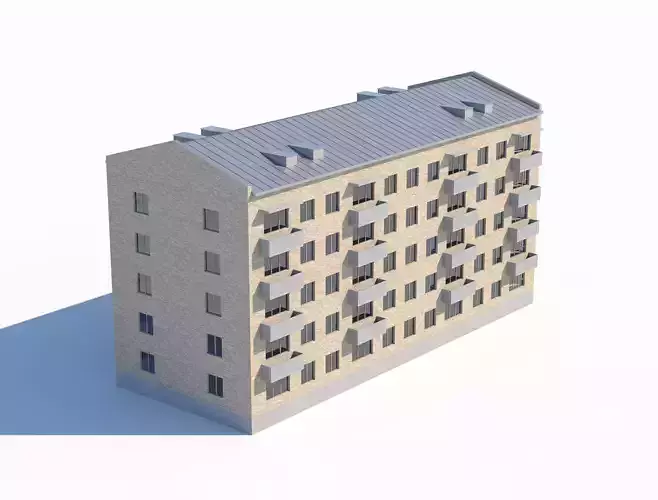
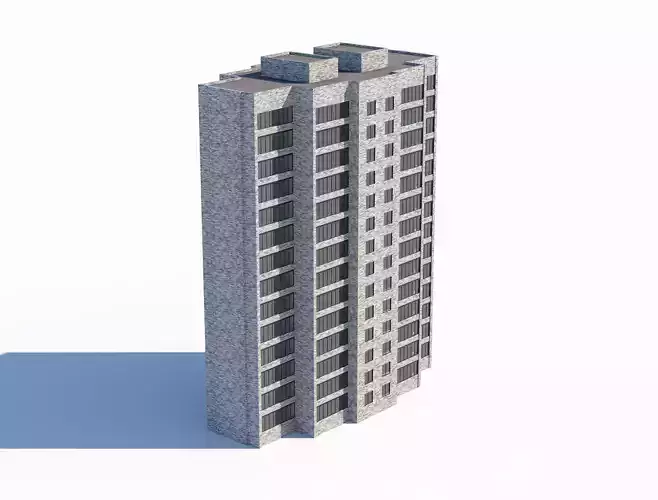
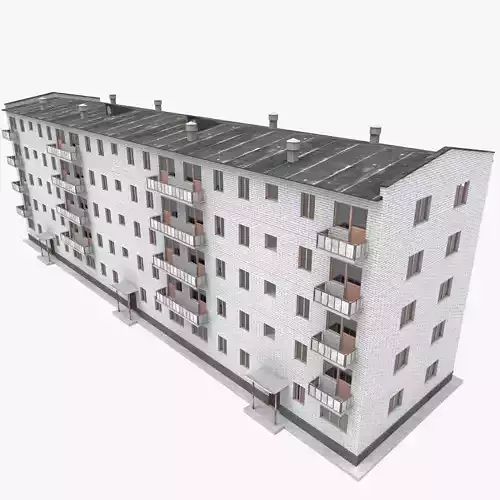
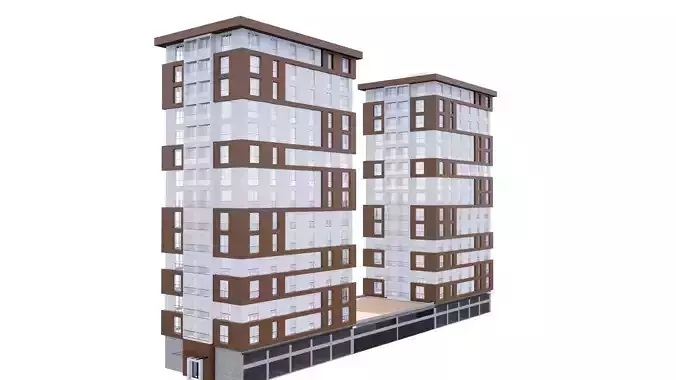
This digital asset is a nine-story modular residential architecture model designed with a comprehensive optimization philosophy to bridge the gap between visual fidelity and hardware performance—one of the biggest technical bottlenecks in modern game development. Aesthetically blending stylized elements with pastel pink tones, this structure is engineered not merely as a distant background decoration or skybox prop, but as a primary environment element with which players can interact at street level in open-world games or urban simulations. Fully realized on all four sides—including complete front, back, and side facades—the building has been baked with frozen transforms and precise pivot placement, ensuring it functions flawlessly at a 1:1 real-world scale immediately upon import into game engines without requiring any manual rotation, scaling, or realignment. Ideal for mobile platforms, WebGL-based browser games, or sprawling PC projects with massive city scenes, this model offers developers the luxury of building dense environments without compromising their hardware memory budgets.
At the core of the model's technical architecture lies its greatest engineering advantage: the floor modules and structural sub-elements were produced entirely through linked duplication, utilizing advanced mesh instancing technology within Blender. Consequently, rather than inflating the disk footprint as unique geometric blocks, each individual floor, window frame, or balcony module stores different transform matrices linked back to a single master mesh data block, and this structural hierarchy is preserved seamlessly within the exported FBX container. The secret behind a massive nine-story apartment complex occupying an incredibly lightweight 696 KB on disk is precisely this unmatched data efficiency. When game engines ingest this file, instead of rendering each object from scratch, they load a single geometric reference into the GPU's memory and clone it instantly across the scene; this radically decreases draw call overhead on the CPU, allowing hardware to operate fluidly even under heavy environment loads.
When examining the geometry budget and topological structure in detail, the fact that the entire building—despite its intricate external features—is completed in just 11,508 triangles highlights an optimization success that pushes the boundaries of low-poly efficiency in the gaming industry. The close ratio between the vertex count and face count serves as tangible proof that the topology is entirely free of redundant data, wasted edges, or stray points that would otherwise strain the rendering pipeline. Potential risks commonly associated with stacking modular blocks, such as surface overlapping, face-bleeding, and z-fighting, have been completely eliminated by manually culling the hidden horizontal ceiling and floor polygons where modules meet. This structural housecleaning prevents game engines from generating erroneous shadow or lighting artifacts, while simultaneously stopping the hardware from rendering obscured faces, thereby reducing pixel overdraw and preventing GPU thermal throttling.
The mechanism ensuring that the visual fidelity remains uncompromised even at extreme close-ups, preserving the sharpness of the marble and wall surfaces, is the deliberate implementation of a seamless tiling material architecture rather than using massive unique texture maps. No matter how close the player's camera gets to the balcony rails or the ground-floor marble cladding, the textures will suffer zero pixelation, blurriness, or resolution loss, as the texture coordinates are mapped to deliver infinite crispness across all surfaces. This approach represents the industry-standard method for achieving maximum visual clarity with minimal VRAM utilization, bypassing the need to choke the graphics card's video memory with bloated texture files. Gearing up to deploy this asset, developers only need to ensure that their engine-side import settings do not force-merge all sub-meshes into a single unique static actor, thereby keeping embedded instancing data and lightweight performance benefits fully operational within the build.