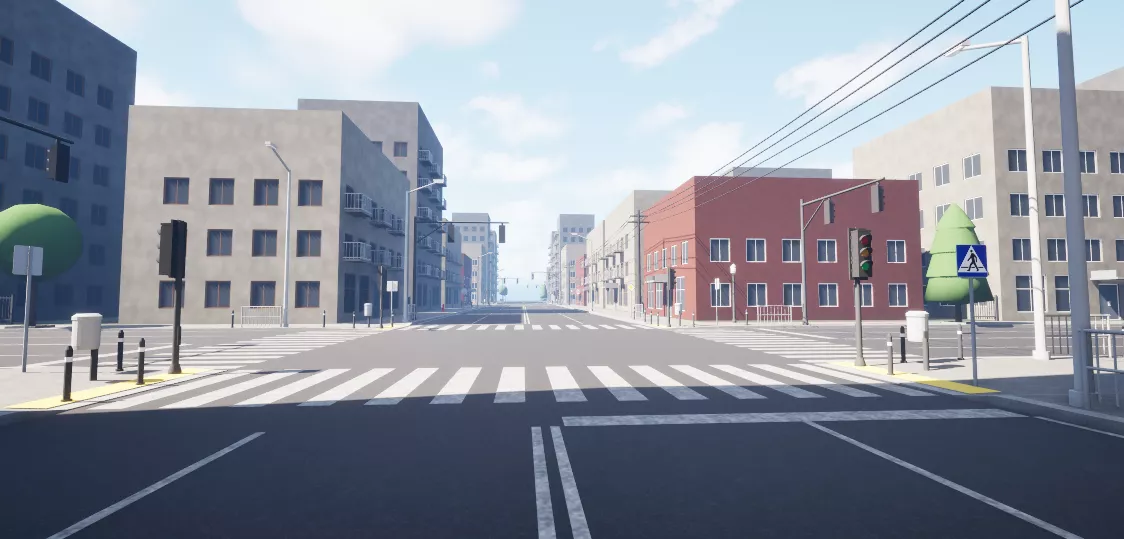
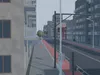
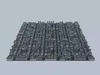
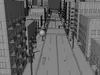
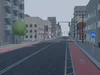
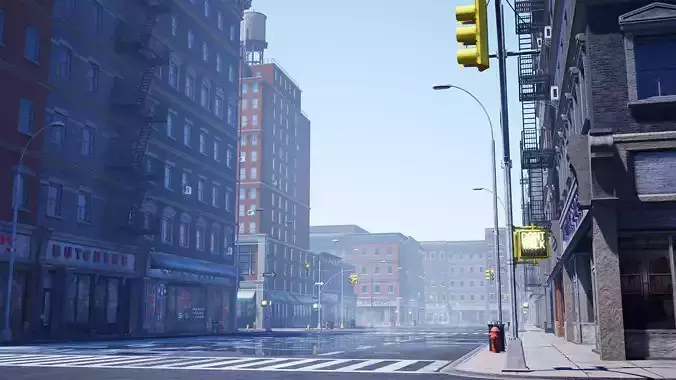
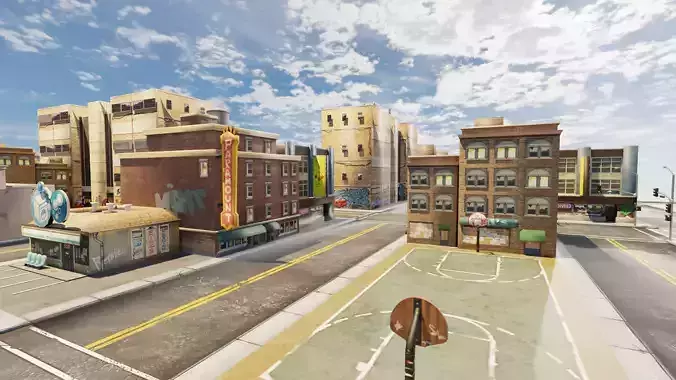
Modular 600 x 600 m city built from nine interchangeable 200 x 200 m tiles, plus all 31 props as separate spawnable files. Made for driving simulation, digital twins and autonomous-vehicle work, and equally usable as a game or archviz environment. Ships as USD, glTF and FBX exports - one file per tile, one per prop, and one full assembled city, in every format, each supplied in a with-colliders and a no-colliders build - plus a single Blender file that contains the lot. Contains blender (python) script to controll traffic lights.
HIGHLIGHTS
- Nine tiles that mate in any rotation. Every open edge presents the same connector: carriageways at +-50 m from the tile centre. One centre tile, four edge tiles, four corner tiles. Arranged as supplied the outer roads close into a perimeter loop, so no road runs off the edge of the world.
- Everything is instanced. 3,262 placed props reference 31 shared prototypes, so the whole city is only 140,620 unique triangles. USD keeps the instancing - the entire city is a 6 MB .usdc. FBX and glTF bake it to 8.8 M triangles but still weigh 17 MB and 12 MB, because each unique mesh is written once and referenced.
- Every tile is centred on zero. Each tile file spans -100..+100 m around the origin, so you drop them onto a plain 200 m grid. Lane dashes, lamp spacing, tree spacing and building frontages all divide 200 m exactly - nothing is cut at a seam.
- Road markings are real geometry, not a texture. Double centre line, dashed dividers that go solid on intersection approaches, edge lines, 14-stripe zebra crossings, stop lines set back.
- Dropped kerbs everywhere they belong. The kerb ramps from 150 mm to 20 mm across every crossing and the footway cross-falls with it, with contrasting tactile paving on each landing.
- A continuous cycle route. 2.0 m red surfacing with hatched buffer, lane lines, bicycle pictograms and C-13 signs, running north-south through every tile.
- Traffic signals in two independent groups. 224 heads, shipped off, split into group A (north-south) and group B (east-west) with separate lens materials - so green on one street and red on the crossing street is two material overrides, not 224 de-instanced heads. Each head carries signal_id, signal_intersection, signal_group, signal_heading_deg and signal_mount as custom properties that survive the USD, FBX and glTF export.A Blender add-on script is included to drive them. traffic_control.py ships with the .blend: open it in the Scripting workspace, press Run Script, and a City tab appears in the 3D viewport sidebar with junction phase buttons (A green / B red, B green / A red), per-group Off / Red / Red+Amber / Amber / Green, and a button that prints every head with its metadata. No file paths to edit, nothing to install. The same functions work from the Python Console - tc.set_phase(A), tc.set_group(B, amber), tc.all_off().
- Real window openings. Modelled frames, jambs, head and cill, mullions and transoms, 140 mm reveals, glass recessed 100 mm. Nothing coplanar, so no z-fighting at distance.
- Collision meshes, or not - your choice. Every format ships twice: a withCollider build with 66 convex *_phys hulls (no material, tagged simready_role and physics_approximation) and a noCollider build with render geometry only. Complex props carry one hull per moving part - the boom-arm signal has four, the bus shelter eleven - so a vehicle can pass under a boom arm.
- Sim-ready orientation. Metric (1 unit = 1 m), Z-up, transforms applied, origins at bottom centre. Nothing to fix on import.
- USD exported with the Isaac Sim preset. Metres, Z up, TOS xform order, custom properties under the userProperties: namespace, textures referenced by relative path. Each file's root prim is named after the file and is the defaultPrim, so you can reference them all into one stage without name collisions.
SPECIFICATIONS
Tiles: 9 (1 centre, 4 edge, 4 corner), 200 x 200 m eachPlaced instances: 3,262Triangles: 140,620 unique, 8,815,216 de-instancedPrototypes: 33Materials: 54, Textures: 24 PNG, 512-1024 pxColliders: 66 convex hullsUnits: metric, 1 unit = 1 m, Z-upFormats: .blend (one file), .usdc, .fbx, .gltf (41 files each, with and without colliders)
WHAT IS IN THE SET
- The full city - 600 x 600 m, all nine tiles assembled, centred on the origin
- 9 tiles - centre, four edge, four corner, each centred on the origin
- 31 props - kerbside and boom-arm traffic signals, 9 m street lamps, 3.6 m pedestrian lamps, four road signs, bollards, pedestrian guardrails, litter bins, hydrants, advertising boards, bus shelters, utility poles with catenary lines, hedges, railings, park benches, five building types and four tree species in street and park variants
- 246 placed road signs - B-33 speed limit, D-6 pedestrian crossing, D-1 priority road, C-13 cycle track
- A park, a car park, bus stops, manholes, gullies and overhead power lines
GOOD TO KNOW
- BaseColor and Roughness maps only. No normal maps. The four road signs additionally carry a packed ORM map.
- Props such as poles, shelters, benches and bins are flat PBR colours, not textured. The road corridor, footways, ground, walls and sign faces are textured.
- Advertising panels are deliberately blank - drop your own artwork on the AdvertPanel material.
- Static environment. No vehicles, no people, no animation, no LODs.
- The Blender folder is one file. It already contains the assembled city, the nine tiles as separate collections and all 33 prototypes in an AssetLibrary collection - File > Append gets you any single tile or prop out of it.