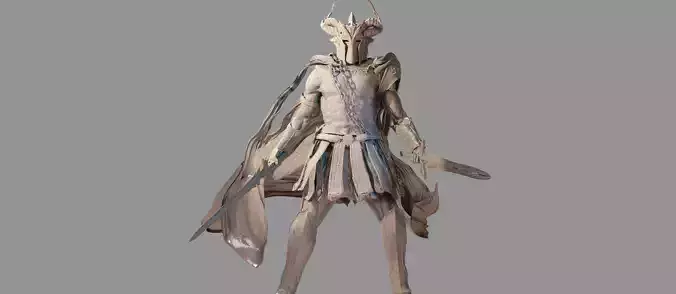
DESCRIPTION

The Huns were a nomadic people who lived in Central Asia, the Caucasus, and Eastern Europe between the 4th and 6th centuries CE. According to European tradition, they were first reported living east of the Volga River, in an area that was part of Scythia at the time.[1] By 370 CE, the Huns had arrived on the Volga, causing the westwards movement of Goths and Alans.[2] By 430, they had established a vast, but short-lived, empire on the Danubian frontier of the Roman empire in Europe. Either under Hunnic hegemony, or fleeing from it, several central and eastern European peoples established kingdoms in the region, including not only Goths and Alans, but also Vandals, Gepids, Heruli, Suebians and Rugians.

The Huns, especially under their King Attila, made frequent and devastating raids into the Eastern Roman Empire. In 451, they invaded the Western Roman province of Gaul, where they fought a combined army of Romans and Visigoths at the Battle of the Catalaunian Fields, and in 452, they invaded Italy. After the death of Attila in 453, the Huns ceased to be a major threat to Rome and lost much of their empire following the Battle of Nedao (c. 454). Descendants of the Huns, or successors with similar names, are recorded by neighboring populations to the south, east, and west as having occupied parts of Eastern Europe and Central Asia from about the 4th to 6th centuries. Variants of the Hun name are recorded in the Caucasus until the early 8th century.

In the 18th century, French scholar Joseph de Guignes became the first to propose a link between the Huns and the Xiongnu people, who lived in northern China from the 3rd century BCE to the late 1st century CE.[3] Since Guignes's time, considerable scholarly effort has been devoted to investigating such a connection. The issue remains controversial, but recent archaeogenetic studies show some Hun-era individuals to have DNA similar to populations in ancient Mongolia.[4] Their relationships with other entities, such as the Iranian Huns and the Huna people who invaded the Indian subcontinent, have also been disputed.

Very little is known about Hunnic culture, and very few archaeological remains have been conclusively associated with the Huns. They are believed to have used bronze cauldrons and to have performed artificial cranial deformation. No description exists of the Hunnic religion at the time of Attila, but practices such as divination are attested, as well as the likely existence of shamans. It is also known that the Huns had a language of their own; however, only three words and personal names attest to it.

Economically, the Huns are known to have practiced a form of nomadic pastoralism. As their contact with the Roman world grew, their economy became increasingly tied with Rome through tribute, raiding, and trade. They do not seem to have had a unified government when they entered Europe but rather to have developed a unified tribal leadership in the course of their wars with the Romans. The Huns ruled over a variety of peoples who spoke numerous languages, and some maintained their own rulers. Their main method of warfare was mounted archery.

The Huns may have initiated the Great Migration, a contributing factor in the collapse of the Western Roman Empire.[5] The memory of the Huns also lived on in the hagiographies of various Christian saints, where the Huns play the role of antagonist, as well as in Germanic heroic legend, where the Huns are variously the antagonists or allies of the main Germanic figures. In Hungary, a legend developed based on medieval chronicles that the Hungarians, and in particular the Székely ethnic group, are descended from the Huns. However, mainstream scholarship has dismissed a close connection between the Hungarians and Huns.[6] Modern culture generally associates the Huns with extreme cruelty and barbarism and is intertwined with the Mongol Empire.[7]

REVIEWS & COMMENTS

See what other buyers think about this model - real feedback on quality,
accuracy, and usability.
There are no reviews or comments yet. Please be the first one to write it.

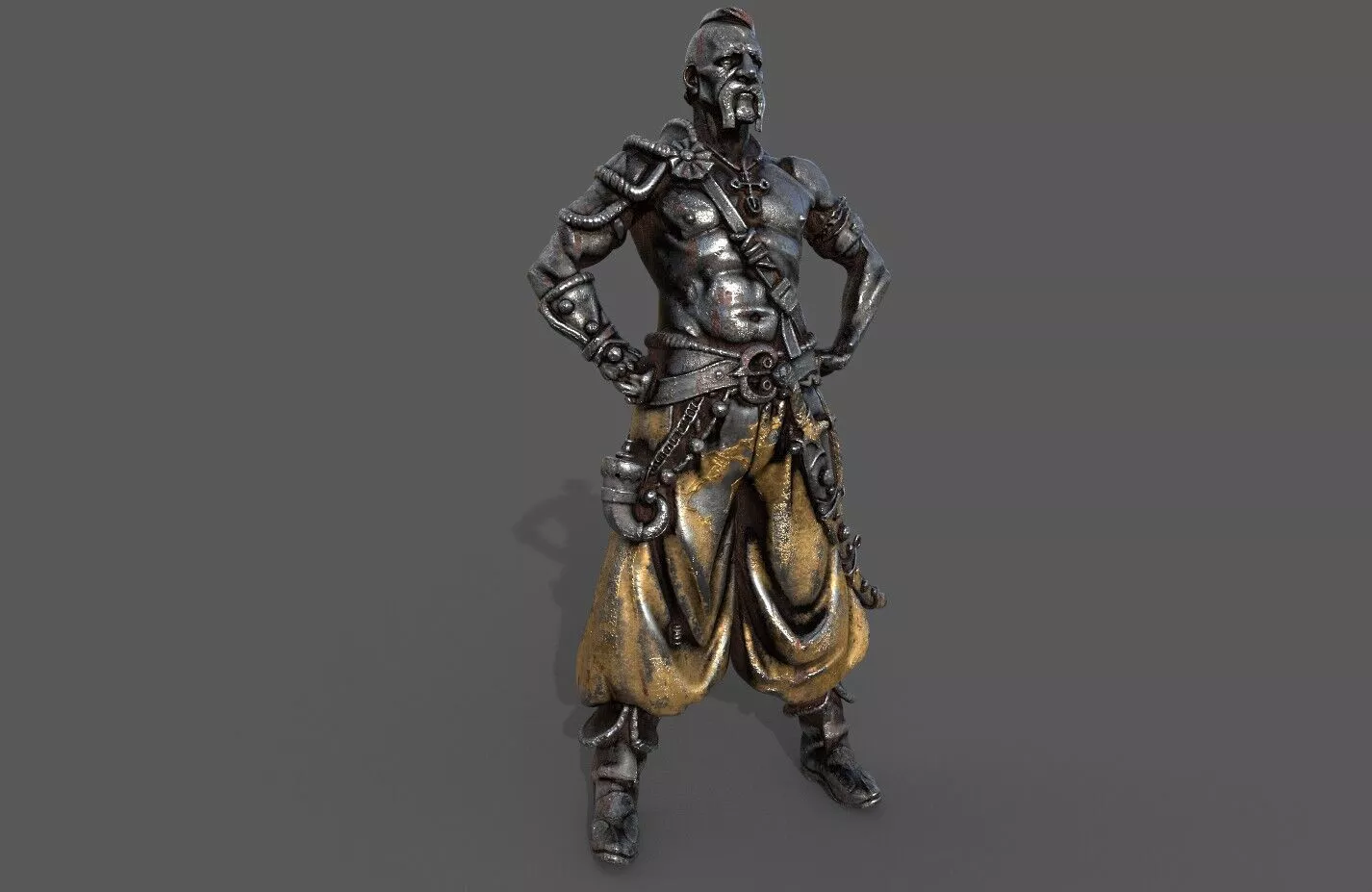
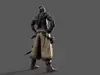
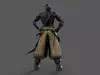
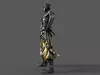
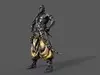
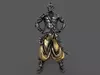
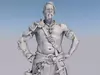
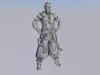
Hun warrior statue 3D model 3D model

$73.00
Royalty Free License
Hire
Like this model to show appreciation to the designer.
See how many times this model was viewed.
Share this model to support the designer and boost their visibility.
File formats
STL
Stereolithography<br />File Size: 47.5 MB
C4D
Cinema 4D<br />Version: 19 - Renderer: Default 19<br />File Size: 34.9 MB
FBX
Autodesk FBX<br />Version: 7.5<br />File Size: 36.9 MB
DAE
Collada<br />Version: 1.5<br />File Size: 77.3 MB
JPG
JPG<br />Version: 19<br />File Size: 59.8 MB
PNG
PNG<br />File Size: 59.8 MB
3DS
3D Studio<br />Version: 1<br />File Size: 25.3 MB
Verified by CGTrader
Verified models are of higher quality as they have
passed CGT Standard technical and visual checks,
making them more professional-grade 3D assets.
Learn more.
FBX
This FBX file has successfully passed the CGT Standard technical and visual checks. The verification results are detailed in the section below.
File & scene
Binary FBX
Binary FBX file is more compact and faster to load and process.
Learn more
No unsupported objects
Unsupported objects:
- Lights
- Cameras
Learn more
Geometry
No N-gons
N-gons are polygons with five or more sides which might cause issues in certain processes like rendering or animation. Learn more
No faceted geometry
Faceted geometry uses flat surfaces without smoothing, which can look unrealistic on curves.
Learn more
Manifold geometry
Manifold geometry ensures all surfaces are properly connected, avoiding issues like edges shared by more than two faces.
Learn more
Textures & material
PBR textures
PBR textures simulate how light interacts with materials, making the model look realistic under different lighting.
Required PBR textures:
- Base Color
- Roughness
- Metalness
- Normal
Learn more
No embed textures
Embedded textures are stored inside the model file, increasing its size and sometimes causing compatibility issues.
Learn more
Square textures
Texture aspect ratio is the width-to-height ratio of a texture. Expected texture aspect ratio: 1:1
Learn more
Power of 2 texture sizes
Textures with dimensions in power of two (e.g. 512x512px, 1024x1024px) are used to optimize performance and memory usage.
Learn more
Assigned materials
Materials are applied to the 3D model to allow visualize a model's surface properties and appearance.
Learn more
UVs & naming
No UV overlaps
UVs overlap when multiple points on the 3D model's surface are mapped to the same point on the UV island causing texture stretching.
Learn more
UV unwrapped model
A UV unwrapped model means its 3D surface is flattened into 2D space, allowing textures to be applied accurately.
Learn more
Allowed characters
Allowed ASCII characters: a-zA-Z0-9-_
Learn more
Provided by designer
Information and details shared directly by the model's designer.
3D Features
PBR
Uses Physically Based Rendering materials, which give the model realistic lighting and surface properties.
Textures
The model includes image files (textures) that add color, patterns, or detail to its surfaces.
Materials
The model has material settings that define how surfaces look (color, shine, transparency, etc.).
UV Mapping
The model's surfaces are mapped to a 2D image, allowing textures to display correctly.
Plugins Used
Some external plugins were used to create the model. These may be required for full functionality.
3D printing
Indicates whether the designer marked this model as suitable for 3D printing.
Model is not 3D printable
The designer indicates this model is intended for digital use only (rendering, animation, or AR/VR) and not for 3D printing.
Geometry
Polygon mesh
A model built from polygons (triangles or quads) connected in a mesh.
1100000 polygons
The total number of polygons (flat shapes) that make up the 3D model.
/
689000 vertices
The number of points (corners) that define the shape of the model's polygons.
Unwrapped UVs
Publish date
Model ID
Chat