Further information: Hanna DiyabKnown along with Ali Baba as one of the orphan tales, the story was not part of the original Nights collection and has no authentic Arabic textual source, but was incorporated into the book Les mille et une nuits by its French translator, Antoine Galland.[2]
John Payne quotes passages from Galland's unpublished diary recording Galland's encounter with a Maronite storyteller from Aleppo, Hanna Diyab.[1] According to Galland's diary, he met with Hanna, who had travelled from Aleppo to Paris with celebrated French traveller Paul Lucas, on March 25, 1709.
Galland's diary further reports that his transcription of Aladdin for publication occurred in the winter of 1709–10. It was included in his volumes ix and x of the Nights, published in 1710, without any mention or published acknowledgment of Hanna's contribution.
Payne also records the discovery in the Bibliothèque Nationale in Paris of two Arabic manuscripts containing Aladdin (with two more of the interpolated tales).
One was written by a Syrian Christian priest living in Paris, named Dionysios Shawish, alias Dom Denis Chavis. The other is supposed to be a copy Mikhail Sabbagh made of a manuscript written in Baghdad in 1703.
It was purchased by the Bibliothèque Nationale at the end of the nineteenth century.[3] As part of his work on the first critical edition of the Nights, Iraq's Muhsin Mahdi has shown[4] that both these manuscripts are back-translations of Galland's text into Arabic.[5][6]Ruth B. Bottigheimer[7] and Paulo Lemos Horta[8][9] have argued that Hanna Diyab should be understood as the original author of some of the stories he supplied, and even that several of Diyab's stories (including Aladdin) were partly inspired by Diyab's own life, as there are parallels with his autobiography.[10]
Plot
The Sorcerer traps Aladdin in the magic cave.
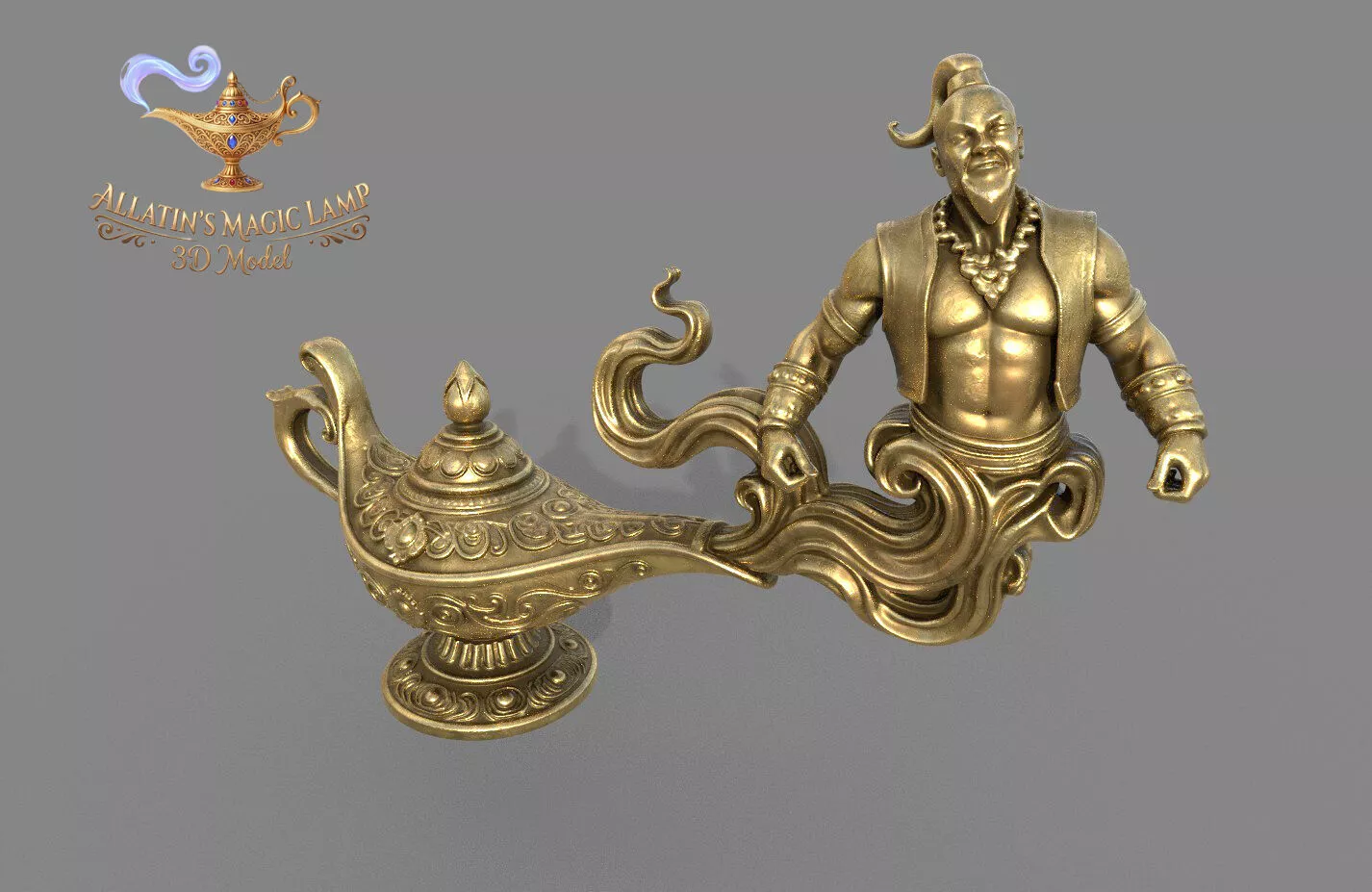
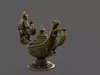
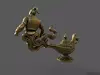
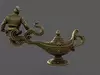
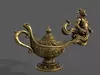
The story has frequently been retold with a number of variations. The following is a précis of the Burton translation of 1885, one of the more significant versions.[11]Aladdin is an impoverished young ne'er-do-well, dwelling in one of the cities of Ancient China. He is recruited by a sorcerer from the Maghreb, who passes himself off as the brother of Aladdin's late father, Mustapha the tailor. The sorcerer convinces Aladdin and his mother of his good will by pretending to set up the lad as a wealthy merchant, but his real ulterior motive is to persuade young Aladdin to retrieve a wonderful oil lamp (chirag) from a booby-trapped magic cave.After the sorcerer attempts to double-cross him, Aladdin finds himself trapped in the cave. Aladdin is still wearing a magic ring the sorcerer has lent him. When he rubs his hands in despair, he inadvertently rubs the ring and a genie appears and releases him from the cave, allowing him to return to his mother while in possession of the lamp. When his mother tries to clean the lamp, so they can sell it to buy food for their supper, a second, far more powerful genie appears; this one is bound to do the bidding of the person holding the lamp.
With the aid of the genie of the lamp, Aladdin becomes rich and powerful and marries Princess Badroulbadour, the sultan's daughter (after magically foiling her marriage to the vizier's son).
The genie builds Aladdin and his bride a wonderful palace, far more magnificent than the sultan's.The sorcerer hears of Aladdin's good fortune, and returns; he gets his hands on the lamp by tricking Aladdin's wife (who is unaware of the lamp's importance) by offering to exchange new lamps for old. He orders the genie of the lamp to take the palace, along with all its contents, to his home in the Maghreb. Aladdin still has the magic ring and is able to summon the lesser genie. The genie of the ring is too weak to directly undo any of the magic of the genie of the lamp, but he is able to transport Aladdin to the Maghreb where, with the help of the woman's wiles of the princess, he recovers the lamp and slays the sorcerer, returning the palace to its proper place.The sorcerer's more powerful and evil brother plots to destroy Aladdin for killing his brother by disguising himself as an old woman known for her healing powers. Princess Badroulbadour falls for his disguise and commands the woman to stay in her palace in case of any illnesses. Aladdin is warned of this danger by the genie of the lamp and slays the impostor.
Aladdin eventually succeeds to his father-in-law's throne