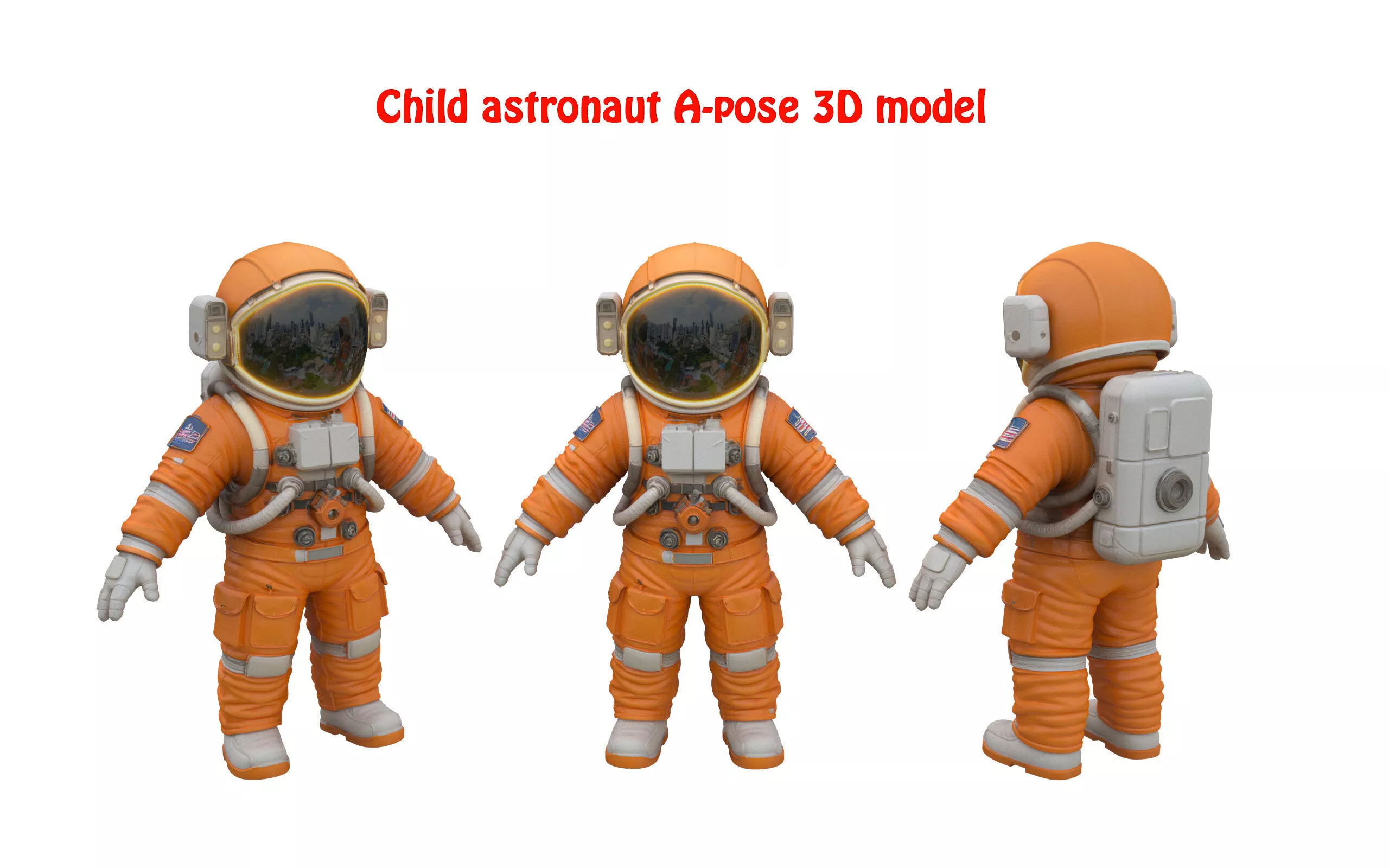
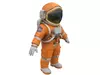
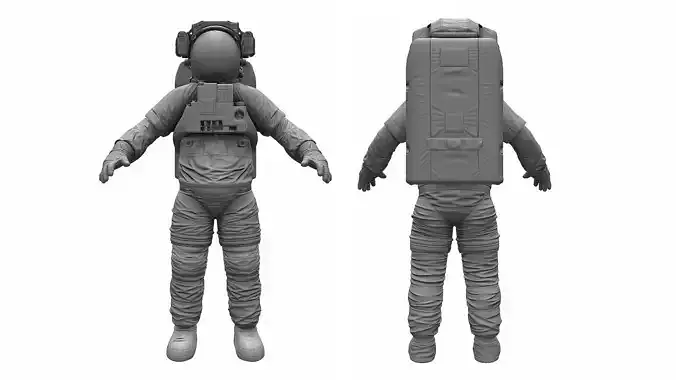
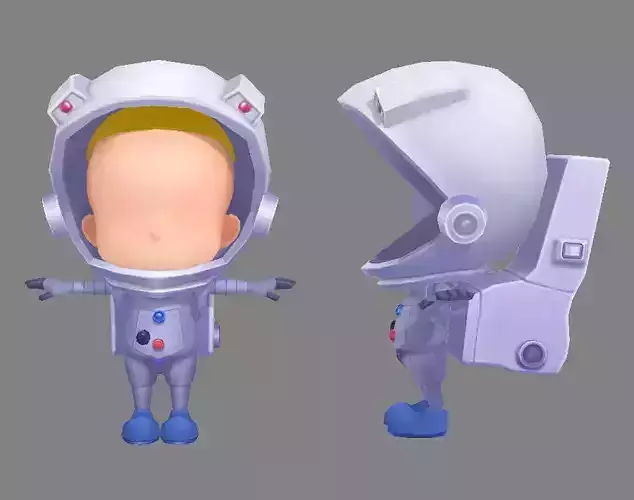
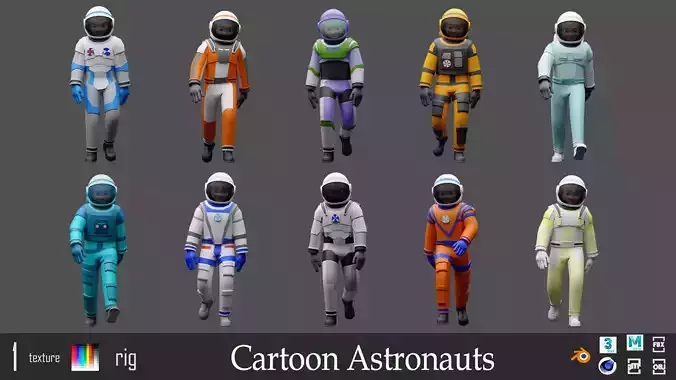
Child astronaut A-pose 3D modelAn astronaut (from the Ancient Greek ἄστρον (astron), meaning 'star', and ναύτης (nautes), meaning 'sailor') is a person trained, equipped, and deployed by a human spaceflight program to serve as a commander or crew member of a spacecraft. Although generally reserved for professional space travelers, the term is sometimes applied to anyone who travels into space, including scientists, politicians, journalists, and space tourists.[1][2] In the United States, it is a designated term used by three agencies: NASA, the FAA, and the military.[3] The term is also used for people who are trained to fly in a spacecraft[4][5] after passing certain training courses,[6] regardless of their experience of space travel.[4][7][8]
Astronaut technically applies to all human space travelers regardless of nationality. However, astronauts fielded by Russia or the Soviet Union are typically known instead as cosmonauts (from the Russian kosmos (космос), meaning space, also borrowed from Greek κόσμος).[9] Comparatively recent successes of the China Manned Space Program have led to the rise of the informal term taikonaut (from the Mandarin tàikōng (太空), meaning space); Chinese official media refers to its astronauts and their foreign counterparts as hángtiānyuán (航天员, meaning celestial navigator or literally heaven-sailing staff). The Canadian Space Agency, European Space Agency, and JAXA refer to their crew as astronauts regardless of launch vehicle; historically other nationalities launched by the Soviet Interkosmos adopted the cosmonaut term.
As of April 2026, 781 humans have flown in space, many of these to space stations.[10] Over 290 individuals have visited the International Space Station;[11] 105 individuals visited the Mir station.[12] Until 2002, astronauts were sponsored and trained exclusively by governments, either by the military or by civilian space agencies. With the suborbital flight of the privately funded SpaceShipOne in 2004, a new category of astronaut was created: the commercial astronaut.
Definition
Alan Shepard aboard Freedom 7 (1961)The word astronaut is sometimes used in a strictly defined sense, such as in the United States, where it is a designated term used by three agencies: NASA, the Federal Aviation Administration, and the military, with slightly different criteria for each. NASA and the military only use the term for their own employees who meet specific criteria.[3] In Europe, the European Astronaut Corps calls graduates of their training program ESA astronauts, being active ESA staff having successfully completed Basic Astronaut training recognised by ESA or who have participated in a mission to space.[6] People who have completed this training are generally described as astronauts in the press,[7][8] and the Collins and Cambridge English Dictionaries define astronaut as people who are trained to fly in a spacecraft.[4][5]
In addition, the criteria for what constitutes human spaceflight vary, with some focus on the point where the atmosphere becomes so thin that centrifugal force, rather than aerodynamic force, carries a significant portion of the weight of the flight object. The Fédération Aéronautique Internationale (FAI) Sporting Code for astronautics recognizes only flights that exceed the Kármán line, at an altitude of 100 kilometers (62 mi).[13] In the United States, professional, military, and commercial astronauts who travel above an altitude of 80 kilometres (50 mi)[14] are awarded astronaut wings.
As of 22 May 2026, 781 people from 55 countries have reached 100 km (62 mi) or more in altitude.[10] Of these, 28 people, all but Canadian Jeremy Hansen from the United States, have traveled beyond low Earth orbit, with three of them—Jim Lovell, John Young and Eugene Cernan—doing so twice.[15] There have been ten crewed missions beyond low Earth orbit: Apollo 8 and Apollo 10 orbited the Moon without landing, Apollos 11–12 and 14–17 landed on the Moon, and Apollo 13 and Artemis II looped around the Moon.
As of 8 November 2023, 676 humans had flown to space under the U.S. definition[16]. Of eight X-15 pilots who exceeded 50 miles (80 km) in altitude, only one, Joseph A. Walker, exceeded 100 kilometers (about 62.1 miles) and he did it two times, becoming the first person in space twice.[17] Space travelers have spent over 41,790 man-days (114.5-man-years) in space, including over 100 astronaut-days of spacewalks.[18][19] As of 2026, the man with the longest cumulative time in space is Oleg Kononenko, who has spent over 1100 days in space.[20] Peggy A. Whitson holds the record for the most time in space by a woman, at 695 days.[21]