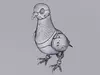
The domestic pigeon (Columba livia domestica or Columba livia forma domestica)[2] is a domesticated bird derived from the rock dove (Columba livia), of which it is also a subspecies. Although often termed a subspecies, the domesticated pigeon does not constitute an accepted zoological subspecies of the rock dove,[1] but a collection of over 350 breeds.[3] The rock dove is among the world's first birds to be domesticated; Mesopotamian cuneiform tablets mention the domestication of pigeons more than 5,000 years ago, as do Egyptian hieroglyphs.
Pigeons have held historical importance to humans as food, pets, symbolic animals, and messengers. Due to their homing ability, pigeons have been used to deliver messages, including war pigeons during the two world wars. City pigeons, which are feral birds, are generally seen as pests, mainly due to their droppings and a reputation for spreading disease.
History of domestication
Emperor Honorius is a historically prominent individual who kept pigeons as pets.Which subspecies of C. livia was the progenitor of domestics, exactly when, how many times, where and how they were domesticated, and how they spread, remains poorly known; despite the long history of pigeons, little is known about the specifics of their initial domestication. Genetically, domesticated pigeons are closest to a cluster of origins of rock dove in the Middle East, particularly in the Syria – Jordan – Iraq – Arabian Peninsula region but also eastern Sudan,[3] thus encompassing all or parts of the ranges of C. l. gaddi, C. l. palaestinae, and C. l. butleri.[3][1]
Their fragile bones and similarity to wild birds make the fossil record a poor tool for their study. Thus most of what is known comes from written accounts, which almost certainly do not cover the first stages of domestication.[4][5][6]
Dovecote at Nymans Gardens, West Sussex, EnglandPigeons were most likely domesticated at least 2000–5000 years ago, and may have been domesticated earlier as a food source.[7] Some research suggests that domestication occurred as early as 10,000 years ago.[8][9] The earliest recorded mention of pigeons comes from Mesopotamia some 5,000 years ago.[10] Pigeon Valley in Cappadocia has rock formations that were carved into ancient dovecotes. Ancient Egyptians kept them.[11] Akbar the Great traveled with a coterie of thousands of pigeons.[12][13][14]
Because domestic and feral pigeons have extensively interbred with wild rock doves, genetically pure wild-type rock doves are now rare and endangered, confined to remote regions such as the oceanic fringes of the species' natural range, in particular the Outer Hebrides off western Scotland.[15][16][17] This frequent admixture further muddies the true origins of pigeons.[5][6]
The domestic pigeon was brought to the Americas by European colonists as an easy source of food and as messengers. Some sources state the species was first introduced to North America in 1606 at Port Royal, Nova Scotia,[18] although other sources cite Plymouth and Jamestown settlements in the early 17th century as the first place for species introduction in North America.[19]
Around the 18th century, European interest in fancy pigeons began, and breeders there greatly expanded the variety of pigeons, importing birds from the Middle East and South Asia and mixing different breeds to create new ones.[5][9] Among these European fanciers was Charles Darwin, who was famously requested to write a book on pigeons during the process of writing On the Origin of Species. His own experiences with pigeon fancying would ultimately lead to another book; The Variation of Animals and Plants Under Domestication.[20][12]
GeneticsA pigeon with A pigeon with ruffled, upright feathers on the back of the head and neck.A Spread Ash Pomeranian show crest pigeon, showing one of the forms of feather crest that pigeons may possessFrom a genetic perspective, there are two loose ancestral clades of pigeons, but there is striking genetic homogeneity due to frequent interbreeding and human directed cross-breeding; pigeon fanciers often do not enforce breed standards, unlike with dogs. The first ancestral clade contains pigeons with exaggerated crops, tails, and manes; the second contains tumblers (the most diverse group), homing pigeons, owl pigeons, and those with exaggerated wattles.[5] Over the millennia of human interaction with pigeons, a multitude of pigeon breeds have been created, which differ in either plumage or body structure.[citation needed]
Some varieties of domestic pigeon have modified feathers called fat quills. These feathers contain yellow, oil-like fat that derives from the same cells as powder down. This is used while preening and helps reduce bacterial degradation of feathers by feather bacilli.[21]