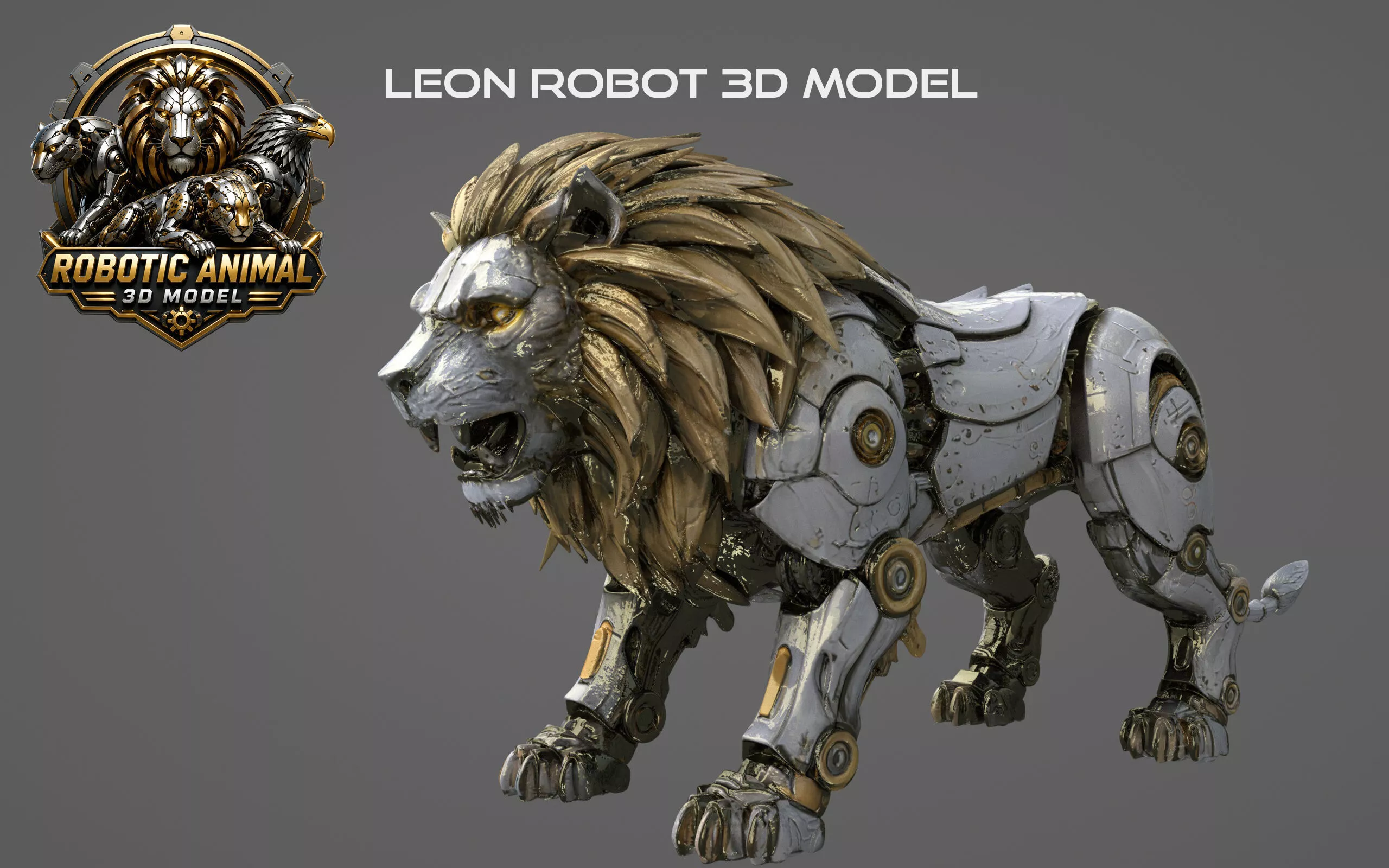
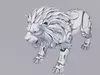
The lion (Panthera leo) is a large cat of the genus Panthera, currently ranging only in Sub-Saharan Africa and India. It has a muscular, broad-chested body; a short, rounded head; round ears; and a dark, hairy tuft at the tip of its tail. It is sexually dimorphic; adult male lions are larger than females and have a prominent mane that extends from the head to the shoulders and chest.
The lion inhabits grasslands, savannahs, and shrublands. It is an apex and keystone predator, preying mostly on medium-sized and large hooved mammals. It is usually more diurnal than other wild cats, but when persecuted, it adapts to being active at night and at twilight. It is a social species, forming groups called prides. A lion pride consists of related females and cubs, and a few or one adult male who is unrelated to the females. Groups of female lions usually hunt together. Adult males often compete to keep or gain their membership in the pride.
During the Neolithic period, the lion ranged throughout Africa and Eurasia, from Southeast Europe to India. Still, it has been reduced to fragmented populations in sub-Saharan Africa and one population in western India. It has been listed as Vulnerable on the IUCN Red List since 1996 because populations in African countries have declined by about 43% since the early 1990s. Lion populations are untenable outside designated protected areas. Although the cause of the decline is not fully understood, habitat loss and conflicts with humans are the greatest causes for concern.
The lion has been extensively depicted in sculptures and paintings, on national flags, and in literature and films. It is one of the most widely recognised animal symbols in human culture. Lions have been kept in menageries since the time of the Roman Empire and have been a key species sought for exhibition in zoological gardens across the world since the late 18th century. Cultural depictions of lions have occurred worldwide, particularly as a symbol of power and royalty. They figure prominently as symbols and deities in ancient religions.
EtymologyThe generic name Panthera is traceable to the classical Latin word 'panthēra' and the ancient Greek word πάνθηρ 'panther'.[4] The English word lion is derived via Anglo-Norman liun from Latin leōnem (nominative: leō), which in turn was a borrowing from ancient Greek λέων léōn. The Hebrew word לָבִיא lavi may also be related.[5]
TaxonomyPanthera
Snow leopard
Tiger
Jaguar
Leopard
Lion
Phylogeny of the genus Panthera based on a 2016 nuclear DNA study[6]Felis leo was the scientific name used by Carl Linnaeus in 1758, who described the lion in his work Systema Naturae.[3] The genus name Panthera was coined by Lorenz Oken in 1816.[7] Between the mid-18th and mid-20th centuries, 26 lion specimens were described and proposed as subspecies, of which 11 were recognised as valid in 2005.[2] They were distinguished mostly by the size and colour of their manes and skins.[8]
SubspeciesIn the 19th and 20th centuries, several lion type specimens were described and proposed as subspecies, with about a dozen recognised as valid taxa until 2017.[2] Between 2008 and 2016, IUCN Red List assessors used only two subspecific names: P. l. leo for African lion populations, and P. l. persica for the Asiatic lion population.[1][9][10] In 2017, the Cat Classification Task Force of the Cat Specialist Group revised lion taxonomy, and recognises two subspecies based on results of several phylogeographic studies on lion evolution, namely:[11]
P. l. leo (Linnaeus, 1758) − the nominate lion subspecies includes the Asiatic lion, the regionally extinct Barbary lion, and lion populations in West and northern parts of Central Africa.[11] Synonyms include P. l. persica (Meyer, 1826), P. l. senegalensis (Meyer, 1826), P. l. kamptzi (Matschie, 1900), and P. l. azandica (Allen, 1924).[2] It has been called 'northern lion' and 'northern subspecies'.[12][13]P. l. melanochaita (Smith, 1842) − includes the extinct Cape lion and lion populations in East and Southern African regions.[11] Synonyms include P. l. somaliensis (Noack 1891), P. l. massaica (Neumann, 1900), P. l. sabakiensis (Lönnberg, 1910), P. l. bleyenberghi (Lönnberg, 1914), P. l. roosevelti (Heller, 1914), P. l. nyanzae (Heller, 1914), P. l. hollisteri (Allen, 1924), P. l. krugeri (Roberts, 1929), P. l. vernayi (Roberts, 1948), and P. l. webbiensis (Zukowsky, 1964).[2][8] It has been referred to as 'southern subspecies' and 'southern lion'.[13]Based on nuclear and mitochondrial DNA, the two subspecies can be further divided into seven clades. Scientists have recommended these clades as basal units for possible translocations of lions between different areas of occurrence.[14]
There is, however, some degree of overlap between the two groups in northern Central Africa. DNA analysis from a more recent study indicates that Central African lions are derived from both northern and southern lions, as they cluster with P. leo leo in mtDNA-based phylogenies. In contrast, their genomic DNA indicates a closer relationship with P. leo melanochaita.[15]
Lion samples from some parts of the Ethiopian Highlands cluster genetically with those from Cameroon and Chad, while lions from other areas of Ethiopia cluster with samples from East Africa. Researchers, therefore, assume Ethiopia is a contact zone between the two subspecies.[16] Genome-wide data of a wild-born historical lion sample from Sudan showed that it clustered with P. l. leo in mtDNA-based phylogenies, but with a high affinity to P. l. melanochaita; this suggested that the taxonomic position of lions in Central Africa may require revision.[17]
Fossil recordsOther lion subspecies or sister species to the modern lion existed in prehistoric times:[18]
P. fossilis was larger than the modern lion and lived in the Middle Pleistocene in Eurasia.[19][20] Thought to be the ancestor of P. spelaea.[21]P. spelaea, or the cave lion, lived in Eurasia and Beringia during the Late Pleistocene. It became extinct due to climate warming or human expansion, latest by 11,900 years ago.[22] Bone fragments excavated in European, North Asian, Canadian, and Alaskan caves indicate that it ranged from Europe across Siberia into western Alaska.[23] It likely derived from P. fossilis,[21] and was genetically isolated and highly distinct from the modern lion in Africa and Eurasia.[24][21] It is depicted in Paleolithic cave paintings, ivory carvings, and clay busts.[25]P. atrox, or the American lion, ranged in the Americas from Canada to possibly Patagonia during the Late Pleistocene.[26] It diverged from the cave lion around 165,000 years ago.[27]Additionally, in 1938, paleontologist Paulus Deraniyagala named a subspecies P. l. sinhaleyus based on two fossils, a lower left carnassial and a damaged right lower canine tooth, both excavated from deposits in Kuruwita, Sri Lanka. He called it narrower and more elongate but otherwise failed to distinguish P. l. sinhaleyus from other lion subspecies. A subsequent study of felid fossils from the Kuruwita deposits in 2005 described the fossils in further detail but only assigned them to P. leo.[28][29]
Evolution
Skull of an American lion on display at the National Museum of Natural History
Panthera spelaea Panthera atrox Panthera leo
Maximal range of the modern lionand its prehistoric relativesin the late PleistoceneThe Panthera lineage is estimated to have genetically diverged from the common ancestor of the Felidae around 10.8 million years ago.[30] Hybridisation between lion and snow leopard ancestors possibly continued until about 2.1 million years ago.[6] The lion-leopard clade was distributed in the Asian and African Palearctic since at least the early Pliocene.[31] The earliest fossils recognisable as lions were found at Olduvai Gorge in Tanzania and are estimated to be up to 2 million years old.[32] Lions first dispersed from Africa into Eurasia around 1 million years ago, giving rise to the cave lion lineage, which is now regarded as a distinct species from the modern lion.[33]
Estimates for the divergence time between the modern and cave lion lineages range from 500,000[17] to 1.9 million years ago.[33] Genetic analysis of the nuclear genome of several cave lion specimens and historical lion specimens indicates that there was limited gene flow (less than 5% of total genome) between them, as some Late Pleistocene cave lion specimens show up to 3.2%–4.4% introgressed ancestry from modern lions, with this modern lion ancestry apparently most closely related to the recently extinct populations of the Asiatic lion found in West Asia.[33] The Eurasian cave and American lions became extinct at the end of the last glacial period as part of the end-Pleistocene extinction event.[24][34][35] The modern lion was probably widely distributed in Africa during the Middle Pleistocene and started to diverge in sub-Saharan Africa during the Late Pleistocene. Lion populations in East and Southern Africa became separated from populations in West and North Africa when the equatorial rainforest expanded 183,500 to 81,800 years ago.[36] They shared a common ancestor probably between 98,000 and 52,000 years ago.[17] Due to the expansion of the Sahara between 83,100 and 26,600 years ago, lion populations in West and North Africa became separated. As the rainforest decreased and thus gave rise to more open habitats, lions moved from West to Central Africa. Lions from North Africa dispersed to southern Europe and Asia between 38,800 and 8,300 years ago.[36]