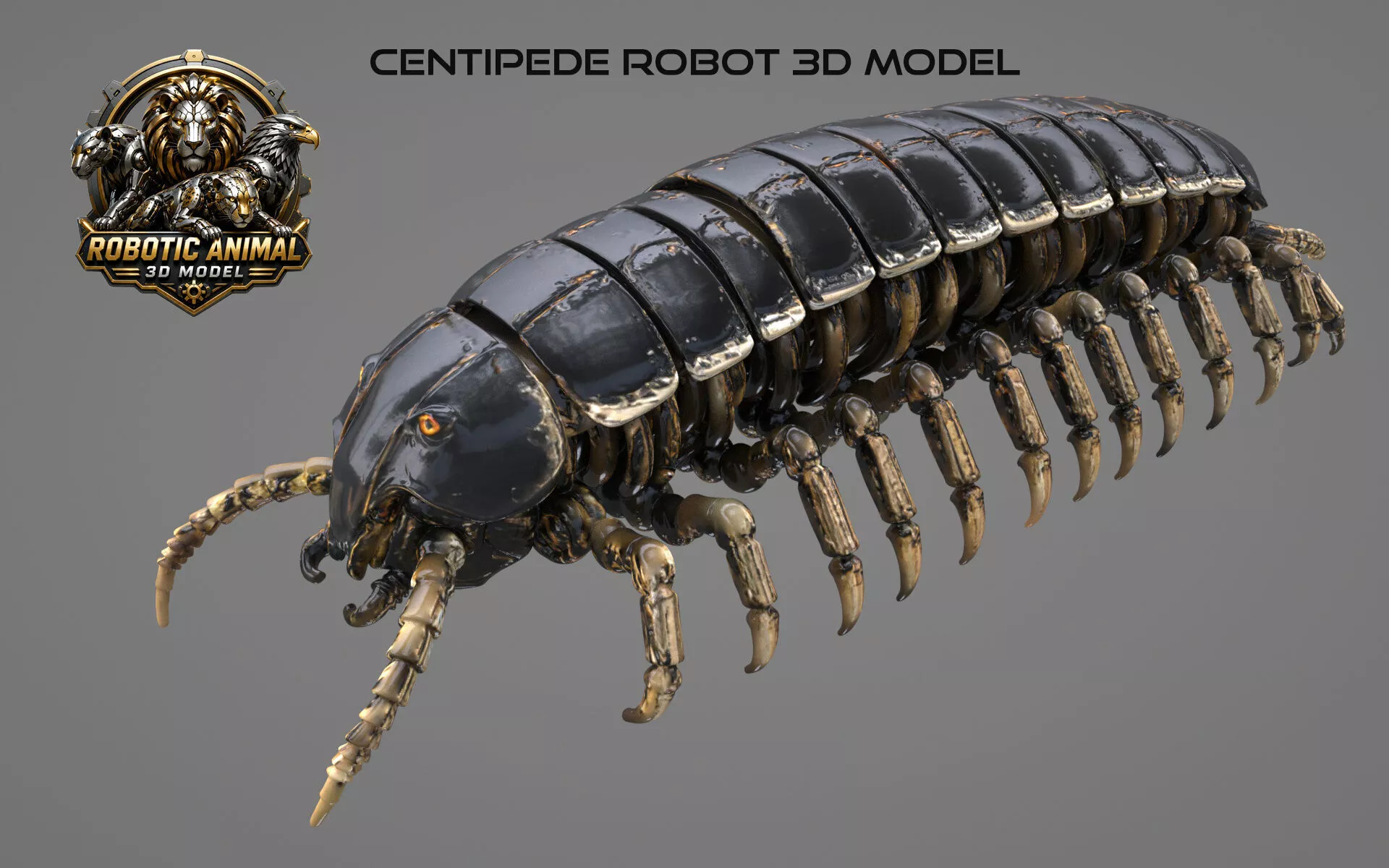
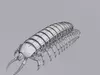
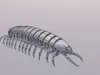
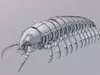
DESCRIPTION

Millipedes (originating from the Latin mille, thousand, and pes, foot)[1][2] are a group of arthropods that are characterised by having two pairs of jointed legs on most body segments; they are known scientifically as the class Diplopoda, the name derived from this feature. Each double-legged segment is a result of two single segments fused together. Most millipedes have very elongated cylindrical or flattened bodies with more than 20 segments, while pill millipedes are shorter and can roll into a tight ball. Although the name millipede derives from Latin for thousand feet, no species was known to have 1,000 or more until the discovery in 2020 of Eumillipes persephone, which can have over 1,300 legs.[3] There are approximately 12,000 named species classified into 16 orders and around 140 families, making Diplopoda the largest class of myriapods, an arthropod subphylum which also includes centipedes and other multi-legged creatures.

Most millipedes are slow-moving detritivores, eating decaying leaves and other dead plant matter; however, some eat fungi or drink plant fluid. Millipedes are generally harmless to humans, although some can become household or garden pests. Millipedes can be an unwanted nuisance particularly in greenhouses where they can potentially cause severe damage to emergent seedlings. Most millipedes defend themselves with a variety of chemicals secreted from pores along the body, although the tiny bristle millipedes are covered with tufts of detachable bristles. Its primary defence mechanism is to curl into a tight coil, thereby protecting its legs and other vital delicate areas on the body behind a hard exoskeleton. Reproduction in most species is carried out by modified male legs called gonopods, which transfer packets of sperm to females.

First appearing in the Silurian period, millipedes are some of the oldest known land animals. Some members of prehistoric groups, such as Arthropleura, grew to over 2 m (6+1⁄2 ft); the largest modern species reach maximum lengths of 27 to 38 cm (10+1⁄2 to 15 in). The longest extant species is the giant African millipede (Archispirostreptus gigas).

Among myriapods, millipedes have traditionally been considered most closely related to the tiny pauropods, although some molecular studies challenge this relationship. Millipedes can be distinguished from the somewhat similar but only distantly related centipedes (class Chilopoda), which move rapidly, are venomous, carnivorous, and have only a single pair of legs on each body segment.

The scientific study of millipedes is known as diplopodology, and a scientist who studies them is called a diplopodologist.

Etymology and namesThe term millipede is widespread in popular and scientific literature, but among North American scientists, the term milliped (without the terminal e) is also used.[4] Other vernacular names include thousand-legger or simply diplopod.[5] The study of millipede biology and taxonomy is called diplopodology.[6]

REVIEWS & COMMENTS

See what other buyers think about this model - real feedback on quality,
accuracy, and usability.
There are no reviews or comments yet. Please be the first one to write it.
NEW
Recently added to CGTrader - explore one of the latest models on the marketplace.

centipede robot 3D model 3D model

Royalty Free License
One-time purchaseRoyalty-free
$78
  • Yours forever — royalty-free license
  • All 8 file formats included
  • Instant download after purchase
Like this model to show appreciation to the designer.
See how many times this model was viewed.
Share this model to support the designer and boost their visibility.
File formats
STL
Stereolithography<br />Version: 1<br />File Size: 47.7 MB
OBJ
OBJ | 2 files<br />Version: 1<br />File Size: 139 MB
3DS
3D Studio<br />Version: 1<br />File Size: 25.3 MB
JPG
JPG<br />Version: 19<br />File Size: 25.7 MB
PNG
PNG<br />File Size: 25.7 MB
DAE
Collada<br />Version: 1<br />File Size: 95.7 MB
C4D
Cinema 4D<br />Version: 19 - Renderer: Default 19<br />File Size: 57.6 MB
FBX
Autodesk FBX<br />Version: 1<br />File Size: 64.8 MB
Verified by CGTrader
Verified models are of higher quality as they have
passed CGT Standard technical and visual checks,
making them more professional-grade 3D assets.
Learn more.
FBX
This FBX file has successfully passed the CGT Standard technical and visual checks. The verification results are detailed in the section below.
File & scene
Binary FBX
Binary FBX file is more compact and faster to load and process.
Learn more
No unsupported objects
Unsupported objects:
- Lights
- Cameras
Learn more
Geometry
No N-gons
N-gons are polygons with five or more sides which might cause issues in certain processes like rendering or animation. Learn more
No faceted geometry
Faceted geometry uses flat surfaces without smoothing, which can look unrealistic on curves.
Learn more
Manifold geometry
Manifold geometry ensures all surfaces are properly connected, avoiding issues like edges shared by more than two faces.
Learn more
Textures & material
PBR textures
PBR textures simulate how light interacts with materials, making the model look realistic under different lighting.
Required PBR textures:
- Base Color
- Roughness
- Metalness
- Normal
Learn more
No embed textures
Embedded textures are stored inside the model file, increasing its size and sometimes causing compatibility issues.
Learn more
Square textures
Texture aspect ratio is the width-to-height ratio of a texture. Expected texture aspect ratio: 1:1
Learn more
Power of 2 texture sizes
Textures with dimensions in power of two (e.g. 512x512px, 1024x1024px) are used to optimize performance and memory usage.
Learn more
Assigned materials
Materials are applied to the 3D model to allow visualize a model's surface properties and appearance.
Learn more
UVs & naming
No UV overlaps
UVs overlap when multiple points on the 3D model's surface are mapped to the same point on the UV island causing texture stretching.
Learn more
UV unwrapped model
A UV unwrapped model means its 3D surface is flattened into 2D space, allowing textures to be applied accurately.
Learn more
Allowed characters
Allowed ASCII characters: a-zA-Z0-9-_
Learn more
Provided by designer
Information and details shared directly by the model's designer.
3D Features
PBR
Uses Physically Based Rendering materials, which give the model realistic lighting and surface properties.
Textures
The model includes image files (textures) that add color, patterns, or detail to its surfaces.
Materials
The model has material settings that define how surfaces look (color, shine, transparency, etc.).
UV Mapping
The model's surfaces are mapped to a 2D image, allowing textures to display correctly.
Plugins Used
Some external plugins were used to create the model. These may be required for full functionality.
3D printing
Indicates whether the designer marked this model as suitable for 3D printing.
Model is not 3D printable
The designer indicates this model is intended for digital use only (rendering, animation, or AR/VR) and not for 3D printing.
Geometry
Polygon mesh
A model built from polygons (triangles or quads) connected in a mesh.
1100000 polygons
The total number of polygons (flat shapes) that make up the 3D model.
/
1100000 vertices
The number of points (corners) that define the shape of the model's polygons.
Unwrapped UVs
Publish date
Model ID
Chat