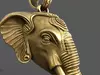
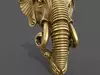
The Indian elephant (Elephas maximus indicus) is one of three extant recognized subspecies of the Asian elephant, native to mainland Asia. It has a convex back and the highest body point on its head, exhibits significant sexual dimorphism with a male reaching an average shoulder height of about 2.75 m (9 ft 0 in) and weighing 4,000 kg (8,800 lb). A female reaches an average shoulder height of about 2.4 m (7 ft 10 in) and weighs 2,700 kg (6,000 lb). It has a broader skull with a concave forehead, two large laterally folded ears and a large trunk. It has smooth grey skin with four large legs and a long tail.
The Indian elephant is native to mainland Asia with nearly three-fourth of the population in India. It also occurs in Nepal, Bangladesh, Bhutan and Southeast Asian countries including Myanmar, Thailand, Malaysia, Laos, Cambodia, and Vietnam with a small population in China. It inhabits grasslands, dry deciduous, moist deciduous, evergreen and semi-evergreen forests across the range. It is classified as a megaherbivore and consumes up to 150 kg (330 lb) of plant matter per day. Its diet depends on the habitat and seasons and includes leaves and twigs of fresh foliage, thorn-bearing shoots, flowering plants, fruits and grass.
Since 1986, the Asian elephant has been listed as Endangered on the IUCN Red List as the wild population has declined by at least 50% over the last three elephant generations. It is threatened by environmental degradation, habitat loss and fragmentation. Poaching for ivory is a serious threat in some parts of Asia. Project Elephant was launched in 1992 by the Government of India to protect elephant habitats and population.
The Indian elephant is a cultural symbol throughout its range and appears in various religious traditions and mythologies. It is treated positively and is revered as a form of Ganesha in Hinduism. It has been designated the national heritage animal in India and is the national animal of Thailand and Laos