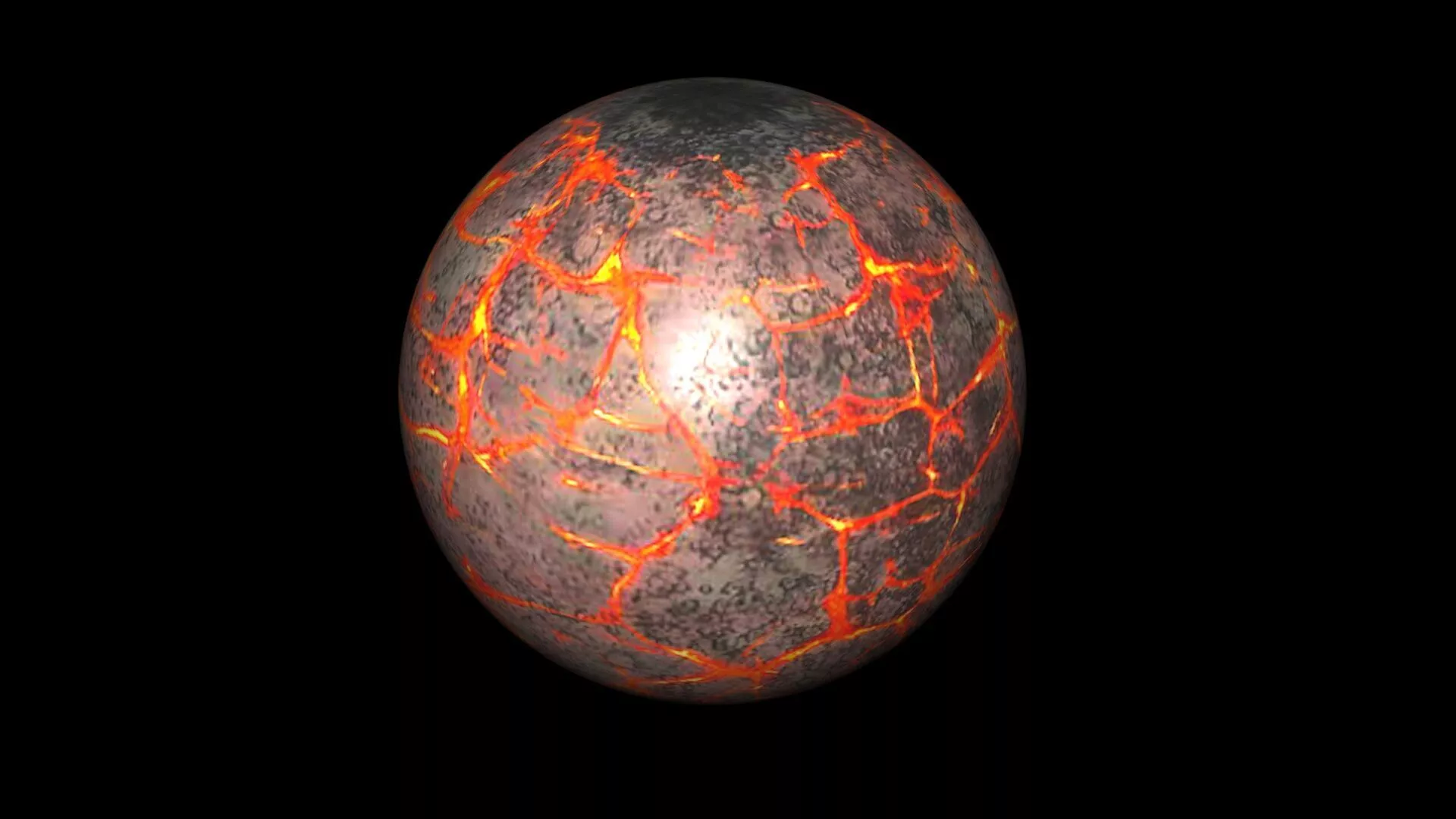
Description55 Cancri Ae (abbreviated 55 Cnc Ae), officially named Janssen, is an exoplanet orbiting a Sun-like host star, 55 Cancri A. The mass of the exoplanet is about eight Earth masses and its diameter is about twice that of the Earth. 55 Cancri Ae was discovered in data taken during 2003–2004 and announced in 2004, thus making it the first super-Earth discovered around a main sequence star, predating Gliese 876 d by a year. It is the innermost planet in its planetary system, taking less than 18 hours to complete an orbit. However, until the 2010 observations and recalculations, this planet had been thought to take about 2.8 days to orbit the star. Due to its proximity to its star, 55 Cancri Ae is extremely hot, with temperatures on the day side exceeding 3,000 Kelvin. The planet's thermal emission is observed to be variable, possibly as a result of volcanic activity. It has been proposed that 55 Cancri Ae could be a carbon planet. The atmosphere of 55 Cancri Ae has been extensively studied, with varying results. Initial studies suggested an atmosphere rich in hydrogen and helium, but later studies failed to confirm this, instead supporting an atmosphere composed of heavier molecules, possibly only a thin atmosphere of vaporized rock. Most recently as of 2024, JWST observations have ruled out the rock vapor atmosphere scenario and provided evidence for a substantial atmosphere rich in carbon dioxide or carbon monoxide. In July 2014 the International Astronomical Union (IAU) launched NameExoWorlds, a process for giving proper names to certain exoplanets and their host stars. The process involved public nomination and voting for the new names. In December 2015, the IAU announced the winning name was Janssen for this planet. The winning name was submitted by the Royal Netherlands Association for Meteorology and Astronomy of the Netherlands. It honors the spectacle maker Zacharias Janssen who is sometimes associated with the invention of the telescope. 55 Cancri Ae was discovered in 2004 by a team of astronomers led by Barbara E. McArthur, using data taken with the Hobby–Eberly Telescope at McDonald Observatory in Davis Mountains, Texas. Like the majority of extrasolar planets found prior to the Kepler mission, 55 Cancri Ae was discovered by detecting variations in its star's radial velocity. This was achieved by making sensitive measurements of the Doppler shift of the spectrum of 55 Cancri A. At the time of its discovery, three other planets were known orbiting the star. After accounting for these planets, a signal at around 2.8 days remained, which could be explained by a planet of at least 14.2 Earth masses in a very close orbit. The same measurements were used to confirm the existence of the uncertain planet 55 Cancri Ac. 55 Cancri Ae was one of the first extrasolar planets with a mass comparable to that of Neptune to be discovered. It was announced at the same time as Gliese 436 b, another hot Neptune orbiting the red dwarf star Gliese 436. In 2005, the existence of planet e was questioned by Jack Wisdom in a reanalysis of the data. He suggested that the 2.8-day planet was an alias and, separately, that there was a 260-day planet in orbit around 55 Cancri. In 2008, Fischer et al. published a new analysis that appeared to confirm the existence of the 2.8-day planet and the 260-day planet. However, the 2.8-day planet was shown to be an alias by Dawson and Fabrycky in 2010; its true period was 0.7365 days. The planet's transit of its host star was announced on 27 April 2011, based on two weeks of nearly continuous photometric monitoring with the MOST space telescope. The transits occur with the period (0.74 days) and phase that had been predicted by Dawson and Fabrycky. This is one of the few planetary transits to be confirmed around a well-known star, and allowed investigations into the planet's composition. 55 Cancri Ae orbits very close to its parent star; with average orbital distance of 0.01544 ± 0.00005 AU, it takes only 18 hours to complete an orbit. Analysis of its transits reveal that its orbital inclination is about 83.6° and appears to be close to being aligned with the rotation of its parent star, with obliquity of 23 +14°−12°, favouring dynamically gentle inward migration scenarios for this planet. 55 Cancri Ae may also be coplanar with the next planet in the system, 55 Cancri Ab. Due to its old age and proximity to the star, the planet is extremely likely to be tidally locked, meaning that one hemisphere, referred to as dayside, permanently faces the star, while the other, the nightside, always faces away from it.
Texture Resolution: 783 x 391