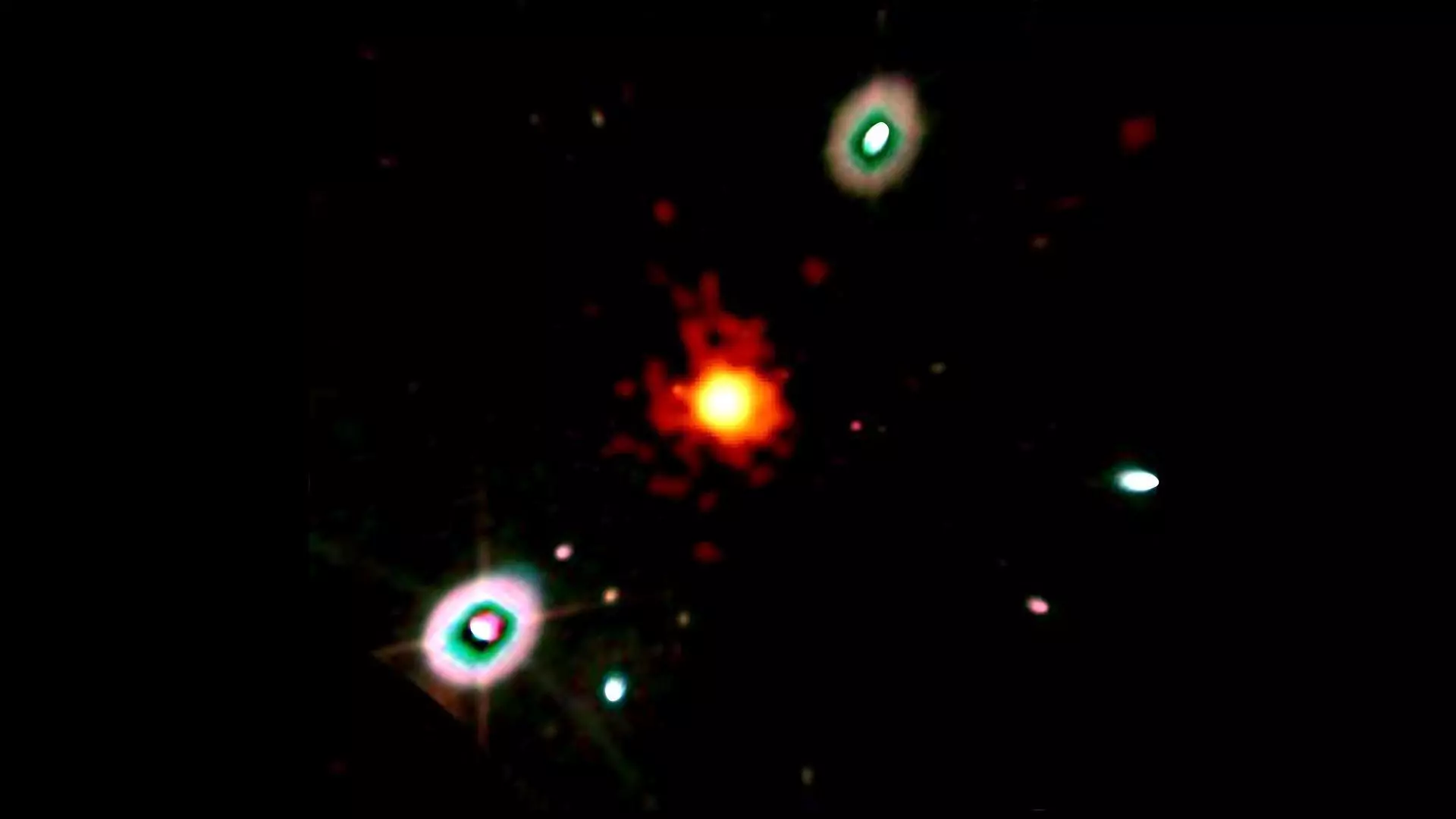
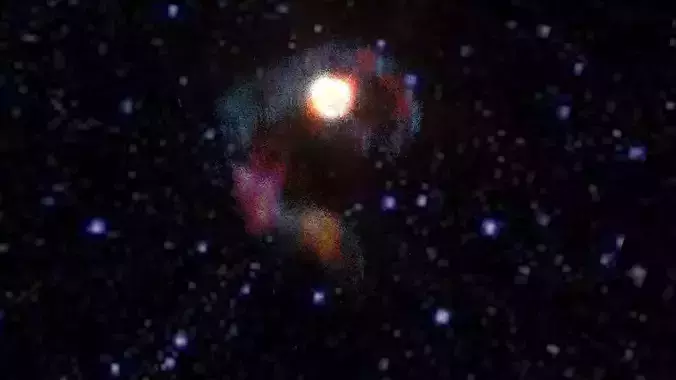
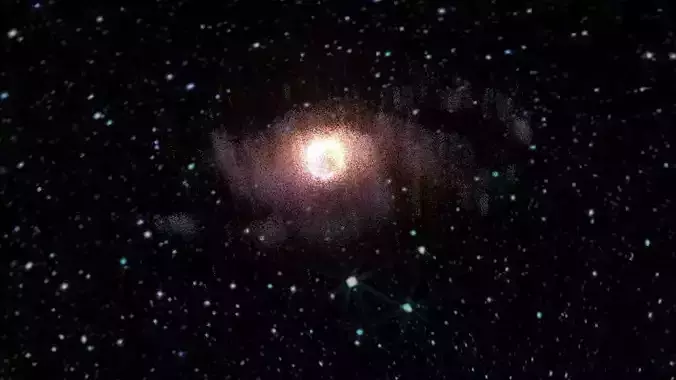
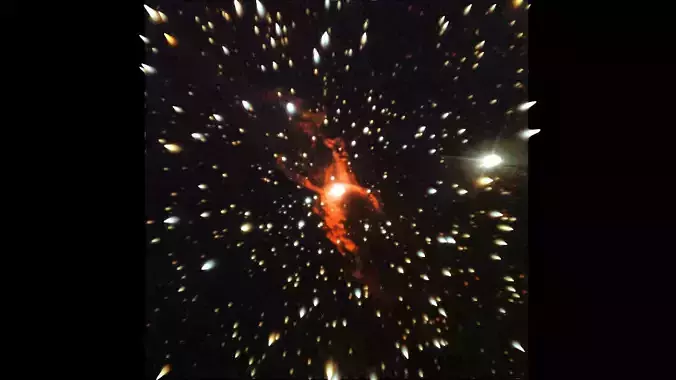
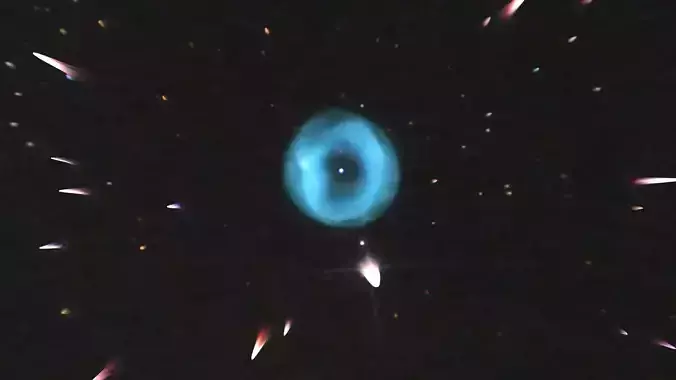
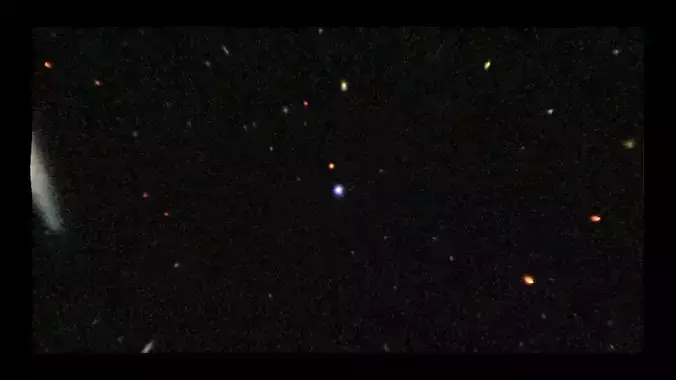
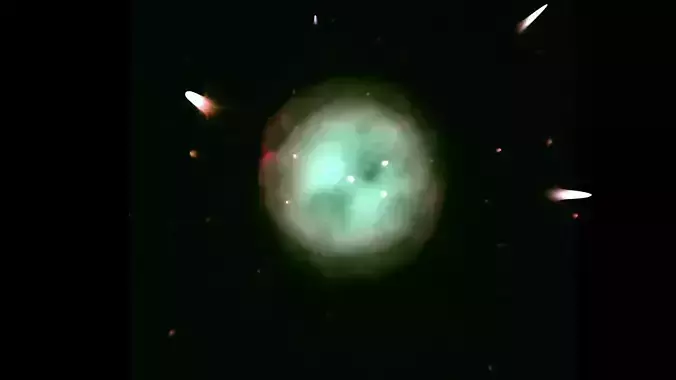
DescriptionGRB 090423. This GRB 090423 is like a comet that's passing through the supernova explosion. GRB 090423 was a gamma-ray burst (GRB) detected by the Swift Gamma-Ray Burst Mission on April 23, 2009, at 07:55:19 UTC whose afterglow was detected in the infrared and enabled astronomers to determine that its redshift is z = 8.2, making it one of the most distant objects detected at that time with a spectroscopic redshift (GN-z11, discovered in 2016, has a redshift of 11). A gamma-ray burst is an extremely luminous event flash of gamma rays that occurs as the result of an explosion, and is thought to be associated with the formation of a black hole. The burst itself typically only lasts for a few seconds, but gamma-ray bursts frequently produce an afterglow at longer wavelengths that can be observed for many hours or even days after the burst. Measurements at these wavelengths, which include X-ray, ultraviolet, optical, infrared, and radio, enable follow-up study of the event. The finite speed of light means that GRB 090423 is also one of the earliest objects ever detected for which a spectroscopic redshift has been measured. The universe was only 630 million years old when the GRB occurred, and its detection confirms that massive stars were born and dying even very early on in the life of the universe. GRB 090423 and similar events provide a unique means of studying the early universe, as few other objects of that era are bright enough to be seen with today's telescopes. On April 23, 2009, at 07:55:19 UTC the Swift satellite detected a burst that lasted about 10 seconds and was located in the direction of the constellation Leo. Swift localized the field in which GRB 090423 occurred, and 77 seconds after the burst, the Swift UVOT Photometric System took a 150-second exposure of the field, but was unable to detect an optical or ultraviolet afterglow. A few minutes after its discovery, ground-based telescopes began observing the field. Within 20 minutes of the burst, Nial Tanvir and his team found an infrared source at the Swift position using the United Kingdom Infrared Telescope (UKIRT) on Mauna Kea, Hawaii. The initial observations taken by UKIRT were triggered autonomously via the eSTAR Project. They observed a drop off in flux beyond 1.13 micrometres with the VLT. Attributing this drop off to Lyman alpha absorption by neutral hydrogen in the intergalactic medium, they calculated a redshift of 8.2 for GRB 090423. The team of C.C. Thöne and Paolo D'Avanzo observed the afterglow of GRB 090423 using the Italian TNG 3.6m telescope located in the Canary Islands, Spain. They obtained two hours of spectra, which when combined, suggested a very weak signal at the position of the afterglow. They too saw a drop off in flux near 1.1 micrometres, and reported a redshift of 8.1 for GRB 090423, which is consistent, within error, of the redshift reported by Tanvir et al. The redshift of 8.1 suggest the burst may have lasted approximately 1.2 seconds in the local frame of the emitter, its duration being redshifted accordingly to the observed 10 seconds. The intergovernmental astronomy organisation, European Southern Observatory (ESO) operates the Very Large Telescope that obtained the spectrum reported by Tanvir et al. The GRB was not visible in Chile when Swift first detected the burst at 07:55 UTC, but was the following day at 03:00 UTC, which enabled the Gamma-Ray Burst Optical/Near-Infrared Detector (GROND) at La Silla Observatory to make observations of the burst, and find a photometric redshift consistent with the value reported elsewhere. The last observers to gather data during the event was the Combined Array for Research in Millimeter-wave Astronomy (CARMA) observatory. The observation of GRB 090423 by CARMA was taken at a frequency of 92.5 GHz. While the afterglow was not detected, they were able to place a 3-sigma upper limit of 0.7 mJy on the flux density of the afterglow.
Texture Resolution: 400 x 400