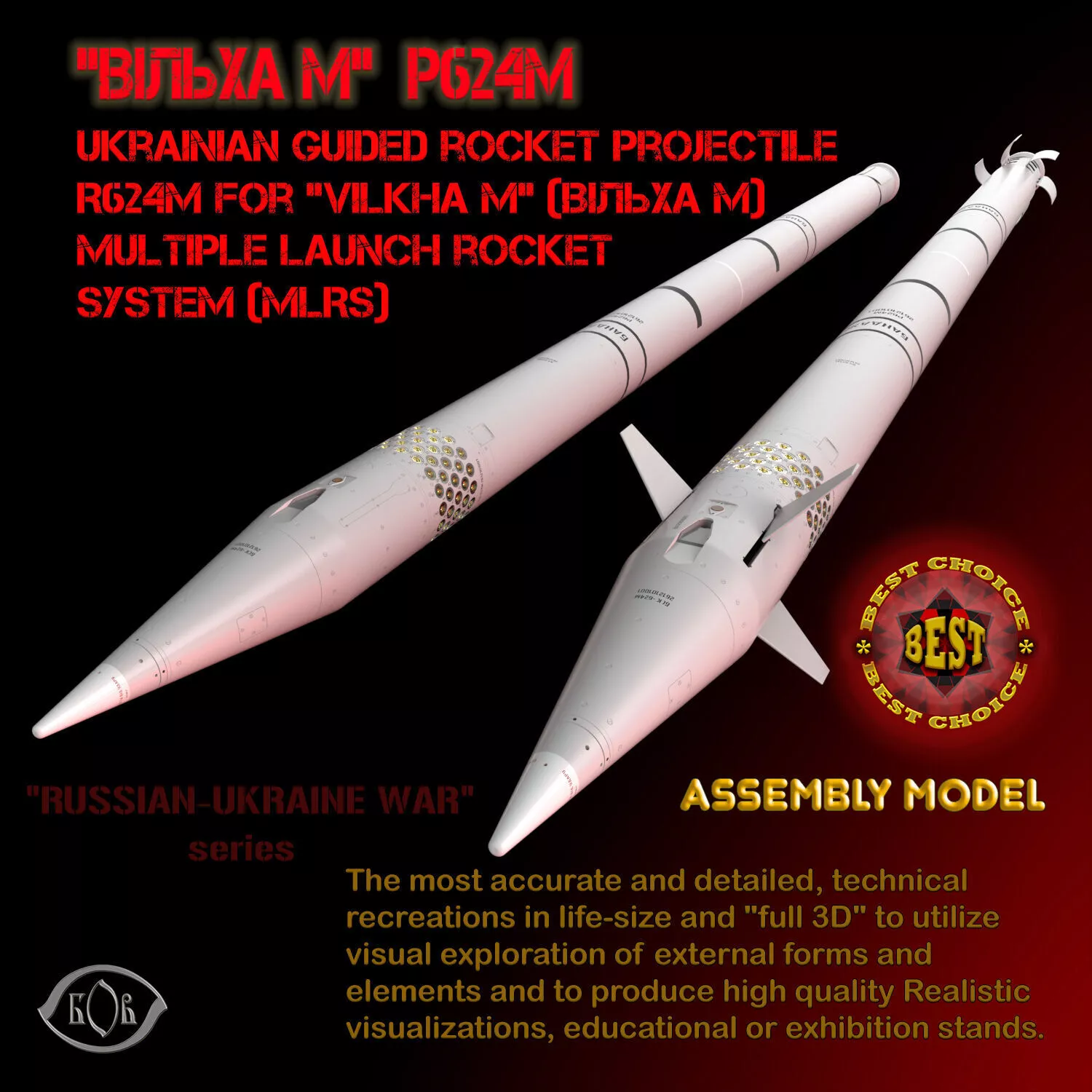
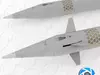
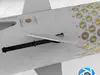
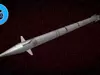
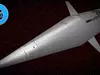
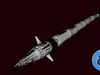
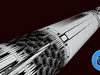
A Ukrainian High-tech development based on the improved Soviet 9K58 “Smerch”
heavy rocket artillery system. The R624 (P624) rocket-projectile and the “Vilkha” MLRS
system itself were developed by the Luch Design Bureau as part of Ukraine’s missile
program following the onset of the local phase of the russion-Ukrainian War
and were adopted into service in 2018. State tests of the R624M variant were conducted in 2021.
By the time of the start of russian’s full-scale invasion, according to open-source data,
several hundred missiles of various variants of this type had been produced;
they performed exceptionally well in combat from the very first days of the invasion
and during the Kharkiv-Kherson liberation operation in the second half of 2022.
The achieves a circular error probability (R624M) of 15–10 meters and a range of 70–130 km.
The warhead types include high-explosive fragmentation, cluster, and thermobaric,
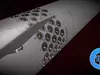
weighing from 250 to 170 kg. A salvo consists of 12 missiles. A ring of 90 inertial engines
and retractable control surfaces, which operate during the final stage of flight,
are used to correct and refine the flight path.
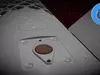
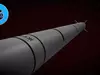
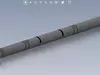
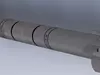
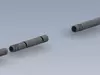
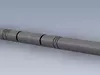
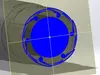
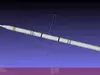
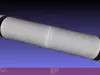
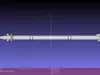
Development of a life-size 3D model, Diameter 300 mm and length 7,600 mm
(for the compact, pre-launch assembly variant)—as detailed as possible that
incorporates virtually all external structural elements into the modelas far, as
was possible from the limited information available from open sources .
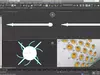
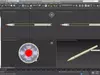
The model is rendered in CAD quality and precision in its assembled version—
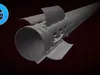
The control surfaces are movable, and the tailplane is a sliding type.
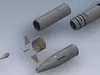
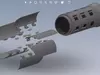
(allowing for animation of this model). These parts, as well as the housing
sections and the fuze, are manufactured as separate sub-assemblies.
All model elements are rendered in full 3D format and do not require the
use of additional special 2D textures. Additionally, the package
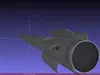
includes TWO independent 3D models—assemblies in the pre-launch configuration,
with an electric igniter in the engine nozzle, and in the operational configuration,
with the rudders extended and the stabiliser deployed, and without an igniter in the engine nozzle.
The model is ready for realistic 3D visualization in virtually any application designed for
this purpose, using a standard set of “materials”—all surfaces are prepared for this and
marked as “Assigned materials” with color-coded labels. See examples of realistic rendering in KeyShot 5.0 and Sketch fab.
The model is technically accurate and is made as close as possible to the original and in the
original dimensions, including the elements. Even the screw heads, rivets which are not filled
with putty and sealant in the real product, correspond to real metric fasteners. Everything is
made as accurately as possible, as much as possible relying on the little information from
available open sources - photo materials. The model can be successfully used for
detailed study of the external design of the product, creating realistic 3D visualizations of high quality and
pixel resolution - much higher than 4K (smooth surfaces and high detail).
As well as can be used for the production of high-quality stand models,
models for training and for exhibition purposes. The model is assembled,
all moving elements are made by separate parts, Attitude and position rudders,
which if desired, allows you to use the model to create 3D animation.
The model was originally developed in technical-engineering 3D format (solid model CAD).
In addition to solid model file formats, converted highly detailed polygonal file formats are additionally provided.
Mesh:
Vertices 1042277
Faces 2084294
(P624M.obj)
Please rate and write a review about this model.
If you have any questions, please message me. Always willing to consider your price offer.