DESCRIPTION

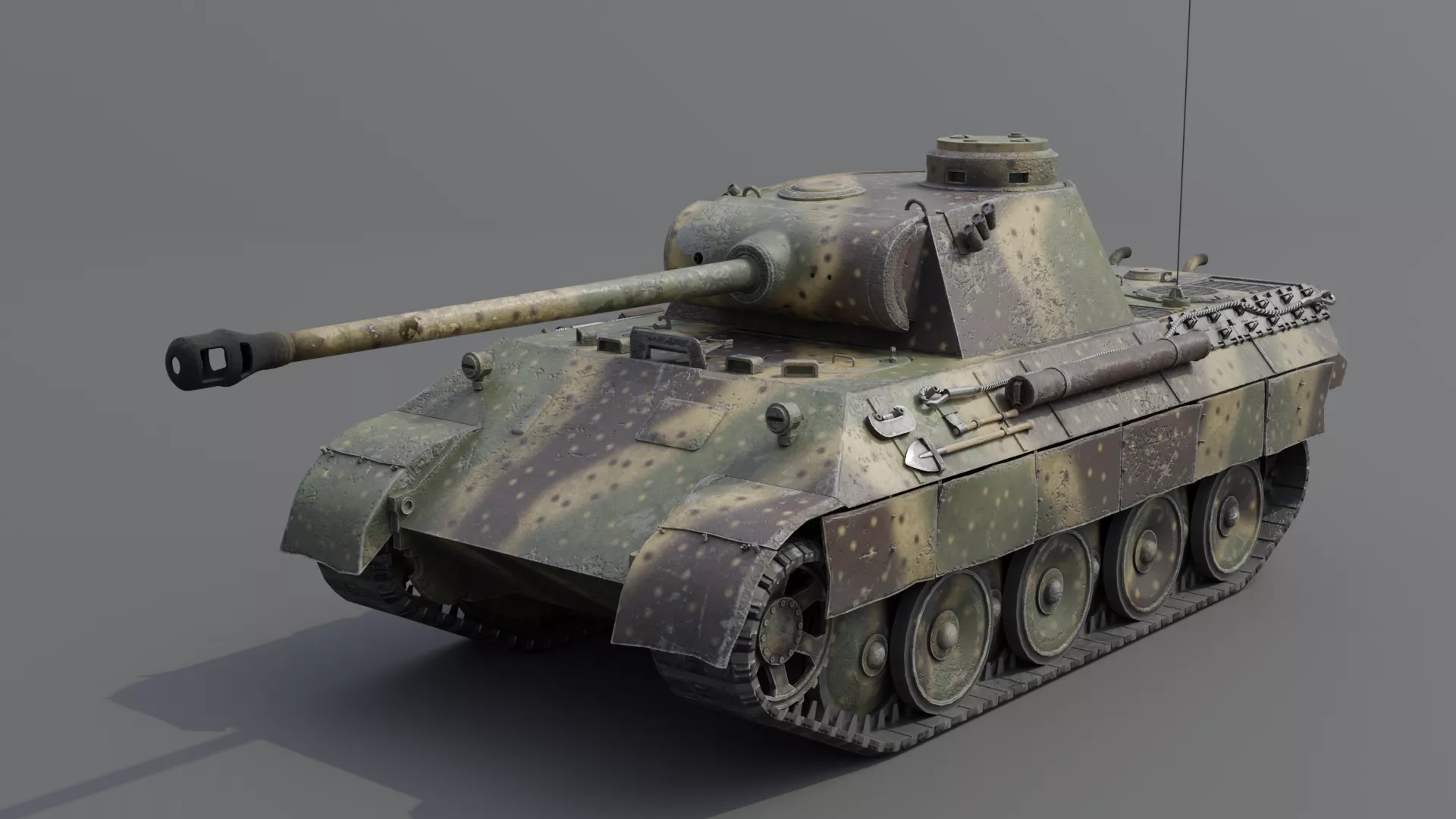
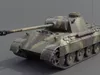
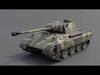
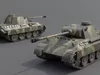
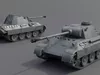
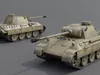
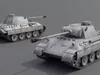
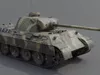
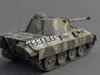
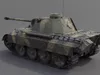
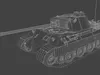
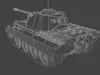
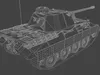
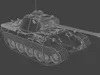
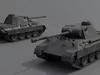
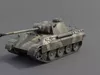
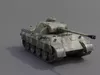
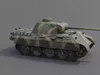
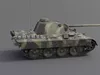
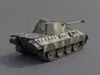
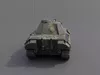
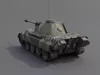
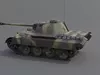
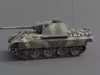
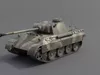
Panzerkampfwagen V Panther D Medium Tank

ZIP file contain Blendfile, Texture folder , FBX , Obj mtl

Centered (in right place) and Seperated parts

Blender 5.2.1

Textured with substance painter (Basecolor , AO , Metalness , Roughness , Normal , Opacity)

3 Set of material and 5 Texture set (Camo , Winter , Burned , Grey , Desert)

56 Seperated Objects

No interior , 3 hatches

4k Texture PNG (2k Burned)

Pictures rendered in Cycles engine

Vertices:31,253

Faces:34,782

Tris: 60,114

Description:The Panther tank, officially Panzerkampfwagen V Panther (abbreviated Pz.Kpfw. V) with ordnance inventory designation: Sd.Kfz. 171, is a German medium tank of World War II. It was used in most European theatres of World War II from mid-1943 to the end of the war in May 1945.The Panther was intended to counter the Soviet T-34 medium tank and to replace the Panzer III and Panzer IV. Nevertheless, it served alongside the Panzer IV and the heavier Tiger I until the end of the war. While having essentially the same Maybach V12 petrol (690 hp) engine as the Tiger I, the Panther had better gun penetration, was lighter and faster, and could traverse rough terrain better than the Tiger I. The trade-off was weaker side armour, which made it vulnerable to flanking fire, and a weaker high explosive shell. The Panther proved to be effective in open country and long-range engagements. The Panther had excellent firepower, protection and mobility, though early variants suffered from reliability issues. The Panther was far cheaper to produce than the Tiger I. Key elements of the Panther design, such as its armour, transmission, and final drive, were simplifications made to improve production rates and address raw material shortages.The Panther was rushed into combat at the Battle of Kursk in the summer of 1943 despite numerous unresolved technical problems, leading to high losses due to mechanical failures. Most design flaws were rectified by late 1943 and early 1944, though the Allied bombing of production plants in Germany, increasing shortages of high-quality alloys for critical components, shortage of fuel and training space, and the declining quality of crews all impacted the tank's effectiveness. Though officially classified as a medium tank, at 44.8 metric tons the Panther was closer in weight to contemporary foreign heavy tanks. The Panther's weight caused logistical problems, such as an inability to cross certain bridges; otherwise, the tank had a very high power-to-weight ratio which made it highly mobile.The naming of Panther production variants did not follow alphabetical order, unlike most German tanks – the initial variant, Panther D (Ausf. D), was followed by A and G variants.

REVIEWS & COMMENTS

See what other buyers think about this model - real feedback on quality,
accuracy, and usability.
There are no reviews or comments yet. Please be the first one to write it.
BEST PRICE GUARANTEED
Found this model cheaper on another marketplace? Let our support team know - we’ll match it.
NEW
Recently added to CGTrader - explore one of the latest models on the marketplace.

Panzerkampfwagen V Panther D Medium Tank Low-poly 3D model

Royalty Free License
One-time purchaseRoyalty-free
$60
  • Yours forever — royalty-free license
  • All 4 file formats included
  • Instant download after purchase
Like this model to show appreciation to the designer.
See how many times this model was viewed.
Share this model to support the designer and boost their visibility.
Native file format
BLEND
Size: 393 MB
Renderer: Default | 5.2.1
Exchange formats
OBJ
OBJ<br />File Size: 393 MB
FBX
Autodesk FBX<br />File Size: 393 MB
PNG
PNG<br />File Size: 393 MB
Verified by CGTrader
Verified models are of higher quality as they have
passed CGT Standard technical and visual checks,
making them more professional-grade 3D assets.
Learn more.
FBX
This FBX file has successfully passed the CGT Standard technical and visual checks. The verification results are detailed in the section below.
File & scene
Binary FBX
Binary FBX file is more compact and faster to load and process.
Learn more
No unsupported objects
Unsupported objects:
- Lights
- Cameras
Learn more
Geometry
No N-gons
N-gons are polygons with five or more sides which might cause issues in certain processes like rendering or animation. Learn more
No faceted geometry
Faceted geometry uses flat surfaces without smoothing, which can look unrealistic on curves.
Learn more
Manifold geometry
Manifold geometry ensures all surfaces are properly connected, avoiding issues like edges shared by more than two faces.
Learn more
Textures & material
PBR textures
PBR textures simulate how light interacts with materials, making the model look realistic under different lighting.
Required PBR textures:
- Base Color
- Roughness
- Metalness
- Normal
Learn more
No embed textures
Embedded textures are stored inside the model file, increasing its size and sometimes causing compatibility issues.
Learn more
Square textures
Texture aspect ratio is the width-to-height ratio of a texture. Expected texture aspect ratio: 1:1
Learn more
Power of 2 texture sizes
Textures with dimensions in power of two (e.g. 512x512px, 1024x1024px) are used to optimize performance and memory usage.
Learn more
Assigned materials
Materials are applied to the 3D model to allow visualize a model's surface properties and appearance.
Learn more
UVs & naming
No UV overlaps
UVs overlap when multiple points on the 3D model's surface are mapped to the same point on the UV island causing texture stretching.
Learn more
UV unwrapped model
A UV unwrapped model means its 3D surface is flattened into 2D space, allowing textures to be applied accurately.
Learn more
Allowed characters
Allowed ASCII characters: a-zA-Z0-9-_
Learn more
Provided by designer
Information and details shared directly by the model's designer.
3D Features
PBR
Uses Physically Based Rendering materials, which give the model realistic lighting and surface properties.
Textures
The model includes image files (textures) that add color, patterns, or detail to its surfaces.
Materials
The model has material settings that define how surfaces look (color, shine, transparency, etc.).
UV Mapping
The model's surfaces are mapped to a 2D image, allowing textures to display correctly.
3D printing
Indicates whether the designer marked this model as suitable for 3D printing.
Model is not 3D printable
The designer indicates this model is intended for digital use only (rendering, animation, or AR/VR) and not for 3D printing.
Geometry
Polygon mesh
A model built from polygons (triangles or quads) connected in a mesh.
34782 polygons
The total number of polygons (flat shapes) that make up the 3D model.
/
31253 vertices
The number of points (corners) that define the shape of the model's polygons.
Unwrapped UVs
Publish date
Model ID
Chat