High-quality 3D assets at affordable prices — trusted by designers, engineers, and creators worldwide. Made with care to be versatile, accessible, and ready for your pipeline.
Included File Formats
This model is provided in 14 widely supported formats, ensuring maximum compatibility:
• - FBX (.fbx) – Standard format for most 3D software and pipelines
• - OBJ + MTL (.obj, .mtl) – Wavefront format, widely used and compatible
• - STL (.stl) – Exported mesh geometry; may be suitable for 3D printing with adjustments
• - STEP (.step, .stp) – CAD format using NURBS surfaces
• - IGES (.iges, .igs) – Common format for CAD/CAM and engineering workflows (NURBS)
• - SAT (.sat) – ACIS solid model format (NURBS)
• - DAE (.dae) – Collada format for 3D applications and animations
• - glTF (.glb) – Modern, lightweight format for web, AR, and real-time engines
• - 3DS (.3ds) – Legacy format with broad software support
• - 3ds Max (.max) – Provided for 3ds Max users
• - Blender (.blend) – Provided for Blender users
• - SketchUp (.skp) – Compatible with all SketchUp versions
• - AutoCAD (.dwg) – Suitable for technical and architectural workflows
• - Rhino (.3dm) – Provided for Rhino users
Model Info
• - All files are checked and tested for integrity and correct content
• - Geometry uses real-world scale; model resolution varies depending on the product (high or low poly)
• • - Scene setup and mesh structure may vary depending on model complexity
• - Rendered using Luxion KeyShot
• - Affordable price with professional detailing
Buy with confidence. Quality and compatibility guaranteed.
If you have any questions about the file formats, feel free to send us a message — we're happy to assist you!
Sincerely,
SURF3D
Trusted source for professional and affordable 3D models.
More Information About 3D Model :
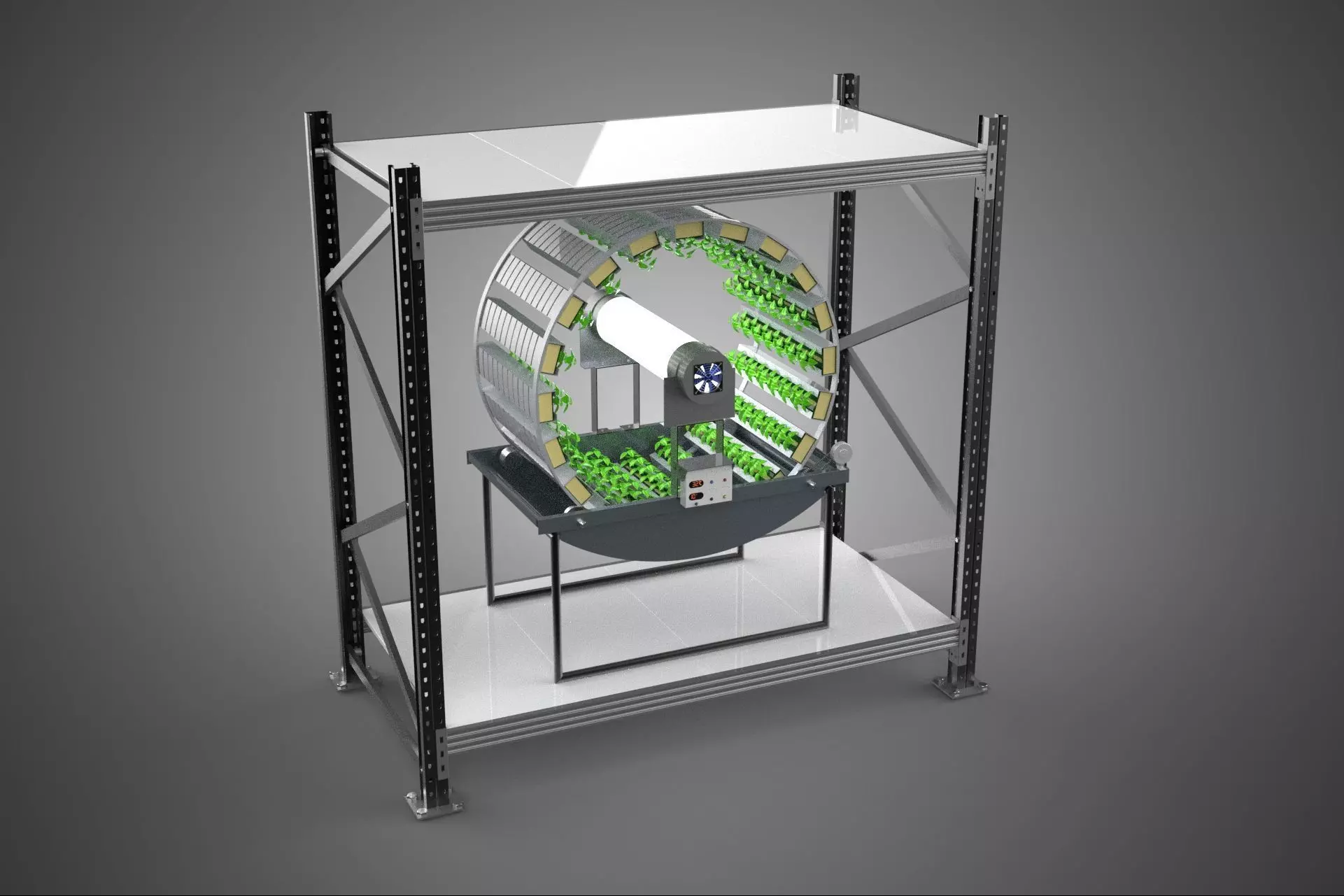
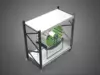
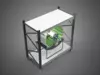
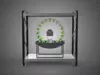
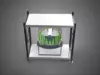
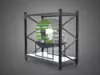
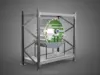
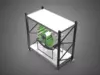
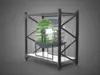
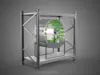
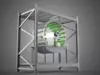
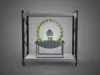
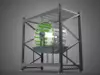
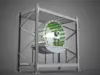
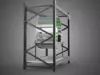
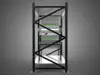
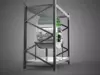
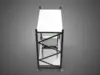
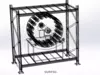
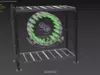
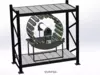
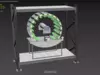
A Shelf Rack Rotary Hydroponic Spin Garden Plant Farm System Wheel describes an advanced agricultural technology that integrates hydroponic cultivation with a rotating structural framework to optimize plant growth efficiency and maximize yield within a compact footprint. This sophisticated system, often referred to as a rotary hydroponic system, vertical spin garden, or hydroponic carousel, is a prime example of controlled environment agriculture (CEA), designed for high-density plant production in resource-constrained or urban environments.
Principle of Operation:
The fundamental principle involves mounting plants, typically housed in net pots or grow plugs, within a series of modules or shelves that revolve around a central axis. This rotational movement continuously exposes each plant to a centrally positioned light source, usually high-efficiency LED arrays, and a consistent or intermittent supply of nutrient-rich water. The rotation ensures uniform light distribution across all plant surfaces, preventing phenomena like etiolation (stretching due to insufficient light) and promoting balanced, robust growth. Furthermore, the constant movement enhances air circulation around the plants, which can mitigate the risk of certain plant diseases and optimize carbon dioxide absorption. As a hydroponic system, plants derive all essential macro- and micronutrients directly from an oxygenated water solution, eliminating the need for soil and significantly reducing water consumption compared to traditional soil-based agriculture.
Key Components:
- Structural Framework: A robust, corrosion-resistant frame, typically constructed from materials such as PVC, aluminum, or stainless steel, provides the foundational support for the entire system and encases the rotary mechanism.
- Rotary Mechanism: This comprises an electric motor, gearing system, and a central axle that facilitates the slow, continuous, and often adjustable rotation of the plant-holding modules. The speed of rotation can be calibrated to suit specific plant species and developmental stages.
- Plant Holding Modules/Shelves: These are the specialized containers or racks designed to securely hold individual plants. They are frequently wheel-shaped or drum-like, featuring individual pockets, trays, or baskets engineered for hydroponic media.
- Hydroponic Reservoir and Delivery System: A central reservoir stores the meticulously balanced nutrient solution. A pump circulates this solution through a network of tubes and emitters (e.g., drippers or spray nozzles) directly to the plant roots, or via methods like nutrient film technique (NFT) or ebb-and-flow (flood and drain). A return system ensures that excess solution is collected and recirculated, minimizing waste.
- Lighting System: Energy-efficient grow lights, predominantly light-emitting diodes (LEDs), are centrally located to illuminate the rotating plants. LED technology offers precise spectrum control, high luminous efficacy, and low heat emission, which is crucial in enclosed environments.
- Environmental Control Unit: Advanced systems integrate a suite of sensors and automated controllers to precisely monitor and adjust critical environmental parameters. These include the pH and electrical conductivity (EC) of the nutrient solution, ambient air temperature, relative humidity, and atmospheric CO2 levels, ensuring optimal growth conditions.
- Aeration System: Devices such as air stones or venturi pumps are utilized within the nutrient reservoir to ensure adequate oxygenation of the solution, which is vital for healthy root respiration and nutrient uptake.
Advantages:
- Space Efficiency: By leveraging vertical space and a compact, rotating design, these systems dramatically increase cultivation area per square foot, making them exceptionally suitable for urban farming, indoor environments, and areas with limited arable land.
- Resource Conservation: Water consumption is significantly reduced (often by up to 90%) compared to conventional agriculture due to the closed-loop recirculation of nutrient solutions. Nutrient use is also optimized, reducing waste and runoff.
- Accelerated Growth Rates and Yields: The precisely controlled environment and direct nutrient delivery can lead to faster plant growth cycles and higher yields compared to traditional farming methods.
- Consistent Quality: Uniform light exposure and meticulous environmental control contribute to a more consistent plant quality, size, and nutritional profile, while minimizing crop variability and failure rates.
- Pest and Disease Reduction: The soilless, often enclosed nature of the system inherently minimizes exposure to soil-borne pathogens, pests, and environmental contaminants, frequently negating the need for chemical pesticides.
- Reduced Labor and Automation Potential: Automation of watering, nutrient delivery, environmental monitoring, and light cycles can substantially decrease manual labor requirements, improving operational efficiency.
Applications:
Shelf Rack Rotary Hydroponic Spin Garden Systems find diverse applications across various sectors:
- Urban Agriculture: Facilitating localized, fresh food production in densely populated metropolitan areas.
- Commercial Greenhouses and Vertical Farms: Enhancing production capacity and yield per unit area in large-scale indoor farming operations.
- Research and Education: Providing highly controlled environments for plant science research, experimental cultivation, and educational demonstrations.
- Home Gardening: Offering a compact, efficient, and aesthetic solution for individuals to grow their own produce indoors, regardless of external climate or space constraints.
Variations:
While the wheel design implies a circular rotation, rotary systems can also adopt more linear or drum-like configurations, varying in scale from small domestic units to large industrial installations.