High-quality 3D assets at affordable prices — trusted by designers, engineers, and creators worldwide. Made with care to be versatile, accessible, and ready for your pipeline.
Included File Formats
This model is provided in 14 widely supported formats, ensuring maximum compatibility:
• - FBX (.fbx) – Standard format for most 3D software and pipelines
• - OBJ + MTL (.obj, .mtl) – Wavefront format, widely used and compatible
• - STL (.stl) – Exported mesh geometry; may be suitable for 3D printing with adjustments
• - STEP (.step, .stp) – CAD format using NURBS surfaces
• - IGES (.iges, .igs) – Common format for CAD/CAM and engineering workflows (NURBS)
• - SAT (.sat) – ACIS solid model format (NURBS)
• - DAE (.dae) – Collada format for 3D applications and animations
• - glTF (.glb) – Modern, lightweight format for web, AR, and real-time engines
• - 3DS (.3ds) – Legacy format with broad software support
• - 3ds Max (.max) – Provided for 3ds Max users
• - Blender (.blend) – Provided for Blender users
• - SketchUp (.skp) – Compatible with all SketchUp versions
• - AutoCAD (.dwg) – Suitable for technical and architectural workflows
• - Rhino (.3dm) – Provided for Rhino users
Model Info
• - All files are checked and tested for integrity and correct content
• - Geometry uses real-world scale; model resolution varies depending on the product (high or low poly)
• • - Scene setup and mesh structure may vary depending on model complexity
• - Rendered using Luxion KeyShot
• - Affordable price with professional detailing
Buy with confidence. Quality and compatibility guaranteed.
If you have any questions about the file formats, feel free to send us a message — we're happy to assist you!
Sincerely,
SURF3D
Trusted source for professional and affordable 3D models.
More Information About 3D Model :
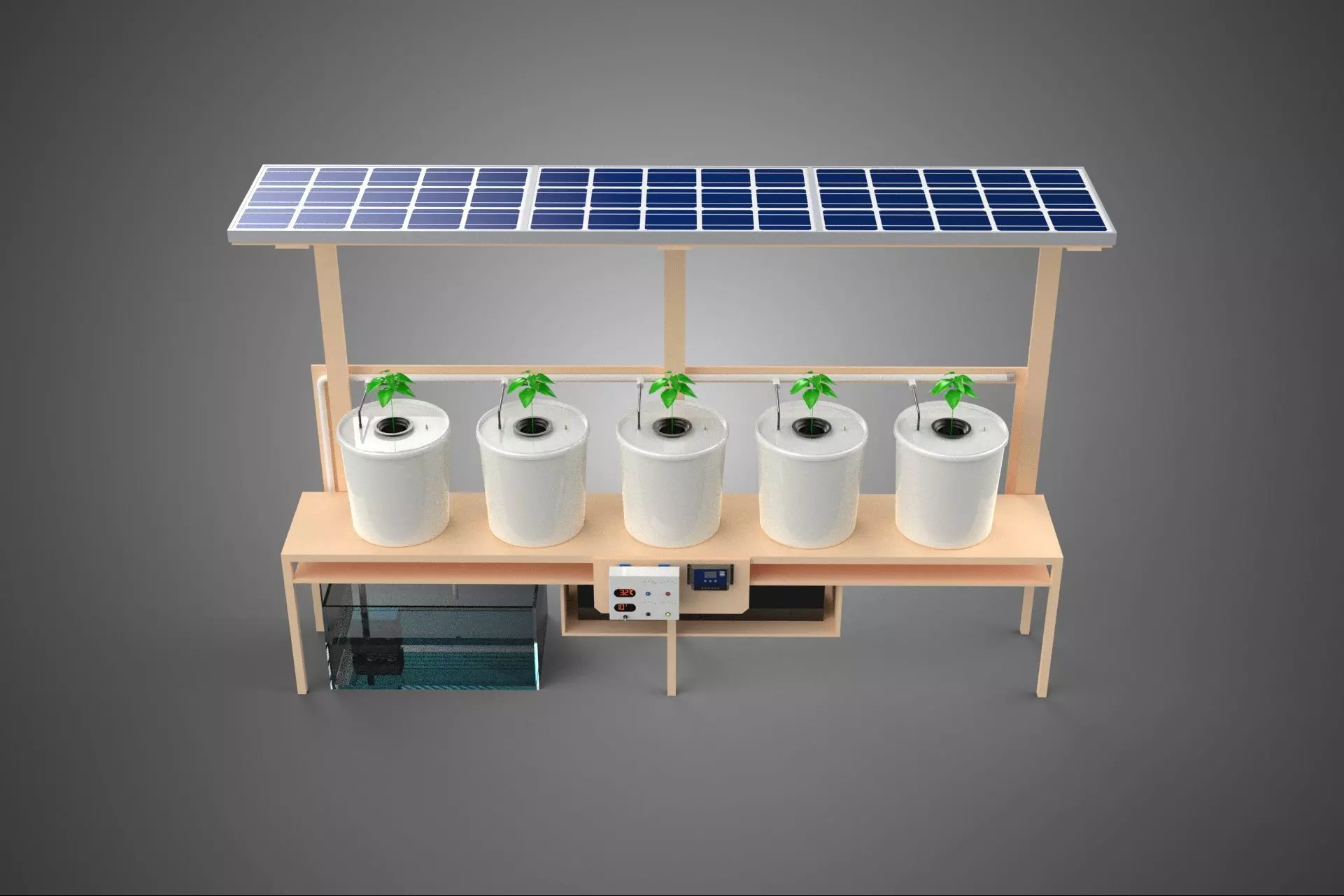
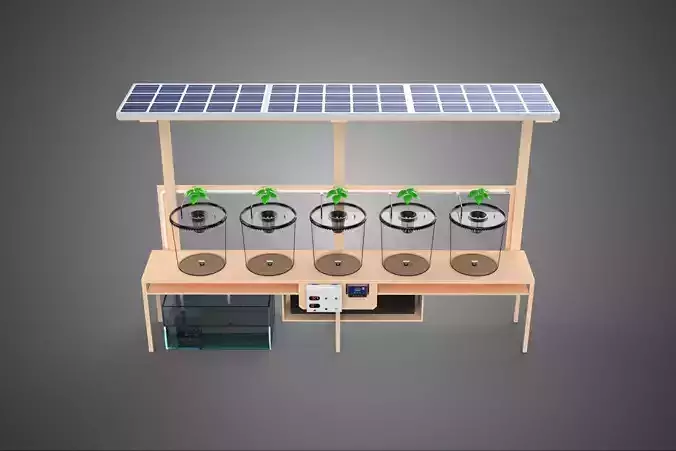
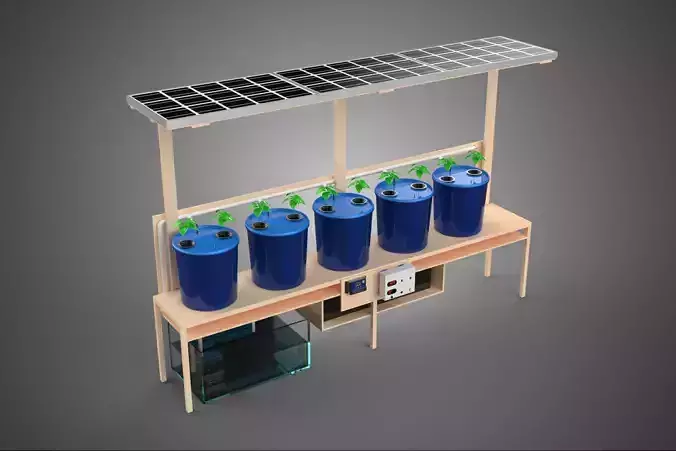
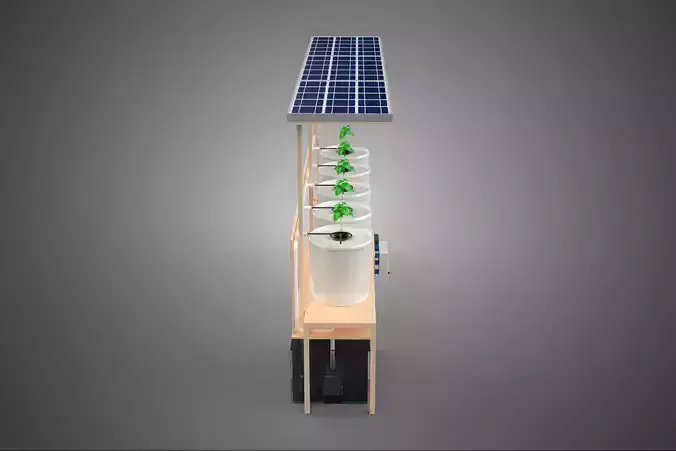
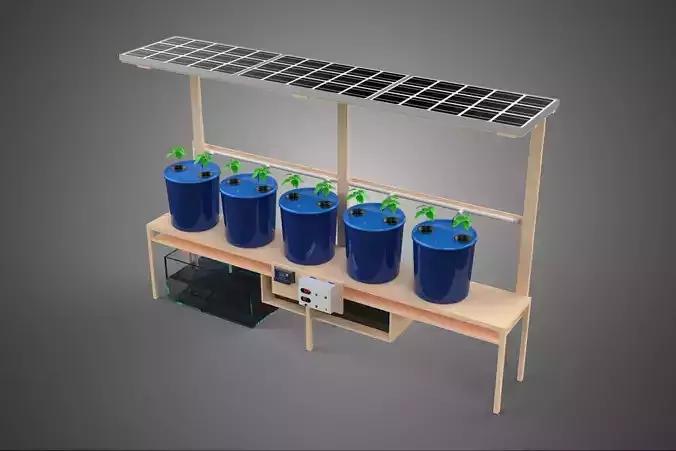
The Compact Hydroponic Bato Dutch Bucket System Powered by Solar Panel is a sophisticated, integrated apparatus designed for soilless cultivation, specifically optimized for resource efficiency, modularity, and energy independence. This system merges the operational mechanics of the Dutch Bucket (or 'Bato pot') technique with a decentralized photovoltaic (PV) energy source, enabling autonomous, high-density crop production in environments where grid power is unstable or unavailable, or where sustainable practices are prioritized.
System Definition and Operational Mechanics
The core component is the Bato Dutch Bucket, a modular container typically fabricated from opaque, food-grade plastic. Unlike passive hydroponic methods, the Bato system utilizes an inert substrate—such as perlite, rockwool, clay pebbles, or coco coir—to provide physical support and moderate aeration for the root zone. Each bucket operates independently but is interconnected via a shared drainage manifold that guides excess nutrient solution back to a central reservoir, defining it as a recirculating or closed-loop system.
Nutrient delivery occurs via timed drip irrigation emitters, which periodically supply the nutrient-rich water (solution) directly to the substrate near the plant base. A distinguishing feature of the Bato design is its specific drainage mechanism, usually a fixed siphon elbow or overflow hole set several centimeters above the bucket floor. This configuration ensures that a shallow, consistent reservoir of solution is maintained at the bottom of the bucket before drainage occurs. This continuous slight saturation maximizes the root zone's access to water and nutrients while preventing total waterlogging, thereby mitigating root disease and optimizing dissolved oxygen (DO) levels.
The Compact designation refers to the system’s high planting density and optimized footprint, often achieved through linear or tiered vertical stacking, making it highly suitable for urban agriculture, balconies, rooftops, and small-scale greenhouse operations.
Solar Power Integration and Energy Management
The critical innovation of this integrated system lies in its dependence on renewable energy. A photovoltaic solar panel array converts solar radiation into direct current (DC) electricity, which powers the essential mechanical components: the water pump and, often, an air pump/diffuser for oxygenating the reservoir solution.
The DC power typically flows through a charge controller (and optionally, a battery bank) to regulate voltage and manage energy storage. The reliance on DC components minimizes energy conversion losses and enhances overall system efficiency compared to systems requiring AC power. The pump’s operation is often managed by a low-power digital timer, dictating the frequency and duration of irrigation cycles based on crop needs, environmental conditions, and available solar irradiance. In systems utilizing battery backup, essential functions (like aeration and brief irrigation during cloudy periods) can be maintained, ensuring crop resilience.
Advantages and Applications
The Compact Hydroponic Bato Dutch Bucket System Powered by Solar Panel offers profound ecological and logistical benefits:
-
Water Efficiency: As a closed-loop system, water consumption can be reduced by up to 90% compared to traditional field farming, as nutrient runoff is recycled and evaporation is minimized.
-
Energy Autonomy: The solar integration eliminates reliance on grid electricity, reducing operational costs and enabling deployment in remote or off-grid locations.
-
Optimized Crop Production: The Bato bucket’s depth and stability are highly advantageous for cultivating larger, fruiting crops such as tomatoes, peppers, cucumbers, pole beans, and eggplants, which require substantial root support and precise nutrient management.
-
Modularity and Scalability: The bucket design allows for easy expansion, crop rotation, and individual plant monitoring, contributing to enhanced farm management practices.
This technology is considered a vital component of sustainable agriculture, decentralized food production, and resource management in controlled environment settings.
KEYWORDS: Hydroponics, Bato Bucket, Dutch Bucket, Soilless Cultivation, Solar Power, Photovoltaic (PV), Recirculating System, Controlled Environment Agriculture (CEA), Urban Farming, Sustainable Agriculture, Water Efficiency, Energy Autonomy, Drip Irrigation, Substrate, Cocopeat, Perlite, Off-Grid Farming, DC Pump, Charge Controller, Modular Design, Food Security, Renewable Energy, Greenhouse Technology, Crop Yield, Water Conservation, Precision Agriculture, Closed-Loop System, Remote Monitoring, Environmental Control, High Density Farming.