High-quality 3D assets at affordable prices — trusted by designers, engineers, and creators worldwide. Made with care to be versatile, accessible, and ready for your pipeline.
Included File Formats
This model is provided in 14 widely supported formats, ensuring maximum compatibility:
• - FBX (.fbx) – Standard format for most 3D software and pipelines
• - OBJ + MTL (.obj, .mtl) – Wavefront format, widely used and compatible
• - STL (.stl) – Exported mesh geometry; may be suitable for 3D printing with adjustments
• - STEP (.step, .stp) – CAD format using NURBS surfaces
• - IGES (.iges, .igs) – Common format for CAD/CAM and engineering workflows (NURBS)
• - SAT (.sat) – ACIS solid model format (NURBS)
• - DAE (.dae) – Collada format for 3D applications and animations
• - glTF (.glb) – Modern, lightweight format for web, AR, and real-time engines
• - 3DS (.3ds) – Legacy format with broad software support
• - 3ds Max (.max) – Provided for 3ds Max users
• - Blender (.blend) – Provided for Blender users
• - SketchUp (.skp) – Compatible with all SketchUp versions
• - AutoCAD (.dwg) – Suitable for technical and architectural workflows
• - Rhino (.3dm) – Provided for Rhino users
Model Info
• - All files are checked and tested for integrity and correct content
• - Geometry uses real-world scale; model resolution varies depending on the product (high or low poly)
• • - Scene setup and mesh structure may vary depending on model complexity
• - Rendered using Luxion KeyShot
• - Affordable price with professional detailing
Buy with confidence. Quality and compatibility guaranteed.
If you have any questions about the file formats, feel free to send us a message — we're happy to assist you!
Sincerely,
SURF3D
Trusted source for professional and affordable 3D models.
More Information About 3D Model :
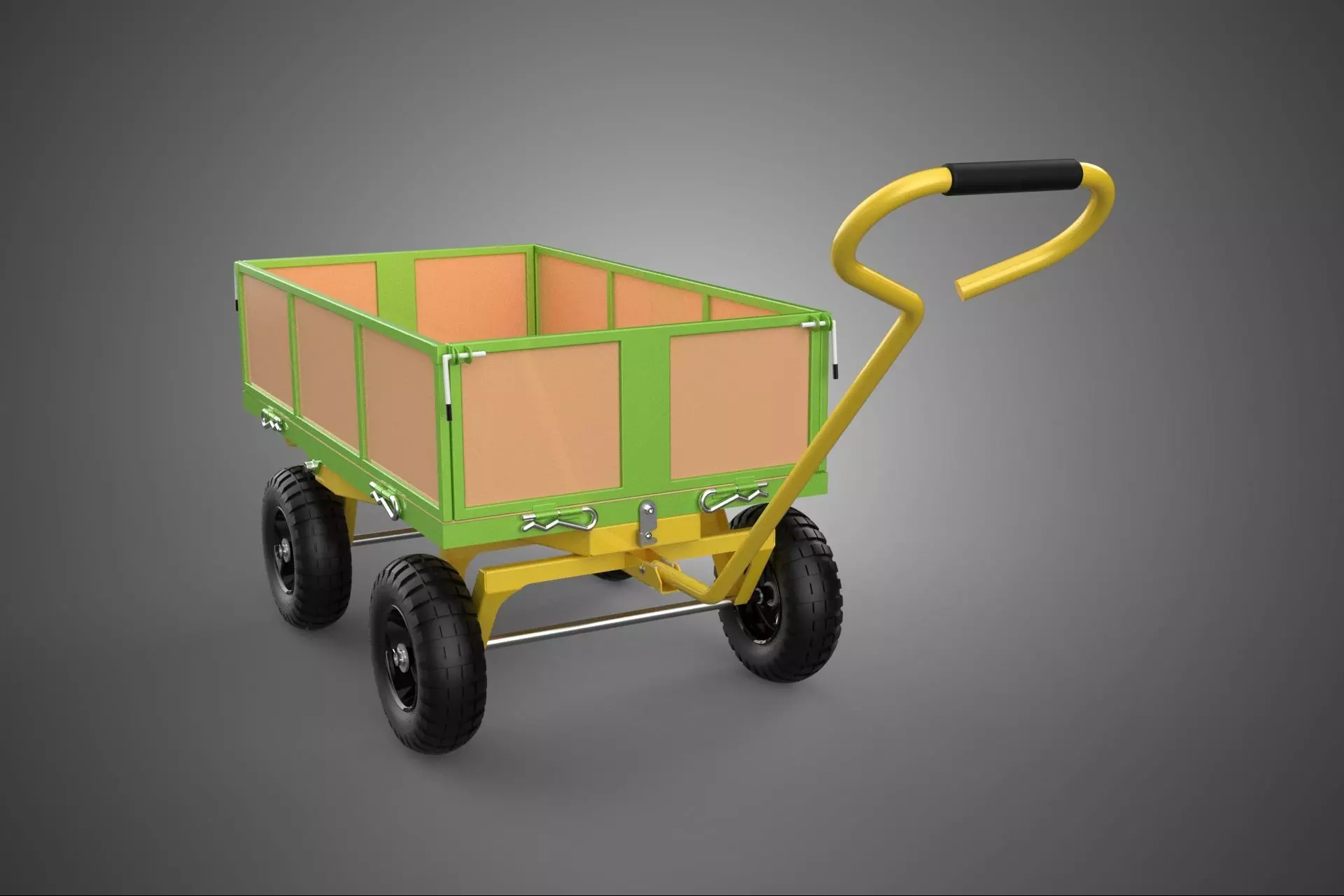
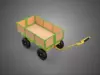
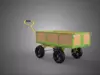
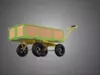
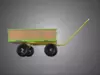
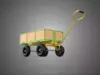
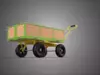
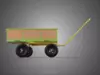
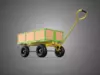
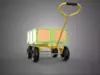
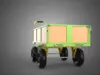
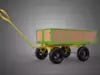
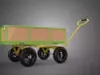
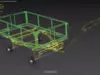
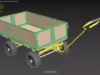
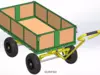
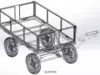
The collective terms Cart, Utility Wagon, Hand Truck, Dump Trolley, Transport Wheelbarrow, and related apparatus refer to a foundational category of non-powered manual material handling equipment (MHE) designed to facilitate the mobilization of loads by human effort. These devices operate primarily by applying the mechanical principles of the lever, axle, and wheel, significantly reducing the required lifting force and frictional resistance necessary to transport objects over short to medium distances.
Functional Mechanics and Classification
Despite variations in configuration, all these devices serve the fundamental function of providing a portable chassis for payload support. They transfer the majority of the load weight from the operator’s muscular effort onto rolling components, allowing the operator to concentrate effort on propulsion and steering rather than static lifting.
The devices are formally categorized based on their wheel configuration, load platform orientation, and specific maneuvering principles:
1. Wheelbarrows and Dump Trolleys
The Wheelbarrow (or Transport Wheelbarrow) is historically the most pervasive form of single-person MHE, characterized by its Class 2 lever system. Typically featuring one wheel (or sometimes two widely spaced wheels for stability) located near the load center, and two extended handles (often terminating in grips), the operator lifts the handles to shift the fulcrum (the wheel) underneath the load, enabling movement. This design is optimized for traversing uneven or soft terrain, as a single wheel provides better traction and maneuverability than multiple wheels.
The Dump Trolley is a variant—often two or four-wheeled—distinguished by its integrated mechanism for controlled unloading. The bin or tray (hopper) is engineered to pivot or articulate, allowing the operator to efficiently tip the contents (such as soil, sand, or debris) without manual scooping. Modern industrial dump trolleys may feature gas struts or minor hydraulic assistance for managing heavy tipping loads.
2. Hand Trucks and Dollies
The Hand Truck (or Sack Truck/Dolly) is designed for handling stackable, vertically oriented loads (e.g., boxes, cylinders, appliances). It consists of an L-shaped frame mounted on two wheels, incorporating a small base plate (nose) that slides underneath the load. The operator uses the vertical handle to tilt the load backward, utilizing the axle as the pivot point, thus engaging a powerful leverage system to break static friction and transport the item while tilted against the frame. This configuration is highly effective in constricted environments and for vertical storage retrieval.
3. Carts and Utility Wagons
Carts and Utility Wagons are defined by four-wheel configurations, ensuring that the payload is fully supported by the frame, placing minimal vertical strain on the operator.
- Utility Wagons often feature larger deck sizes and heavy-duty construction, intended for distributing weight over four points. They typically utilize a long handle or tongue attached to a steerable front axle assembly, facilitating movement via pulling rather than pushing.
- Service Carts or platform carts often feature fixed rear wheels and swiveling front casters, optimizing them for indoor logistical tasks, warehouses, and smooth surfaces where precise maneuverability is required.
### Construction and Materials
The efficacy and durability of these transport tools are highly dependent on material selection, which is often dictated by the intended payload and environment.
- Frames: Historically wood, modern frames utilize welded steel tubing for high load capacity and structural integrity, or aluminum alloys for weight reduction (critical in hand trucks) and corrosion resistance. High-density polyethylene (HDPE) or structural foam is used for specialized applications requiring wash-down or resistance to chemical agents.
- Load Beds: Load beds range from steel or plastic pans (wheelbarrows) to mesh sides (utility wagons) and solid platforms (carts).
- Wheels and Tires: Tires are generally pneumatic (air-filled) for dampening shock and maximizing grip on rough terrain (construction sites, gardens), or solid rubber/polyurethane for maintenance-free operation and non-marking applications indoors (warehouses, retail).
These devices remain essential tools across logistics, agriculture, construction, groundskeeping, and domestic use due to their simplicity, zero energy requirement, and high payload-to-operator-effort ratio.
***
KEYWORDS: Material Handling, Manual Transport, Logistics Equipment, Wheelbarrow, Hand Truck, Utility Wagon, Dump Trolley, Dolly, Cart, MHE, Lever Principle, Payload, Capacity, Ergonomics, Construction Tool, Garden Equipment, Warehouse Operations, Pneumatic Tire, Solid Rubber, Chassis, Axle, Load Plate, Tipping Mechanism, Sack Truck, Platform Cart, Industrial Tool, Non-Powered, Load Mobilization, Two-Wheeled, Four-Wheeled.