High-quality 3D assets at affordable prices — trusted by designers, engineers, and creators worldwide. Made with care to be versatile, accessible, and ready for your pipeline.
Included File Formats
This model is provided in 14 widely supported formats, ensuring maximum compatibility:
• - FBX (.fbx) – Standard format for most 3D software and pipelines
• - OBJ + MTL (.obj, .mtl) – Wavefront format, widely used and compatible
• - STL (.stl) – Exported mesh geometry; may be suitable for 3D printing with adjustments
• - STEP (.step, .stp) – CAD format using NURBS surfaces
• - IGES (.iges, .igs) – Common format for CAD/CAM and engineering workflows (NURBS)
• - SAT (.sat) – ACIS solid model format (NURBS)
• - DAE (.dae) – Collada format for 3D applications and animations
• - glTF (.glb) – Modern, lightweight format for web, AR, and real-time engines
• - 3DS (.3ds) – Legacy format with broad software support
• - 3ds Max (.max) – Provided for 3ds Max users
• - Blender (.blend) – Provided for Blender users
• - SketchUp (.skp) – Compatible with all SketchUp versions
• - AutoCAD (.dwg) – Suitable for technical and architectural workflows
• - Rhino (.3dm) – Provided for Rhino users
Model Info
• - All files are checked and tested for integrity and correct content
• - Geometry uses real-world scale; model resolution varies depending on the product (high or low poly)
• • - Scene setup and mesh structure may vary depending on model complexity
• - Rendered using Luxion KeyShot
• - Affordable price with professional detailing
Buy with confidence. Quality and compatibility guaranteed.
If you have any questions about the file formats, feel free to send us a message — we're happy to assist you!
Sincerely,
SURF3D
Trusted source for professional and affordable 3D models.
More Information About 3D Model :
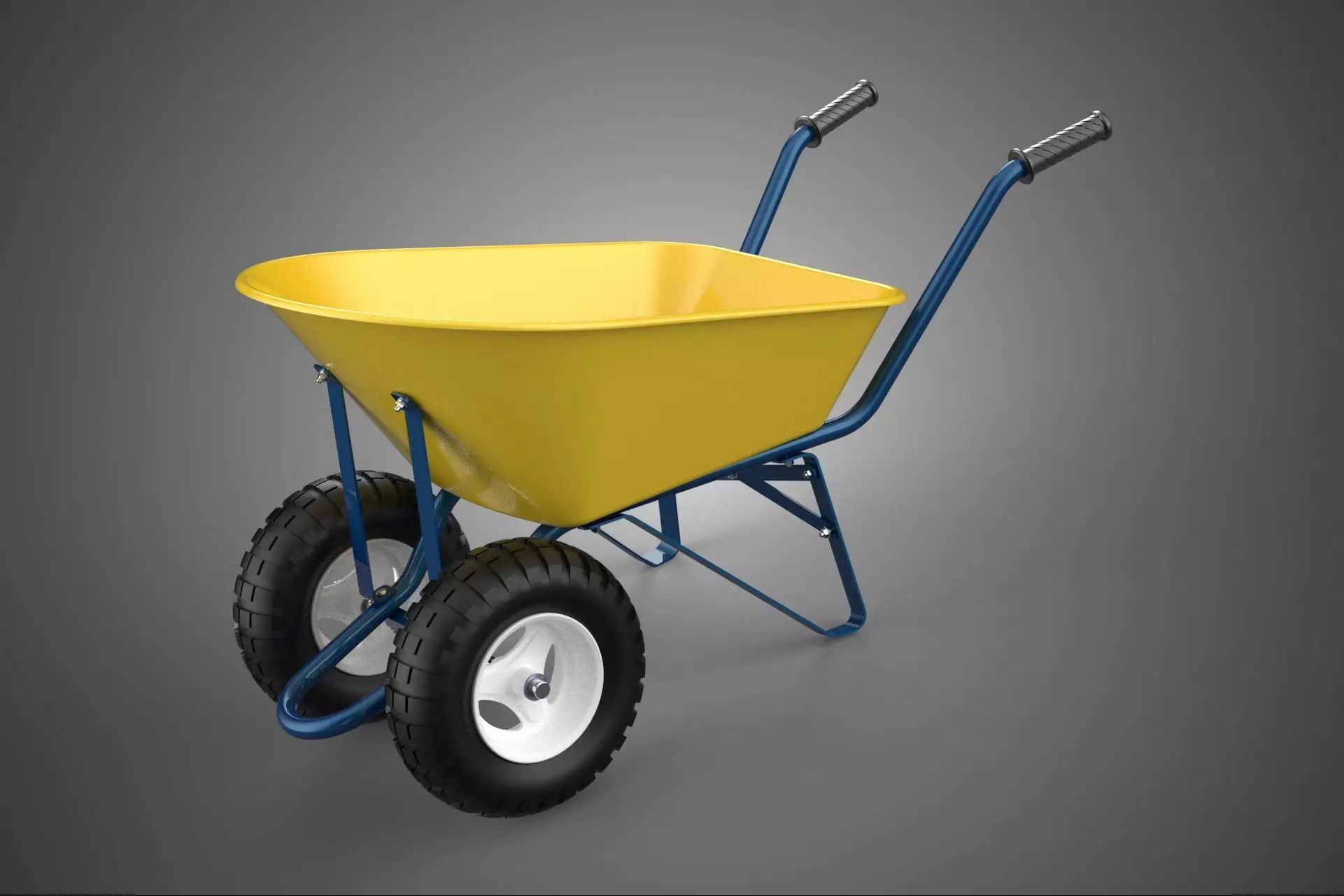
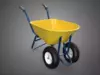
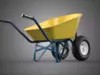
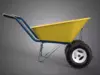
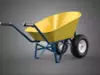
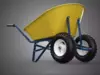
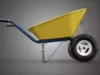
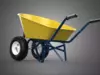
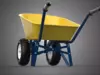
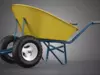
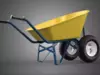
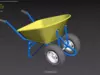
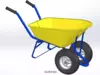
The subject object is formally identified as a Heavy-Duty Dual-Wheel Utility Transport Cart, commonly employed in industrial, construction, and agricultural sectors. While colloquially referred to by various names including wheelbarrow, trolley, or wagon, the standardized nomenclature distinguishes it by its dual-axle load-bearing configuration and enhanced volumetric capacity relative to standard single-wheel models.
Design and Structure
This type of transport apparatus is engineered for the movement of heavy, bulk, or dense materials across uneven terrain, characteristic of active construction sites (e.g., gravel, sand, cement, debris, masonry).
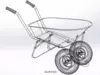
1. Dual-Wheel Configuration: The defining structural feature is the implementation of two wheels mounted parallel on a shared axle or independent axles. This design significantly enhances lateral stability, minimizing the need for the operator to actively balance the load, thereby reducing fatigue and the risk of spillage. The dual-wheel arrangement distributes the load force across a broader ground area, which can be advantageous on soft or yielding surfaces. The wheels typically utilize pneumatic (air-filled) tires for cushioning and traction, though solid, puncture-proof polyurethane tires are increasingly common in highly hazardous environments.
2. Frame and Substructure: The frame is typically constructed from heavy-gauge tubular steel or robust channel steel, welded or bolted for maximum tensile strength and resistance to torsional stress. The handles are elongated to facilitate leverage when tilting the load for dumping or traversing obstacles. The structure is reinforced at critical stress points, particularly the attachment points for the axle and the mounting brackets for the load basin.
3. Load Basin (Hopper): The load-bearing receptacle, or basin, is designed for high capacity and durability. It may be fabricated from thick-gauge pressed steel (suitable for hot or sharp materials) or high-density polyethylene (HDPE) plastic (preferred for wet materials, ease of cleaning, and corrosion resistance). The typical volume capacity ranges substantially, but construction-grade models often exceed 6 cubic feet (approximately 170 liters).
Coloration and Visibility
The standardized coloration of construction equipment is mandated for safety compliance. The characteristic bright yellow hue (often matching specific ANSI Z535 safety yellow standards) is selected for maximum visibility against varied natural and industrial backgrounds. This high-visibility marking is critical for preventing accidents involving heavy machinery, vehicles, and pedestrians in dynamic work zones.
Ergonomics and Operational Performance
Compared to the traditional single-wheel wheelbarrow (which prioritizes maneuverability and tight turning radius), the two-wheeled model sacrifices minor agility in favor of superior stability and load management. The primary ergonomic advantage lies in the reduced vertical lifting force required by the operator, as the dual axle bears the majority of the static load weight. Operation typically involves grasping the dual handles, tilting the frame forward onto the wheels, and pushing. Dumping is achieved by lifting the handles sharply and pivoting the load basin forward.
KEYWORDS: Utility Cart, Wheelbarrow, Construction Equipment, Dual-Wheel, Heavy-Duty, Material Transport, Trolley, Cart, Wagon, Load Basin, High-Visibility, Safety Yellow, Tubular Steel, Industrial Apparatus, Civil Engineering, Stability, Ergonomics, Load Capacity, Pneumatic Tires, Dual-Axle, Hopper, Site Management, Landscaping, Masonry, HDPE, Work Zone, Bulk Material, Push Cart, Transport Vehicle, Contractor Grade.