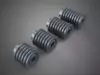
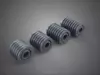
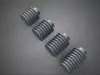
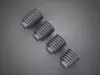
High-quality 3D assets at affordable prices — trusted by designers, engineers, and creators worldwide. Made with care to be versatile, accessible, and ready for your pipeline.
Included File Formats
This model is provided in 14 widely supported formats, ensuring maximum compatibility:
• - FBX (.fbx) – Standard format for most 3D software and pipelines
• - OBJ + MTL (.obj, .mtl) – Wavefront format, widely used and compatible
• - STL (.stl) – Exported mesh geometry; may be suitable for 3D printing with adjustments
• - STEP (.step, .stp) – CAD format using NURBS surfaces
• - IGES (.iges, .igs) – Common format for CAD/CAM and engineering workflows (NURBS)
• - SAT (.sat) – ACIS solid model format (NURBS)
• - DAE (.dae) – Collada format for 3D applications and animations
• - glTF (.glb) – Modern, lightweight format for web, AR, and real-time engines
• - 3DS (.3ds) – Legacy format with broad software support
• - 3ds Max (.max) – Provided for 3ds Max users
• - Blender (.blend) – Provided for Blender users
• - SketchUp (.skp) – Compatible with all SketchUp versions
• - AutoCAD (.dwg) – Suitable for technical and architectural workflows
• - Rhino (.3dm) – Provided for Rhino users
Model Info
• - All files are checked and tested for integrity and correct content
• - Geometry uses real-world scale; model resolution varies depending on the product (high or low poly)
• • - Scene setup and mesh structure may vary depending on model complexity
• - Rendered using Luxion KeyShot
• - Affordable price with professional detailing
Buy with confidence. Quality and compatibility guaranteed.
If you have any questions about the file formats, feel free to send us a message — we're happy to assist you!
Sincerely,
SURF3D
Trusted source for professional and affordable 3D models.
More Information About 3D Model :
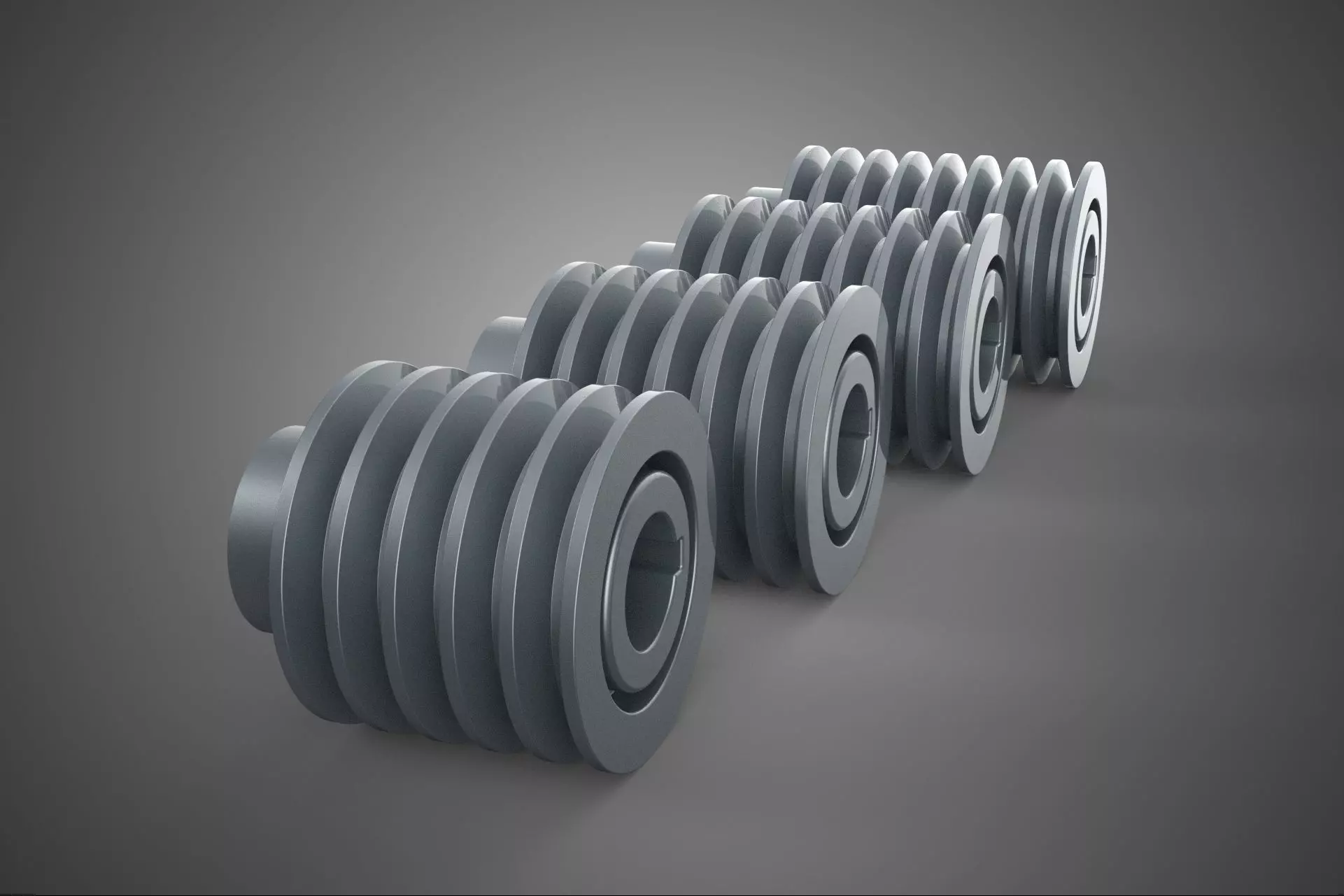
The component collection categorized under the nomenclature COLLECTION STANDARD ROLLER BELT PULLEY SHEAVE WHEEL GROOVE DRIVE refers to a standardized set of rotating mechanical components designed for the transmission of power and motion using flexible elements such as belts, ropes, or cables. These devices are fundamental to kinematics and mechanical engineering systems, employed across nearly all forms of industrial machinery, conveyance systems, and hoisting apparatus.
Definition and Function
A pulley, sheave, or wheel in this context serves as a passive or active rotary element. When functioning as a drive component, it transfers torque between a prime mover (e.g., motor) and a driven element (e.g., machine spindle). When used for redirection or tensioning, it is often termed an idler pulley or tensioner sheave. The defining characteristic is the groove drive system, where the circumference of the component is precisely machined or cast with one or more profiles—the grooves—to accurately seat and secure the transmission element.
The inclusion of standard in the designation highlights adherence to established international or national specifications (e.g., ISO, ANSI, DIN). This standardization ensures dimensional uniformity, interchangeability across different manufacturers, and predictability of operational performance, including torque capacity and fatigue life.
Design and Anatomy
The core purpose of the groove profile is to maximize the effective coefficient of friction between the component surface and the belt or cable, thereby reducing slip and increasing transmission efficiency.
1. Groove Profiles
The geometry of the groove is specific to the medium utilized:
- V-Groove: Predominantly used for V-belts (trapezoidal belts). The wedging action created by the sloped sides of the groove against the belt enhances friction considerably, allowing for greater torque transfer at lower tension compared to flat pulleys. Standard V-groove profiles adhere to industry classifications (e.g., A, B, C, D sections) defining width and depth.
- U-Groove or Round Groove: Typically utilized for wire ropes, cables, or fiber ropes, often found in hoisting systems and material handling. These grooves are designed to fully support the rope profile to prevent abrasion and localized stress concentration.
- Synchronous or Timing Profiles: While technically grooves, these feature teeth designed for timing belts (synchronous drives) rather than friction drives, ensuring phase synchronization between shafts.
#### 2. Materials and Construction
The selection of material is dictated by operational speed, load requirements, environmental factors (corrosion resistance), and inertia considerations. Common construction materials include:
- Cast Iron (e.g., Grey Iron): Highly durable and cost-effective, ideal for high-load, moderate-speed applications.
- Steel (Forged or Fabricated): Used where extreme stress resistance or thin sections are required.
- Aluminum Alloys: Preferred for high-speed systems or aerospace applications where low mass (inertia) is critical.
- Engineered Plastics (e.g., Nylon, Polyurethane): Used in light-duty applications or environments where noise reduction and self-lubrication are desired.
#### 3. Hub and Mounting
Standard pulleys and sheaves must incorporate a robust mounting mechanism. Common bore designs facilitate attachment to rotating shafts and include:
- Fixed Bore and Keyway: A direct fit utilizing a key for torque transfer and setscrews for axial retention.
- Taper Lock Bushing System: A widely adopted standardized method using a split, tapered bushing drawn into the pulley hub by screws, providing high-concentricity, ease of installation, and robust holding power without the need for intricate reboring.
The inclusion of the term Roller often refers to the utilization of rolling element bearings within the hub assembly, crucial for minimizing friction losses in idler (non-driven) applications or sheaves supporting heavy dynamic loads.
### Operational Principles
The efficiency of a grooved drive system depends on maintaining the correct pitch diameter (the effective diameter at which the belt tension line acts) and ensuring proper alignment between the driving and driven components. Deviation from standardized dimensions or misalignment leads to premature belt wear, excessive vibration, and power loss.
Standardization allows engineers to utilize published tables for calculating belt length, center distances, tension requirements, and horsepower rating based on standardized groove angles and component dimensions, ensuring reliable and predictable machine performance.
KEYWORDS: Power transmission, Pulley, Sheave, V-belt drive, Groove profile, Standardization, Mechanical engineering, Torque transfer, Taper lock, Kinematics, Pitch diameter, Drive system, Grooved wheel, Idler pulley, Belt tension, Cast iron, Machined component, ANSI standard, ISO standard, Friction drive, V-groove, Roller bearing, Alignment, Synchronous drive, Conveyor system, Hoisting gear, Mechanical advantage, Dynamic balancing, Component interchangeability, Industrial machinery.