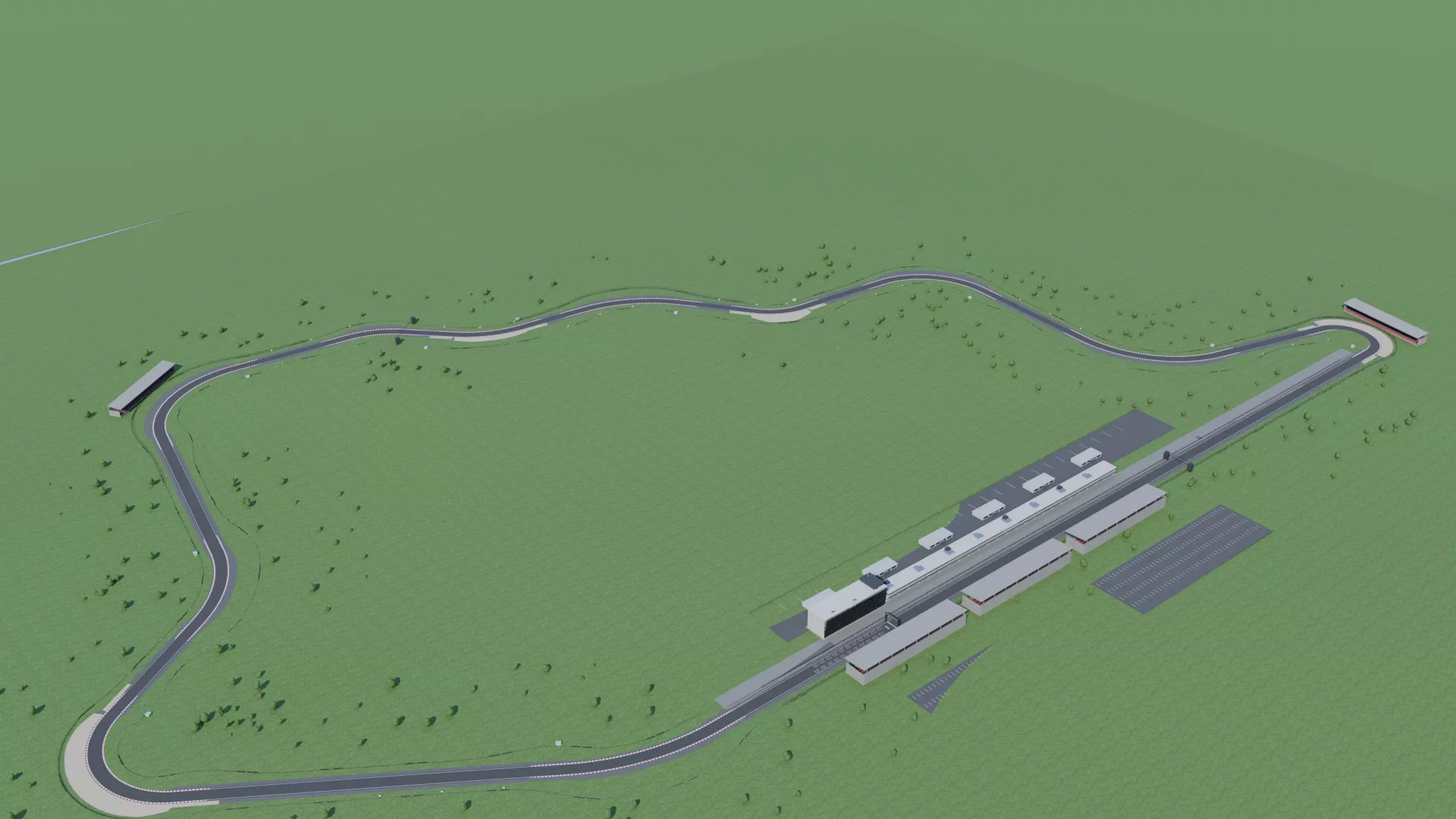
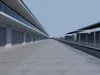
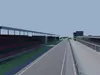
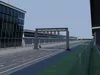
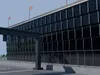
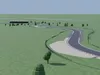
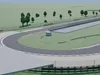
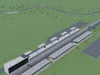
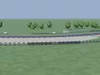
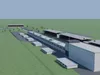
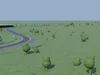
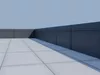
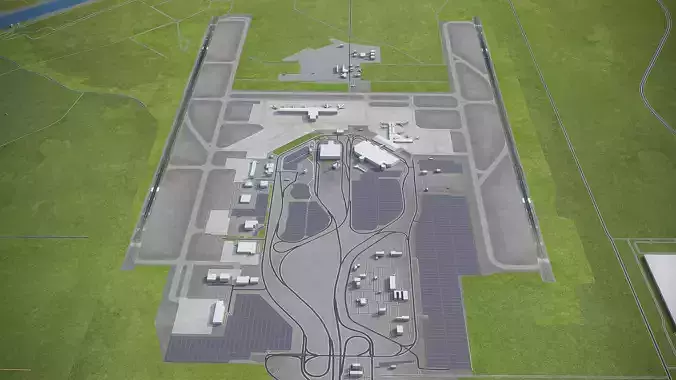
APEX INTERNATIONAL CIRCUIT is a complete Grand Prix road course: a 3.925 km closed lap with a working pit lane, a 24-box garage block, race control, grandstands and a full paddock, built at real-world scale and ready to drop straight into a scene.
The lap was surveyed rather than sketched. It is an ordered chain of straights and constant-radius arcs, tangent continuous throughout, so the corner radii below are the real geometry of the built mesh and not approximations. The circuit runs 3924.5 m over 11 corners, from a 36 m hairpin to a 220 m sweeper, with a 1030 m start/finish straight and 24.1 m of elevation change at up to 3.9 percent gradient.
Every surface is swept from one continuous road definition, so the racing surface, kerbs, run-off, gravel and verges share a single set of levels: a 1.8 percent crown across the 12.2 m carriageway, a 3 percent fall across the run-off, and up to 2 degrees of banking through the corners. Nothing cracks apart at the joints.
WHAT IS MODELLED
Track - racing surface with 150 mm edge lines, asphalt shoulders, red and white kerbs through every corner, asphalt run-off widening from 7 m to 30 m on the outside of the fast corners, four gravel traps with kerb lips, and grass verges.
Pit complex - 24 numbered garage boxes with piers, roller doors and recessed interiors, first-floor glazing, a cantilevered terrace with glass balustrade and rooftop plant. A 12 m pit lane split into fast and working lanes, numbered pit boxes, pit wall with debris fence, and pit entry and exit merges.
Race control - five-storey tower with canted glazing to the start line, flag balcony and roof mast.
Start and finish - gantry with the five-light start rig and signage, start line, and a full 22-car staggered starting grid with numbered boxes.
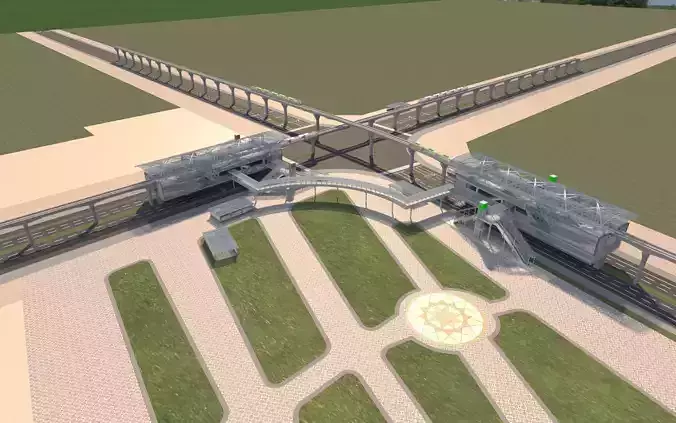
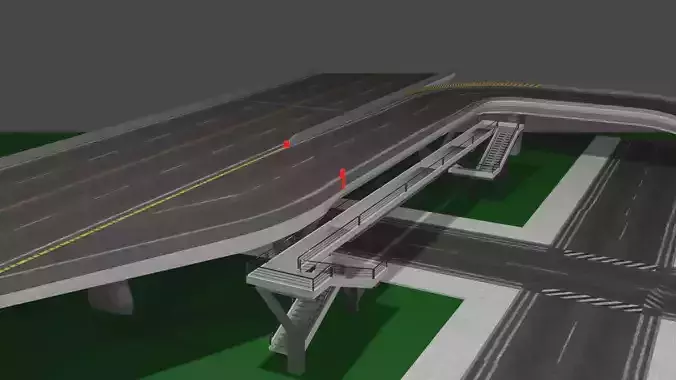
Spectator - three main grandstands plus two corner stands with stepped terracing, banded seating and canopy roofs. Two covered bridges over the track and two marked car parks.
Trackside - 11 marshal posts with flag poles, 150 / 100 / 50 m braking marker boards at every corner, double-sided advertising hoardings, armco guard rail around the entire lap, stacked tyre walls at the gravel corners, debris fencing, a paddock with hospitality units and truck bays, and graded terrain with tree planting.
All branding is fictional and invented, so the model is safe for commercial use.
TECHNICAL SPECIFICATION
573654 triangles / 901247 vertices as shipped in the GLB2094 separate named objectsPolygon mesh, fully triangulated, no n-gonsMetric, real-world scale, 1 unit = 1 metreCircuit size 1674.2 x 1122.4 x 51.3 mOverall size 2429.2 x 1804.8 x 51.3 m including the graded terrain that surrounds the circuitOrigin sits on the start/finish straightNo rigging, no animation, no cameras or lights in the interchange files
MATERIALS AND TEXTURES
24 PBR materials66 texture maps embedded - base colour with ambient occlusion multiplied in, roughness/metallic, and normalResolutions of 512, 1024 and 2048; the racing surface and run-off carry the 2048 setsTextures are generated at real-world scale and mapped one metre to one UV unit, so they tile correctly if the geometry is cut or retopologisedUVs are world-scale tiling and therefore overlap by design - this is not a unique atlas unwrapEvery mesh carries UVs, none missing
FILES INCLUDED
.blend - native Blender scene, materials wired, sun and camera set up ready to render.glb - binary glTF with all textures embedded_gltf.zip - glTF with separate maps and the .bin buffer.fbx - for Unreal, Unity, Maya and 3ds Max.obj and .mtl - universal, texture paths written as bare filenames.usdc and .usdz - Universal Scene Description and AR.stl and .ply - geometry only.abc - Alembic_textures.zip - all 72 maps flat, plus the readme
ENGINE NOTES
Import at 1.0 scale. The OBJ and glTF reference their maps by bare filename, so unzip the textures beside the model file before importing or it will come in untextured. Objects are named by function, so the grandstands, paddock, landscaping or trackside furniture can each be selected and removed in one go. Built for exterior and mid-distance work - the pit lane and garages hold up at close range, and the trees are deliberately low-poly for distance planting. No LODs and no collision meshes are included.