Arabs (Arabic: عَرَب)[d] are an ethnic group[e] mainly inhabiting the Arab world in West Asia and North Africa. A significant Arab diaspora is present in various parts of the world.[76] Before the spread of Arabic language in the wake of the Arab conquests, Arab largely referred to the Semitic inhabitants—both settled and nomadic—of the Arabian Peninsula and the Syrian Desert.[77] In modern usage, it includes people from across the Greater Middle East that share Arabic as a native language.[77]
Arabs have been in the Fertile Crescent for thousands of years.[78] In the 9th century BCE, the Assyrians made written references to Arabs as inhabitants of the Levant, Mesopotamia, and Arabia.[79] Throughout the Ancient Near East, Arabs established influential civilizations starting from 3000 BCE onwards, such as Dilmun, Gerrha, and Magan, playing a vital role in trade between Mesopotamia, and the Mediterranean.[80] Other prominent tribes include Midian,[clarification needed] ʿĀd, and Thamud mentioned in the Bible and Quran. Later, in 900 BCE, the Qedarites enjoyed close relations with the nearby Canaanite and Aramaean states, and their territory extended from Lower Egypt to the Southern Levant.[81] From 1200 BCE to 110 BCE, powerful kingdoms emerged such as Saba, Lihyan, Minaean, Qataban, Hadhramaut, Awsan, and Homerite.[82] According to the Abrahamic tradition, Arabs are descendants of Abraham through his son Ishmael.[83]
During classical antiquity, the Nabataeans established their kingdom with Petra as the capital in 300 BCE,[84] by 271 CE, the Palmyrene Empire with the capital Palmyra, led by Queen Zenobia, encompassed the Syria Palaestina, Arabia Petraea, Egypt, and large parts of Anatolia.[85] The Arab or Aramean Itureans inhabited Lebanon, Syria, and northern Palestine (Galilee) during the Hellenistic and Roman periods.[86] The Osroene and Hatran were Arab-ruled kingdoms in Upper Mesopotamia around 200 CE.[87] In 164 CE, the Sasanians called part of upper Mesopotamia Arbayistan, meaning land of the Arabs,[88] having conquered the land from the previously Jewish Adiabene.[88] The probably Arab Emesenes ruled Emesa (Homs), Syria by 46 BCE.[89] During late antiquity, the Tanukhids, Salihids, Lakhmids, Kinda, and Ghassanids were dominant Arab tribes in the Levant, Mesopotamia, and Arabia, they predominantly embraced Christianity.[90]
During the Middle Ages, Islam fostered a vast Arab union, leading to significant Arab migrations to the Maghreb, the Levant, and neighbouring territories under the rule of Arab empires such as the Rashidun, Umayyad, Abbasid, and Fatimid, ultimately leading to the decline of the Byzantine and Sasanian empires. At its peak, Arab territories stretched from southern France to western China, forming one of history's largest empires.[91] The Great Arab Revolt in the early 20th century aided in dismantling the Ottoman Empire, ultimately leading to the formation of the Arab League on 22 March 1945, with its Charter endorsing the principle of a unified Arab homeland.[92]
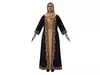
Arabs from Morocco to Iraq share a common bond based on ethnicity, language, culture, history, identity, ancestry, nationalism, geography, unity, and politics,[93] which give the region a distinct identity and distinguish it from other parts of the Muslim world.[94] They also have their own customs, literature, music, dance, media, food, clothing, society, sports, architecture, art and, mythology.[95] Arabs have significantly influenced and contributed to human progress in many fields, including science, technology, philosophy, ethics, literature, politics, business, art, music, comedy, theatre, cinema, architecture, food, medicine, and religion.[96] Before Islam, most Arabs followed polytheistic Semitic religion, while some tribes adopted Judaism or Christianity and a few individuals, known as the hanifs, followed a form of monotheism.[97] Currently, around 93% of Arabs are Muslims, while the rest are mainly Christians, as well as Arab groups of Druze and Baháʼís.[98]