


Learn more
- Lights
- Cameras
Learn more
Learn more
Learn more
Required PBR textures:
- Base Color
- Roughness
- Metalness
- Normal
Learn more
Learn more
Learn more
Learn more
Learn more
Learn more
Learn more
Learn more
1/7
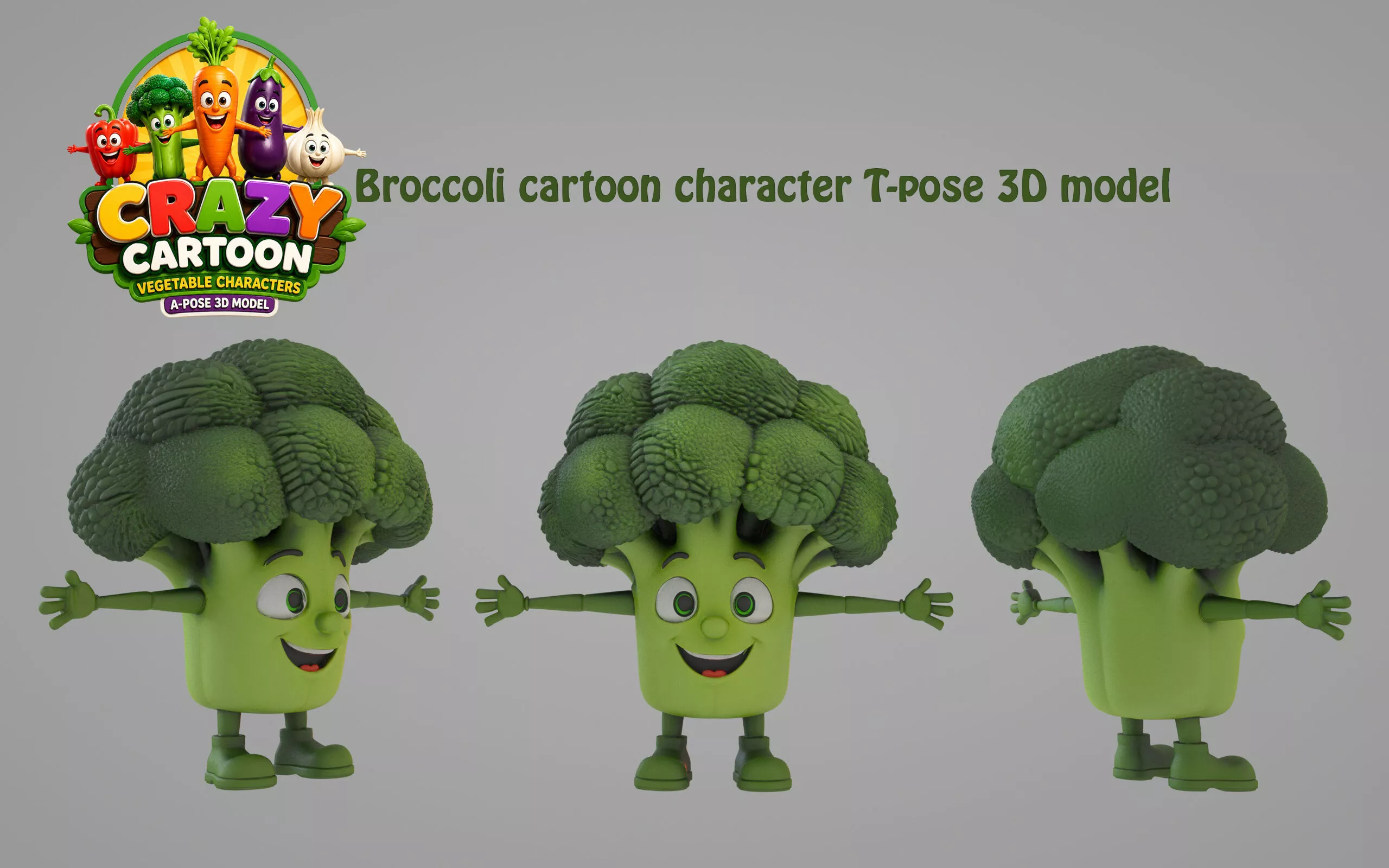
Broccoli (Brassica oleracea var. italica) is an edible green plant in the cabbage family (family Brassicaceae, genus Brassica) whose large flowering head, stalk and small associated leaves are eaten as a vegetable. Broccoli is classified in the Italica cultivar group of the species Brassica oleracea. Broccoli has large flower heads, or florets, usually dark green, arranged in a tree-like structure branching out from a thick stalk, which is usually light green. Leaves surround the mass of flower heads. Broccoli resembles cauliflower, a different but closely related cultivar group of the same Brassica species.
It can be eaten either raw or cooked. Broccoli is a particularly rich source of vitamin C and vitamin K. Contents of its characteristic sulfur-containing glucosinolate compounds, isothiocyanates and sulforaphane, are diminished by boiling but are better preserved by steaming, microwaving or stir-frying.[3]
Rapini, sometimes called broccoli rabe, is a distinct species from broccoli, forming similar but smaller heads, and is actually a type of turnip (Brassica rapa).[4]
TaxonomyBrassica oleracea var. italica was described in 1794 by Joseph Jakob von Plenck in Icones Plantarum Medicinalium 6:29, t. 534.[5] Like all the other brassicas, broccoli was developed from the wild cabbage (Brassica oleracea var. oleracea), also called colewort or field cabbage.
EtymologyThe word broccoli, first used in the 17th century, comes from the Italian plural of broccolo, which means the flowering crest of a cabbage, and is the diminutive form of brocco, meaning small nail or sprout.[6]
HistoryBroccoli resulted from the breeding of landrace Brassica crops in the northern Mediterranean starting in about the sixth century BCE.[7] Broccoli has its origins in primitive cultivars grown in the Roman Empire and was most likely improved via artificial selection in the southern Italian Peninsula or in Sicily.[8][9][10] Broccoli was spread to northern Europe by the 18th century and brought to North America in the 19th century by Italian immigrants.[9] After the Second World War, the breeding of the United States and Japanese F1 hybrids increased yields, quality, growth speed, and regional adaptation, which produced the cultivars commonly grown since then: 'Premium Crop', 'Packman', and 'Marathon'.[9]
Description
Broccoli plants in a nursery
Close-up of broccoli florets (click to enlarge)
Broccoli flowerBroccoli is an annual cruciferous plant which can grow up to 60–90 cm (24–35 in) tall.[11]
Broccoli inflorescence grows at the end of a central, edible stem and is dark green.[11] Violet, yellow, or even white heads have been created, but these varieties are rare. The flowers are yellow with four petals.
The growth season for broccoli is 14–15 weeks. Broccoli is collected by hand immediately after the head is fully formed yet the flowers are still in their bud stage. The plant develops numerous small heads from the lateral shoots which can be harvested later.
VarietiesThere are three commonly grown types of broccoli.[9] The most familiar is Calabrese broccoli, often referred to simply as broccoli, named after Calabria in Italy. It has large 10-to-20-centimetre (4–8 in) green heads and thick stalks. It is a cool-season annual crop. Sprouting broccoli (white or purple) has a larger number of heads with many thin stalks.[12] Purple cauliflower or violet cauliflower is a type of broccoli grown in Europe and North America. It has a head shaped like cauliflower but consists of many tiny flower buds. Sometimes, but not always, it has a purple cast to the tips of the flower buds. Purple cauliflower may also be white, red, green, or other colors.[13]
Beneforté is a variety of broccoli containing 2–3 times more glucoraphanin and produced by crossing broccoli with a wild Brassica variety, Brassica oleracea var villosa.[14]
GenomicsThe first telomere-to-telomere genome assembly of Brassica oleracea var. italica was published in 2026. The genome is approximately 633.6 Mb in size and comprises nine chromosomes. The assembly has a BUSCO completeness of 99.4%, and 58,044 protein-coding genes were predicted.[15]