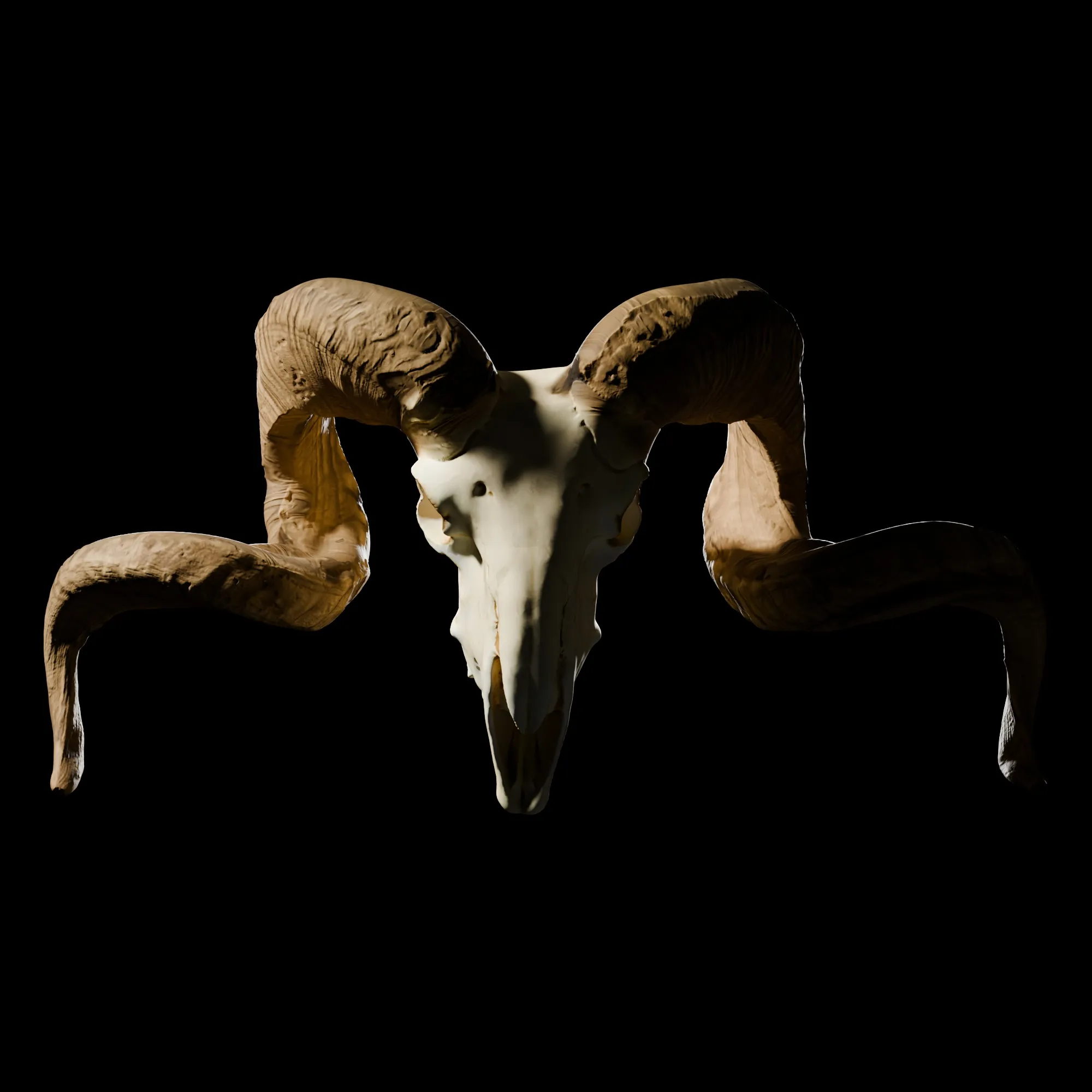
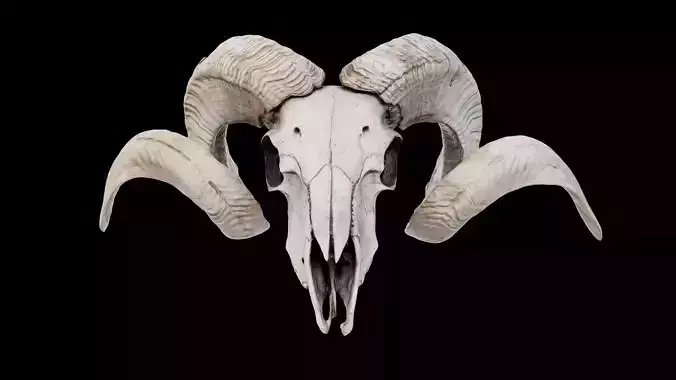
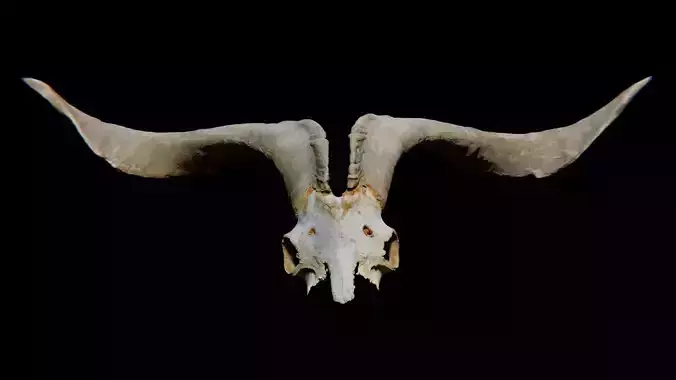
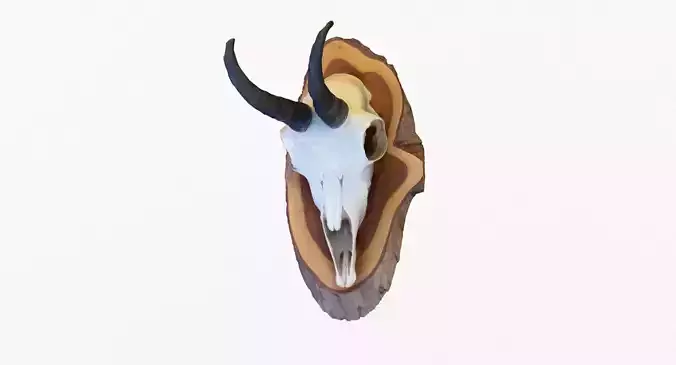
A real ram skull with big curled horns, made as a wall piece. The backs of the two horn coils are cut flat, so it hangs straight on a wall. The horns have deep growth ridges and natural colour.
Photo-scanned by Dylan Friedman (Rapid Roost) from a real piece. The shape and the textures come from photographs of the real object. No generative AI was used.
What you get:
- Two versions: High-res for close-up renders, and Low-poly for games and real-time.
- Real-world scale in metres, pivot on the wall plane (the back sits flat at Y = 0, Z up, facing -Y).
- PBR textures at 4K / 2K / 1K: Base Color, Normal (OpenGL and DirectX), Roughness, Ambient Occlusion and ORM (packed for Unreal and Unity).
- The low-poly version has its own baked texture set (4K / 2K / 1K).
- A Blender 5.1 file with the materials set up and a ready-to-render studio scene.
- STL and 3MF files are in millimetres for 3D printing.
Details:
- Size: about 67.2 x 22.8 x 34.2 cm (width x depth x height)
- High-res: 318,580 triangles, 159,288 vertices
- Low-poly: 20,000 triangles, 9,998 vertices
- Separate named materials: Bone (skull and horns), Backing (the flat backs of the horn coils)
- Species: Ram (male sheep).
- Rendered in Blender Cycles, no post-processing. The other pictures use the studio scene in the .blend file; the main picture uses a separate studio HDRI that is not included.
- No rigging or animation.
Good to know:
- The skull was scanned hanging on a wall, so the backs of the horns and the top of the cranium were never photographed. They are rebuilt to match the scanned surface.
- Only the two horn coils touch the wall. The skull itself sits about 5 cm out from it.
- Pen markings on the real horns are kept as scanned.
- The original scan had no scale. It is set so the skull is 28 cm long, a typical size for a ram.
- This is an older scan with less fine detail. The horn colour and growth lines come from the original scan photos and are softer in close-ups.
- Both horn tips are blunt in the scan.
- Small areas of the right horn and the horn bases were reconstructed and show flatter texture.
- Photo scans capture the real surface, so small soft spots and baked-in lighting from the capture can show in very close shots.
Formats: BLEND, FBX, OBJ, GLB, glTF, USDZ, USDC, ABC (Alembic), STL, PLY, 3MF, WRL (VRML), DAE (Collada), 3DM (Rhino)