.obj.fbx.stl.3dm.stp.gltf
-49.87%
$2
1/7
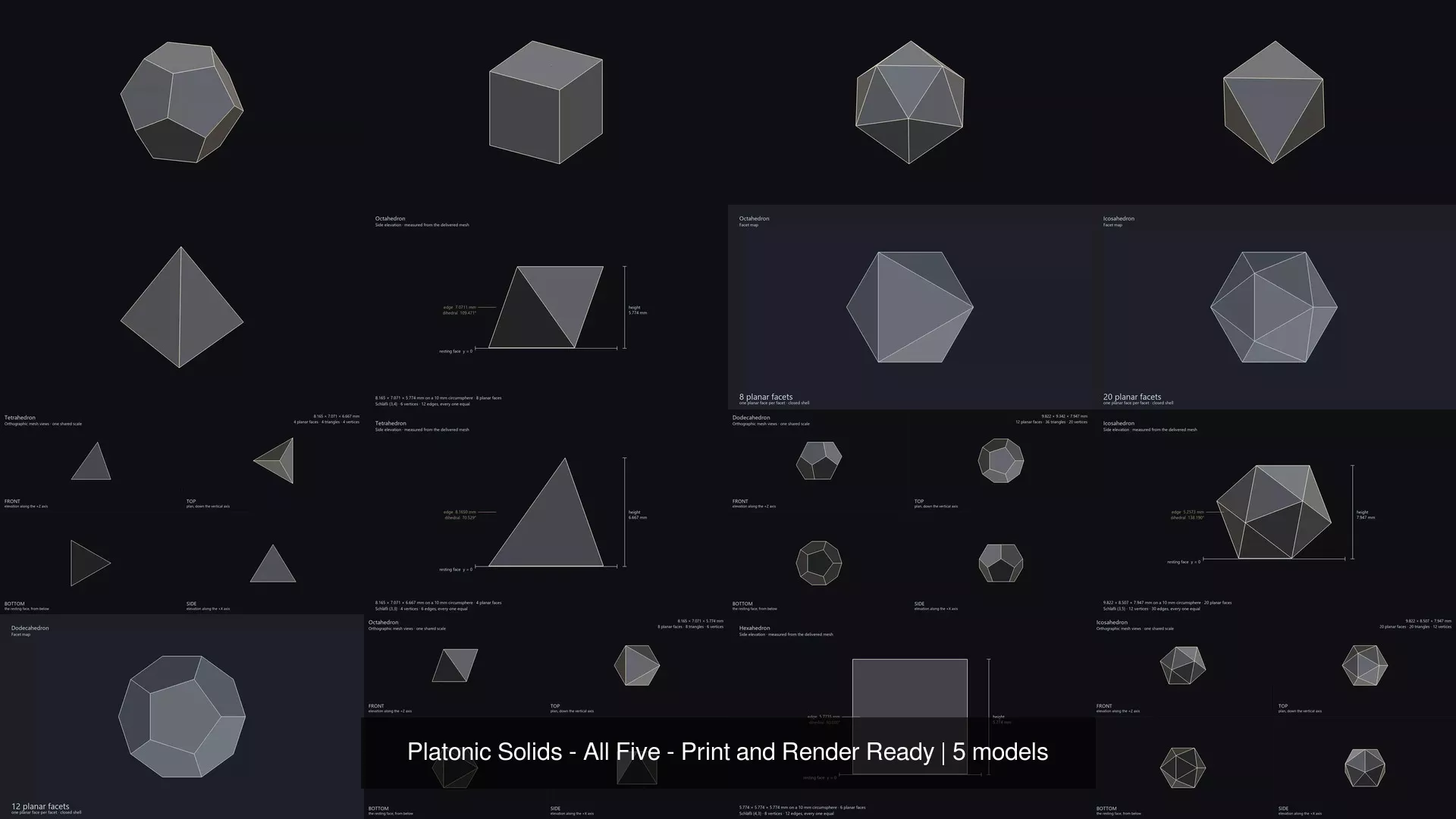







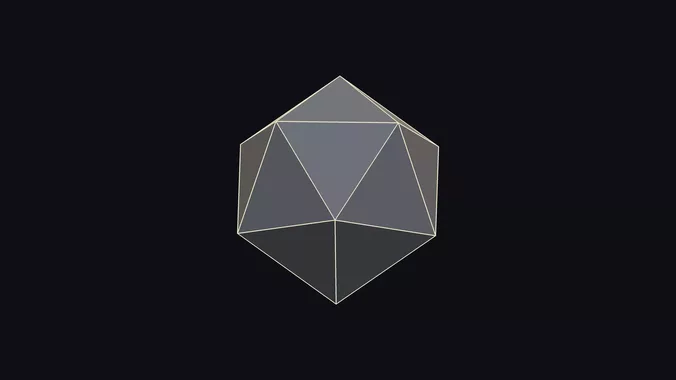
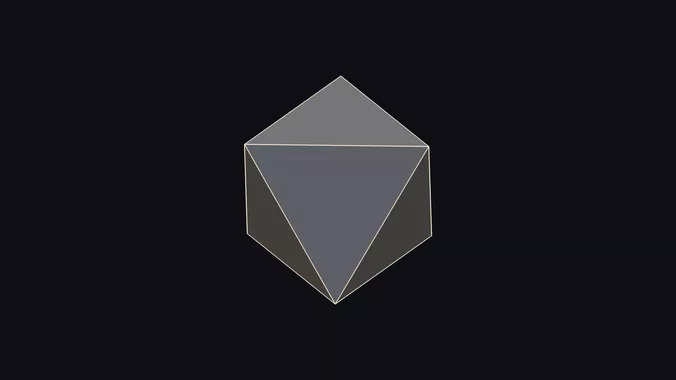
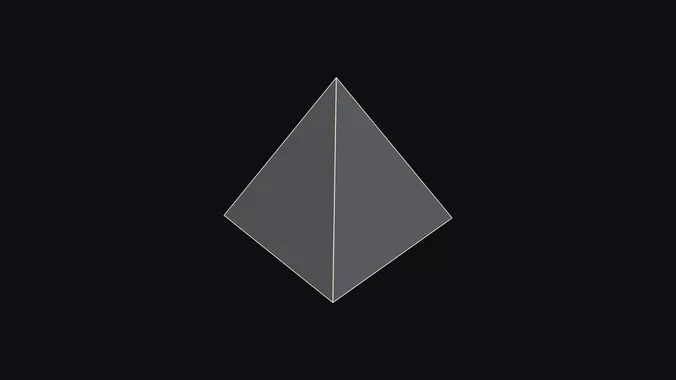
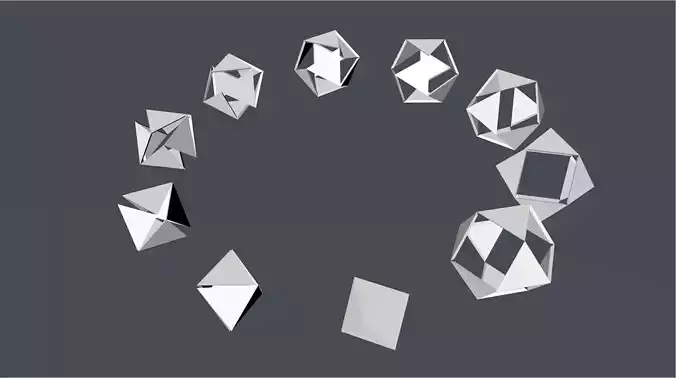
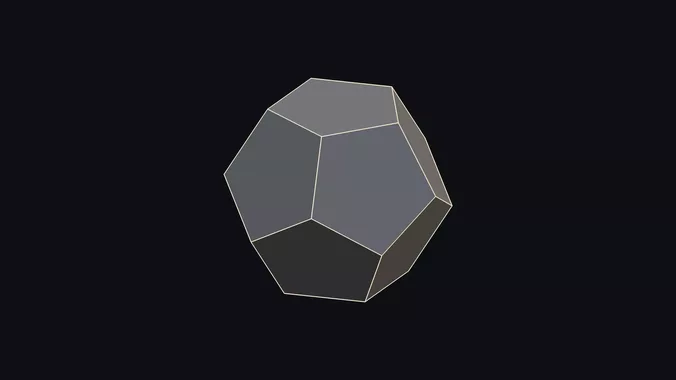
A Platonic solid needs every face to be the same regular polygon, every vertex to look likeevery other, and the whole thing to be convex. Euclid closes the Elements by proving thatthose conditions admit exactly five shapes and no sixth, which makes this the oldest completecatalogue in mathematics. This bundle is all of it.
The setAll five share one 10 mm circumsphere, so they nest inside a single sphere and standtogether in a scene at their true relative sizes. That is why the tetrahedron looks small: itis small. On a common sphere it encloses 12.3% of that sphere's volume against thedodecahedron's 66.5%.
Built to the mathematics, and checked against itEach solid is generated from its exact vertex coordinates. Every face plane is then derived asa supporting plane of that vertex set, so the faceting is a property of the solid rather than asecond table that could disagree with it. Before release each one is measured back against theclosed forms:
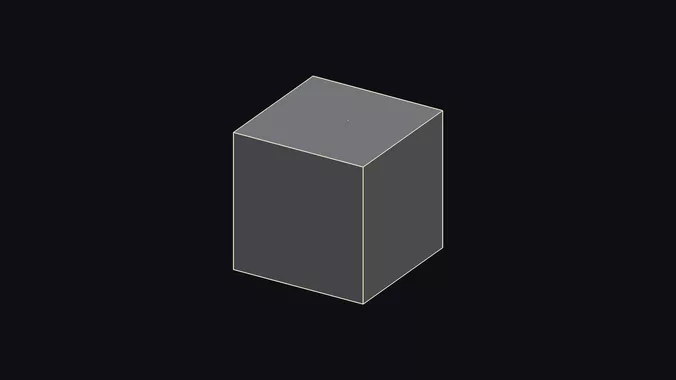
| Solid | Schläfli | Faces | Vertices | Edges | Edge (mm) | Dihedral | Volume (mm³) ||---|---|---|---|---|---|---|---|| Tetrahedron | {3,3} | 4 equilateral triangles | 4 | 6 | 8.1650 | 70.529° | 64.15 || Hexahedron | {4,3} | 6 squares | 8 | 12 | 5.7735 | 90.000° | 192.45 || Octahedron | {3,4} | 8 equilateral triangles | 6 | 12 | 7.0711 | 109.471° | 166.67 || Dodecahedron | {5,3} | 12 regular pentagons | 20 | 30 | 3.5682 | 116.565° | 348.15 || Icosahedron | {3,5} | 20 equilateral triangles | 12 | 30 | 5.2573 | 138.190° | 317.02 |
Every edge within one solid is the same length to one part in 1e15. Every dihedral angle is theexact value, held on every edge. Every volume matches its closed form to one part in 1e9. Thefiles are then read back one reader per format: Open CASCADE for the STEP, assimp for the FBXand the GLB, rhino3dm for the 3DM, and the signed volume compared, which only comes out rightif winding, normals and scale all survived the write.
Three of these are real crystals. Two of them cannot be.The octahedron is the shape rough gem diamond actually grows in, and the early diamond cutsare that crystal worked down: the single cut is an octahedron with the top point sawn off for atable. The cube is the commonest habit in the mineral kingdom, fluorite, pyrite, halite andgalena. The tetrahedron is sphalerite and tetrahedrite, which is where the latter gets itsname.
The dodecahedron and the icosahedron cannot occur as ordinary crystals at all. Bothcarry fivefold symmetry, and the crystallographic restriction theorem rules fivefold rotationout of any periodic lattice. The two minerals usually mistaken for the dodecahedron are not it:pyrite's pyritohedron has twelve pentagonal faces, but irregular ones, and garnet's rhombicdodecahedron has twelve faces that are rhombi. Icosahedral symmetry does turn up inquasicrystals, which are ordered without being periodic, and the natural one, icosahedrite, wasconfirmed in 2009.
FormatsSix per solid, thirty files.
Millimetres, real-world scale. Y up, one face resting on the ground plane at y = 0, thecentroid on the Y axis, and the midpoint of one edge of that resting face on the +X axis, whichis what leaves the cube axis-aligned rather than standing on a plan diagonal. Meshes are weldedand closed: no duplicate vertices, every edge shared by exactly two triangles, Eulercharacteristic 2. Scale uniformly for any other size.
Each solid ships with a SPEC.txt carrying its edge length, circumsphere, midsphere, insphere,dihedral angle, surface area, volume and the weight it would carry cut in diamond or moissanite.
Generated by Brilliani Labs. No third-party model was converted, retopologised or derived fromat any stage.