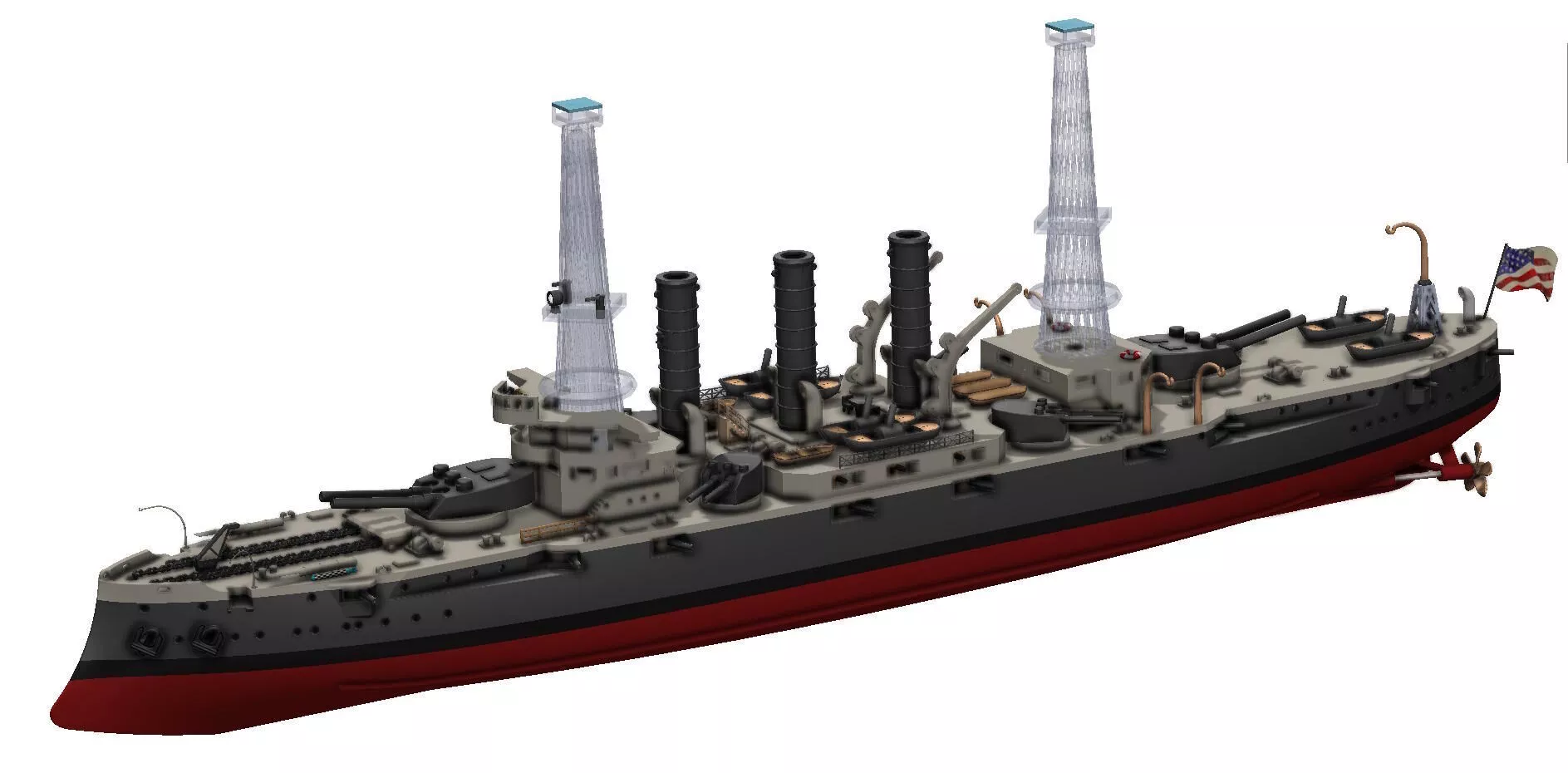
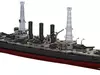
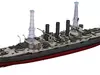
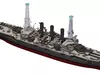
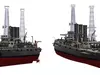
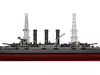
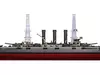
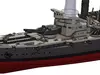
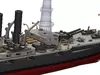
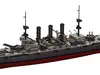
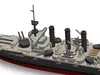
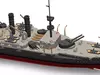
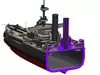
3D model descriptionThe USS Connecticut BB-18 stands as one of the most historically significant American warships of the early twentieth century — the proud lead ship of the six-strong Connecticut class, and the vessel that carried the United States Navy on its most audacious peacetime demonstration of power in history. Her keel was laid on March 10, 1903 at the New York Naval Shipyard, and she was commissioned on September 29, 1906 as the most advanced ship in the US Navy. The Connecticut-class ships were the most powerful pre-dreadnought battleships ever built by the US Navy, armed with a formidable mixed battery of 12-inch, 8-inch, and 7-inch guns — a layered weapons system designed to engage enemies at multiple ranges simultaneously. Her belt armor reached 11 inches in thickness, her main turrets were protected by 12 inches of steel, and her two triple-expansion steam engines drove her to a top speed of 18 knots on two shafts. Even before the last of her sister ships entered service, however, history was already moving against her. The Connecticut class was rendered obsolescent almost immediately by the advent of the all-big-gun battleship epitomized by the British HMS Dreadnought — a vessel whose revolutionary design made every mixed-battery battleship in the world overnight irrelevant. Yet Connecticut's place in naval history was already secured. As flagship of the Atlantic Fleet from April 1907, Connecticut led the Great White Fleet — sixteen battleships painted white — on a globally demonstrative cruise departing Hampton Roads, Virginia in December 1907, visiting ports across the Atlantic and Pacific, calling at South America, Australia, Japan, and the Philippines before returning in February 1909, showcasing American naval power to the world under President Theodore Roosevelt. The voyage covered over 43,000 miles and was the largest peacetime naval deployment in American history to that point. During World War I, Connecticut was pressed into service as a training ship and later as a troop transport, helping return American Expeditionary Forces from France. Her end came as a result of the Washington Naval Treaty of 1922, which mandated the scrapping of older battleships to prevent a post-war naval arms race, and she was sold for scrap in November 1923 — a fate shared by all six of her class, leaving none preserved for posterity. Our 1:96 scale 3D printable model captures Connecticut in her Great White Fleet configuration — the most iconic and historically evocative period of her career — faithfully reconstructed from historical photographs, plans, and period documentation to bring this legendary ship back to life on your workbench.
https://youtu.be/5nWvx3oXH2w
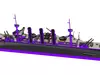
3D printing settingsThis model has been designed from the ground up for accessibility and buildability on standard home FDM printers. The file pack includes over 70 separate high-poly STL files, all sliced to fit on a standard print bed of 22×22 cm, producing a finished model approximately 1 meter in length — a genuinely substantial and impressive display piece that captures the imposing presence of the real ship at scale. The hull is divided into manageable sections with integrated alignment details at every joint, ensuring clean and accurate assembly without guesswork. Many of the most characterful features of the Connecticut — her twin main turrets fore and aft, her distinctive secondary turrets flanking the superstructure, her tall funnels and cage masts — are all rendered as separate, detailed components that build up into a richly layered finished model. Accessories included in the pack cover torpedo launchers, cannons, Gatling guns, and both row and powered dinghies, giving builders the flexibility to configure the ship in different ways and build her to whatever level of detail suits their preference. The hull interior is left open, making the model well suited to RC conversion projects for those who want to take her onto the water. We recommend printing the hull in a clean off-white or light grey to replicate her Great White Fleet livery, or in standard battleship grey for her later service appearance — both look outstanding at this scale. The tall mast structures and fine deck fittings reward a well-tuned printer and a steady hand, but the overall build is approachable and deeply satisfying from first print to finished ship.