High-quality 3D assets at affordable prices — trusted by designers, engineers, and creators worldwide. Made with care to be versatile, accessible, and ready for your pipeline.
Included File Formats
This model is provided in 14 widely supported formats, ensuring maximum compatibility:
• - FBX (.fbx) – Standard format for most 3D software and pipelines
• - OBJ + MTL (.obj, .mtl) – Wavefront format, widely used and compatible
• - STL (.stl) – Exported mesh geometry; may be suitable for 3D printing with adjustments
• - STEP (.step, .stp) – CAD format using NURBS surfaces
• - IGES (.iges, .igs) – Common format for CAD/CAM and engineering workflows (NURBS)
• - SAT (.sat) – ACIS solid model format (NURBS)
• - DAE (.dae) – Collada format for 3D applications and animations
• - glTF (.glb) – Modern, lightweight format for web, AR, and real-time engines
• - 3DS (.3ds) – Legacy format with broad software support
• - 3ds Max (.max) – Provided for 3ds Max users
• - Blender (.blend) – Provided for Blender users
• - SketchUp (.skp) – Compatible with all SketchUp versions
• - AutoCAD (.dwg) – Suitable for technical and architectural workflows
• - Rhino (.3dm) – Provided for Rhino users
Model Info
• - All files are checked and tested for integrity and correct content
• - Geometry uses real-world scale; model resolution varies depending on the product (high or low poly)
• • - Scene setup and mesh structure may vary depending on model complexity
• - Rendered using Luxion KeyShot
• - Affordable price with professional detailing
Buy with confidence. Quality and compatibility guaranteed.
If you have any questions about the file formats, feel free to send us a message — we're happy to assist you!
Sincerely,
SURF3D
Trusted source for professional and affordable 3D models.
More Information About 3D Model :
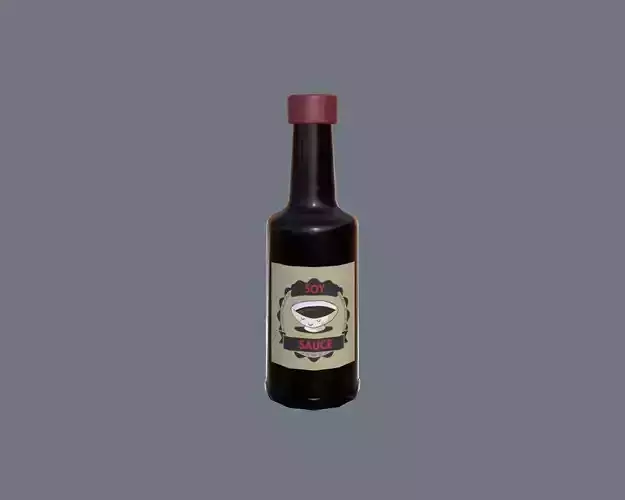
The product designated by the attributes Glass Bottle Soybean Soy Sauce Liquid Oil Ingredient Condiment refers to the widely consumed fermented liquid seasoning known as soy sauce (Chinese: 酱油, jiàngyóu; Japanese: 醤油, shōyu), packaged typically within a rigid glass container for retail and commercial distribution. This substance is globally categorized as a fundamental liquid condiment and a core ingredient in numerous culinary traditions, particularly those of East and Southeast Asia.
I. Definition and Composition
Soy sauce is an aqueous solution produced through the controlled fermentation of soybeans, combined commonly with roasted grains, predominantly wheat, though barley or rice may be used depending on regional style. This mixture is inoculated with a specific strain of mold, Aspergillus oryzae or Aspergillus sojae, collectively referred to as Koji. The fermentation process, which can last from several months to years, involves the breakdown of soy protein and grain starch into amino acids, sugars, and organic acids, facilitated by high-concentration brine (sodium chloride solution).
The defining characteristic of naturally brewed soy sauce is its rich umami flavor, derived primarily from L-glutamate produced during proteolysis. While occasionally differentiated from culinary oils due to texture or shelf placement—leading to the inclusion of the term liquid or oil (the latter term often used generically or contextually near actual vegetable oils in market descriptions)—soy sauce is chemically a highly concentrated, water-based solution, not a lipid-based product.
II. Packaging Rationale and the Glass Bottle
The standard use of a glass bottle for commercial packaging is mandated by several factors relating to product preservation, chemical inertness, and consumer safety. Glass is a non-porous and chemically inert material, essential for housing a high-salt, slightly acidic product like soy sauce. This inertness prevents the leaching of chemical components from the container into the food product, maintaining the sauce’s intended flavor profile and ensuring purity over long shelf periods.
Furthermore, glass provides an exceptional barrier against oxygen and moisture transmission, crucial elements that can degrade the quality and accelerate the spoilage of fermented products. The structural rigidity and transparency of glass also allow for visual inspection of the condiment's color and clarity—indicators highly valued by consumers to assess quality (e.g., distinguishing between light and dark varieties). While plastic (PET) packaging exists for larger volume commercial applications, glass remains the preferred standard for premium, traditionally brewed, or smaller retail formats due to its superior preservation qualities and traditional consumer perception of quality.
III. Culinary Function and Classification
Functionally, soy sauce serves a dual role: as a table condiment for seasoning food immediately before consumption, and as a pivotal ingredient utilized during the cooking process. Its applications are extensive, including use in marinades, stocks, dipping sauces, stir-fries, and braised dishes, where it contributes salinity, color, and a significant depth of savory flavor.
Soy sauces are generally classified based on their manufacturing process (naturally brewed versus chemically hydrolyzed) and their composition or viscosity:
-
Light Soy Sauce: Lighter in color, saltier, and typically used for overall seasoning without unduly coloring the final dish.
-
Dark Soy Sauce: Contains added caramel coloring or molasses and is fermented for a longer period. It is less salty than light soy sauce and used primarily for imparting deep color and a slightly sweeter flavor.
The rigorous control over ingredients, composition, and stable packaging underscores soy sauce's status as a staple food ingredient and a globally traded commodity.
KEYWORDS: Soy sauce, Condiment, Fermentation, Soybean, Glass bottle, Umami, Savory, Liquid seasoning, Ingredient, Shoyu, Jiangyou, Koji, Brine, Hydrolysis, Culinary, Table sauce, Asian cuisine, Food preservation, Non-reactive, Aqueous solution, Sodium chloride, Amino acids, Wheat, Glutamate, Packaging material, Shelf stability, Dark sauce, Light sauce, Brewing, Viscosity.